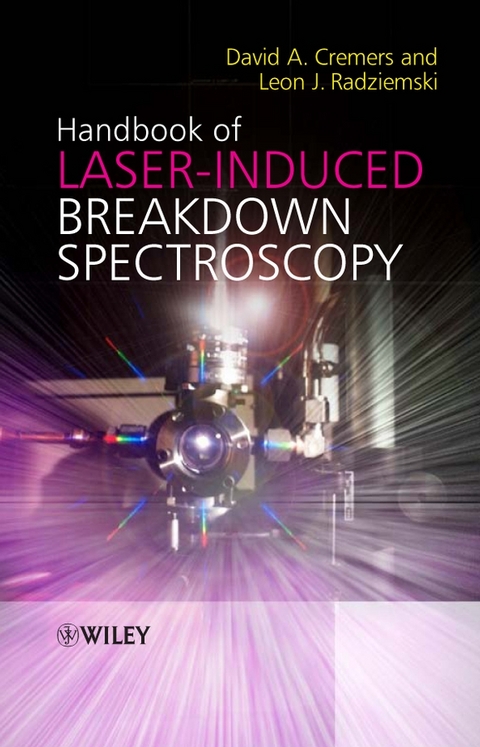
Handbook of Laser-Induced Breakdown Spectroscopy (eBook)
John Wiley & Sons (Verlag)
978-0-470-09300-9 (ISBN)
Provides a thorough but understandable discussion of the basic principles, instrumentation, methodology, and sampling procedures of the method based on atomic emission spectroscopy.
- Presents a discussion of the many advantages of the method along with limitations, to provide the reader a balanced overview of capabilities of the method
- Presents an overview of some real-world applications of the method
- Provides an up-to-date list of references to LIBS literature and a unique list of element detection limits using a uniform analysis method
Professor L.J. Radziemski, Professor Emeritus, Department of Physics, Washington State University
Dr. David Cremers, Chemistry Division, Los Alamos National Laboratory
Starting from fundamentals and moving through a thorough discussion of equipment, methods, and techniques, this text provides a unique reference source for this important new analysis method. The authors use a combination of tutorial discussions ranging from basic principles up to more advanced descriptions along with extensive figures and photographs to clearly explain topics addressed in the text. It is intended that the data tables will be located within the Education section of SpectroscopyNOW.com Provides a thorough but understandable discussion of the basic principles, instrumentation, methodology, and sampling procedures of the method based on atomic emission spectroscopy. Presents a discussion of the many advantages of the method along with limitations, to provide the reader a balanced overview of capabilities of the method Presents an overview of some real-world applications of the method Provides an up-to-date list of references to LIBS literature and a unique list of element detection limits using a uniform analysis method
Professor L.J. Radziemski, Professor Emeritus, Department of Physics, Washington State University Dr. David Cremers, Chemistry Division, Los Alamos National Laboratory
Foreword.
Preface.
Acronyms, Constants, And Symbol.s
1. History.
1.1 Atomic optical emission spectrochemistry (OES).
1.2 Laser-induced breakdown spectroscopy (LIBS).
1.3 LIBS History 1960-1980.
1.4 LIBS History 1980-1990.
1.5 LIBS History 1990-2000.
1.6 Active Areas of Investigation, 2000-2002.
References.
2. Basics of the LIBS plasma.
2.1 LIBS plasma fundamentals.
2.2 laser-Induced Breakdown.
2.3 laser ablation.
2.4 double or multiple pulse libs.
2.5 summary.
References.
3. Apparatus fundamentals.
3.1 Basic LIBS apparatus.
3.2 Lasers.
3.3 Optical systems.
3.4 Methods of spectral resolution.
3.5 Detectors.
3.6 Detection system calibration.
3.7 Timing considerations.
3.8 Methods of LIBS deployment.
References.
4. Determining LIBS analytical figures-of-merit.
4.1 Introduction.
4.2 Basics of LIBS measurements.
4.3 precision.
4.4 Calibration.
4.5 Detection limit.
References.
5. Qualitative LIBS Analysis.
5.1 Identifying elements.
5.2 Material identification.
5.3 Process control.
References.
6. Quantitative LIBS Analysis.
6.1 Introduction.
6.2 Geometric Sampling Parameters.
6.3 Other sampling considerations.
6.4. Particle size.
6.5 use of internal standardization.
6.6 Chemical Matrix effects.
6.7. Example of libs measurement: Impurities in Lithium
Solutions.
6.8 Reported figures of merit for LIBS measurements.
6.9 Conclusions.
References.
Chapter 7. REMOTE LIBS MEASUREMENTS.
7.1 Introduction.
7.2 Conventional open path LIBS.
7.3 Stand-off LIBS using Femtosecond pulses.
7.4 Fiber optic LIBS.
References
8. Examples of recent LIBS fundamental research, instruments
and novel applications.
8.1 Introduction.
8.2 fundamentals.
8.3 calibration-free LIBS.
8.4 laser and spectrometer advances.
8.5 surface analysis.
8.6 Double pulse studies and applications.
8.7 Steel applications.
8.8 libs for biological applications.
8.9 nuclear reactor applications.
8.10 LIBS for space applications.
References.
9. THE FUTURE OF LIBS.
9.1 Introduction.
9.2 Expanding the understanding and capability of the libs
process.
9.3 Widening the universe of libs applications.
9.4 Factors that will speed the commercialization of Libs.
9.5 conclusion.
References.
APPENDIX A: Safety Considerations in LIBS.
A.1. safety plans.
A.2 Laser Safety.
A.3 Generation of Aerosols.
A.4 laser pulse induced ignition.
APPENDIX B: LIBS Application Matrix.
APPENDIX C: LIBS Detection Limits.
C.1 detection limits from the literature.
C.2 uniform detection limits.
APPENDIX D: Major LIBS References.
Index.
| Erscheint lt. Verlag | 11.7.2006 |
|---|---|
| Sprache | englisch |
| Themenwelt | Naturwissenschaften ► Chemie ► Analytische Chemie |
| Naturwissenschaften ► Physik / Astronomie | |
| Technik | |
| Schlagworte | Analytical • Applications • Book • Breakdown • Chemie • Chemistry • comprehensive update • Environmental Analysis • Environmental Chemistry • fielddeployable • Forefront • Invention • Laser • laserinduced • LIBS • LSS • many • NOVICE • Plasma • Review • sometimes • spectroscopy • Spektroskopie • spinoffs • technological • Umweltanalytik • Umweltchemie |
| ISBN-10 | 0-470-09300-5 / 0470093005 |
| ISBN-13 | 978-0-470-09300-9 / 9780470093009 |
| Informationen gemäß Produktsicherheitsverordnung (GPSR) | |
| Haben Sie eine Frage zum Produkt? |
 PDF (Adobe DRM)
Kopierschutz: Adobe-DRM
Adobe-DRM ist ein Kopierschutz, der das eBook vor Mißbrauch schützen soll. Dabei wird das eBook bereits beim Download auf Ihre persönliche Adobe-ID autorisiert. Lesen können Sie das eBook dann nur auf den Geräten, welche ebenfalls auf Ihre Adobe-ID registriert sind.
Details zum Adobe-DRM
Dateiformat: PDF (Portable Document Format)
Mit einem festen Seitenlayout eignet sich die PDF besonders für Fachbücher mit Spalten, Tabellen und Abbildungen. Eine PDF kann auf fast allen Geräten angezeigt werden, ist aber für kleine Displays (Smartphone, eReader) nur eingeschränkt geeignet.
Systemvoraussetzungen:
PC/Mac: Mit einem PC oder Mac können Sie dieses eBook lesen. Sie benötigen eine
eReader: Dieses eBook kann mit (fast) allen eBook-Readern gelesen werden. Mit dem amazon-Kindle ist es aber nicht kompatibel.
Smartphone/Tablet: Egal ob Apple oder Android, dieses eBook können Sie lesen. Sie benötigen eine
Geräteliste und zusätzliche Hinweise
Buying eBooks from abroad
For tax law reasons we can sell eBooks just within Germany and Switzerland. Regrettably we cannot fulfill eBook-orders from other countries.
aus dem Bereich