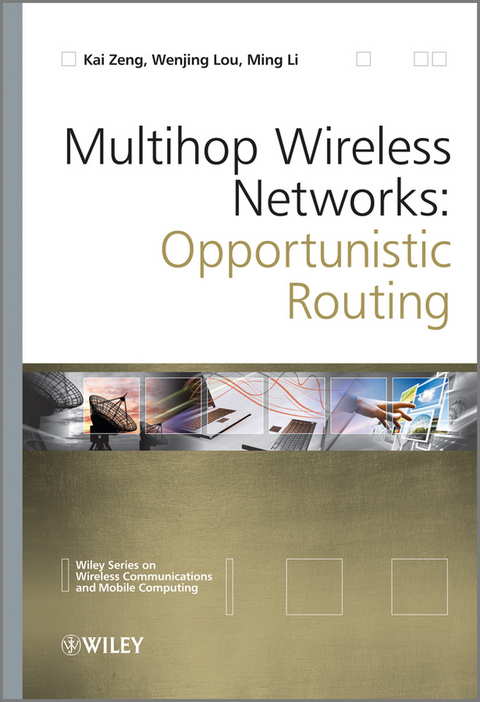
Multihop Wireless Networks (eBook)
304 Seiten
John Wiley & Sons (Verlag)
978-1-119-97429-1 (ISBN)
emerging technology designed to improve the packet forwarding
reliability, network capacity and energy efficiency of multihop
wireless networks
This book presents a comprehensive background to the
technological challenges lying behind opportunistic routing. The
authors cover many fundamental research issues for this new
concept, including the basic principles, performance limit and
performance improvement of opportunistic routing compared to
traditional routing, energy efficiency and distributed
opportunistic routing protocol design, geographic opportunistic
routing, opportunistic broadcasting, and security issues associated
with opportunistic routing, etc. Furthermore, the authors discuss
technologies such as multi-rate, multi-channel, multi-radio
wireless communications, energy detection, channel measurement,
etc. The book brings together all the new results on this topic in
a systematic, coherent and unified presentation and provides a much
needed comprehensive introduction to this topic.
Key Features:
* Addresses opportunistic routing, an emerging technology
designed to improve the packet forwarding reliability, network
capacity and energy efficiency of multihop wireless networks
* Discusses the technological challenges lying behind this new
technology, and covers a wide range of practical implementation
issues
* Explores many fundamental research issues for this new concept,
including the basic principles of opportunistic routing,
performance limits and performance improvement, and compares them
to traditional routing (e.g. energy efficiency and distributed
opportunistic routing protocol design, broadcasting, and security
issues)
* Covers technologies such as multi-rate, multi-channel,
multi-radio wireless communications, energy detection, channel
measurement, etc.
This book provides an invaluable reference for researchers
working in the field of wireless networks and wireless
communications, and Wireless professionals. Graduate students will
also find this book of interest.
Dr. Wenjing Lou, Worcester Polytechnic Institute, USA Wenjing Lou holds a BE and M.Eng in Computer Science and Engineering from Xi'an Jiaotong University, Xi'an, P.R.China, a M.A.Sc in Computer Communications from Nanyang Technological University, Singapore and a PhD in Electrical and Computer Engineering from the University of Florida. Her research interests include Wireless Sensor Networks, Ad hoc Networks, and Wireless Mesh Networks, with emphases on Network Security and Routing. Lou is guest editor for the International Journal of Wireless Information Networks, Editor for IEEE Transactions on Wireless Communications and a Senior Member of IEEE. Kai Zeng, Worcester Polytechnic Institute, USA Kai Zeng graduated with a PhD degree from Worcester polytechnic Institute in 2008 and is currently a post-doc research fellow at University of California, Davis. Ming Li, Worcester Polytechnic Institute, USA Ming Li is currently a PhD student at Worcester Polytechnic Institute.
About the Series Editors.
Preface.
List of Abbreviations.
1 Introduction.
1.1 Multihop wireless networks.
1.2 Routing challenges in MWNs.
1.3 Routing techniques in MWNs.
1.4 Related work.
1.5 Book contribution.
1.6 System model and assumptions.
References.
2 Taxonomy of opportunistic routing: principles and
behaviors.
2.1 EPA generalization.
2.2 Principles of local behavior of GOR.
2.3 Least cost opportunistic routing.
2.4 Conclusions.
References.
3 Energy efficiency of geographic opportunistic
routing.
3.1 EGOR problem formulation.
3.2 Efficient localized node-selection algorithms.
3.3 Energy-efficient geographic opportunistic routing.
3.4 Performance evaluation.
3.5 Conclusion.
References.
4 Capacity of multirate opportunistic routing.
4.1 Computing throughput bound of OR.
4.2 Impact of transmission rate and forwarding strategy on
throughput.
4.3 Rate and candidate selection schemes.
4.4 Performance evaluation.
4.5 Conclusion.
References.
5 Multiradio multichannel opportunistic routing.
5.1 Introduction.
5.2 System model and opportunistic routing primer.
5.3 Problem formulation.
5.4 Forwarding priority scheduling.
5.5 Performance evaluation 1.
5.6 Conclusions and future work.
References.
6 Medium access control for opportunistic routing - candidate
coordination.
6.1 Existing candidate coordination schemes.
6.2 Design and analysis of FSA.
6.3 Simulation results and evaluation.
6.4 Conclusions.
References.
7 Integration of opportunistic routing and network
coding.
7.1 A brief review of MORE.
7.2 Mobile content distribution in VANETs.
7.3 Related works on mobile content distribution in VANETs.
7.4 Background on symbol-level network coding.
7.5 CodeOn: a cooperative popular content broadcast scheme for
VANETs based on SLNC.
7.6 CodePlay: a live multimedia streaming scheme for VANETs
based on SLNC.
7.7 Conclusion.
References.
8 Multirate geographic opportunistic routing protocol
design.
8.1 System model.
8.2 Impact of transmission rate and forwarding strategy on OR
performance.
8.3 Opportunistic effective one-hop throughput (OEOT).
8.4 Heuristic candidate selection algorithm.
8.5 Multirate link-quality measurement.
8.6 Performance evaluation.
8.7 Conclusion.
References.
9 Opportunistic routing security.
9.1 Attack on link quality measurement.
9.2 Attacks on opportunistic coordination protocols.
9.3 Resilience to packet-dropping attack.
9.4 Conclusion.
References.
10 Opportunistic broadcasts in vehicular networks.
10.1 Related works on broadcasts in general MWNs.
10.2 Related works on broadcasts in VANETs.
10.3 Problem statement.
10.4 Overview of OppCast.
10.5 OppCast: main design.
10.6 Parameter optimization.
10.7 Performance evaluation.
10.8 Conclusion.
References
11 Conclusions and future research.
11.1 Summary.
11.2 Future research directions.
References.
Index.
| Erscheint lt. Verlag | 13.7.2011 |
|---|---|
| Reihe/Serie | Wireless Communications and Mobile Computing | Wireless Communications and Mobile Computing |
| Sprache | englisch |
| Themenwelt | Technik ► Elektrotechnik / Energietechnik |
| Technik ► Nachrichtentechnik | |
| Schlagworte | Communication Technology - Networks • Electrical & Electronics Engineering • Elektrotechnik u. Elektronik • Kommunikationsnetz • Kommunikationsnetze |
| ISBN-10 | 1-119-97429-1 / 1119974291 |
| ISBN-13 | 978-1-119-97429-1 / 9781119974291 |
| Informationen gemäß Produktsicherheitsverordnung (GPSR) | |
| Haben Sie eine Frage zum Produkt? |
 EPUB (Adobe DRM)
Kopierschutz: Adobe-DRM
Adobe-DRM ist ein Kopierschutz, der das eBook vor Mißbrauch schützen soll. Dabei wird das eBook bereits beim Download auf Ihre persönliche Adobe-ID autorisiert. Lesen können Sie das eBook dann nur auf den Geräten, welche ebenfalls auf Ihre Adobe-ID registriert sind.
Details zum Adobe-DRM
Dateiformat: EPUB (Electronic Publication)
EPUB ist ein offener Standard für eBooks und eignet sich besonders zur Darstellung von Belletristik und Sachbüchern. Der Fließtext wird dynamisch an die Display- und Schriftgröße angepasst. Auch für mobile Lesegeräte ist EPUB daher gut geeignet.
Systemvoraussetzungen:
PC/Mac: Mit einem PC oder Mac können Sie dieses eBook lesen. Sie benötigen eine
eReader: Dieses eBook kann mit (fast) allen eBook-Readern gelesen werden. Mit dem amazon-Kindle ist es aber nicht kompatibel.
Smartphone/Tablet: Egal ob Apple oder Android, dieses eBook können Sie lesen. Sie benötigen eine
Geräteliste und zusätzliche Hinweise
Buying eBooks from abroad
For tax law reasons we can sell eBooks just within Germany and Switzerland. Regrettably we cannot fulfill eBook-orders from other countries.
aus dem Bereich