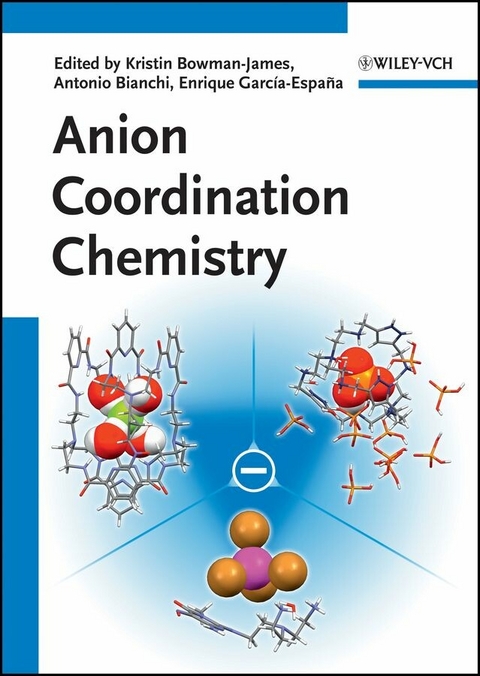

approaches to anion coordination chemistry. Synthesis of receptors, biological receptors and metallareceptors, the energetics of anion binding, molecular structures of anion complexes, sensing devices are presented and computational studies addressed to aid with the understanding of the different driving forces responsible for anion complexation. The reader is promised an actual picture of the state of the art for this exciting and constantly evolving field of supramolecular anion coordination chemistry. The topics range from ion channels to selective
sensors, making it attractive to all researchers and PhD students with an interest in supramolecular chemistry.
Kristin Bowman-James received her Ph.D. in Chemistry at Temple University in Philadelphia, Pennsylvania, USA. She joined the Chemistry Department at the University of Kansas in 1975 and is currently University Distinguished Professor of Chemistry. Her research bridges
across the fields of supramolecular and transition metal coordination chemistry. She is an experienced author with over 100 papers, many reviews, has served as Editor for three books, and has received awards for both research and service.
Antonio Bianchi received his Ph.D. in Chemistry at University of Florence in Italy in 1989. He was employed by the university first as a tenured Researcher, then as an Associate Professor, and from 2000 as Professor of General and Inorganic Chemistry. From 2006 to 2009 he
served as the Head of the Department of Chemistry of the said university. His diverse research interests encompass inorganic chemistry, supramolecular chemistry, coordination of anions, metallo-receptors and thermodynamics of coordination compounds. He has authored over
200 papers and has served as editor of the book 'The Supramolecular Chemistry of Anions' with his current co-editors.
Enrique Garcia-Espa?a Monsonis received his Ph.D. in Chemistry at University of Valencia in Spain. After a period working in industry, he returned to the University of Valencia and held an assistant Professor position before becoming Professor at the Department of Inorganic
Chemistry in 2000. He has worked within Supramolecular Chemistry since 1984 and has authored or co-authored over 215 papers.
Kristin Bowman-James received her Ph.D. in Chemistry at Temple University in Philadelphia, Pennsylvania, USA. She joined the Chemistry Department at the University of Kansas in 1975 and is currently University Distinguished Professor of Chemistry. Her research bridges across the fields of supramolecular and transition metal coordination chemistry. She is an experienced author with over 100 papers, many reviews, has served as Editor for three books, and has received awards for both research and service. Antonio Bianchi received his Ph.D. in Chemistry at University of Florence in Italy in 1989. He was employed by the university first as a tenured Researcher, then as an Associate Professor, and from 2000 as Professor of General and Inorganic Chemistry. From 2006 to 2009 he served as the Head of the Department of Chemistry of the said university. His diverse research interests encompass inorganic chemistry, supramolecular chemistry, coordination of anions, metallo-receptors and thermodynamics of coordination compounds. He has authored over 200 papers and has served as editor of the book "The Supramolecular Chemistry of Anions" with his current co-editors. Enrique García-España Monsonís received his Ph.D. in Chemistry at University of Valencia in Spain. After a period working in industry, he returned to the University of Valencia and held an assistant Professor position before becoming Professor at the Department of Inorganic Chemistry in 2000. He has worked within Supramolecular Chemistry since 1984 and has authored or co-authored over 215 papers.
Preface
ASPECTS OF ANION COORDINATION FROM HISTORICAL PERSPECTIVES
Introduction
Halide and Pseudohalide Anions
Oxoanions
Phosphate and Polyphosphate Anions
Carboxylate Anions and Amino Acids
Anionic Complexes: Supercomplex Formation
Nucleotides
Final Notes
THERMODYNAMIC ASPECTS OF ANION COORDINATION
Introduction
Parameters Determining the Stability of Anion Complexes
Molecular Recognition and Selectivity
Enthalpic and Entropic Contributions in Anion Coordination
STRUCTURAL ASPECTS OF ANION COORDINATION CHEMISTRY
Introduction
Basic Concepts of Anion Coordination Chemistry
Classes of Anion Hosts
Acycles
Monocycles
Cryptands
Transition-Metal-Assisted Ligands
Lewis Acid Ligands
Conclusion
SYNTHETIC STRATEGIES
Introduction
Design and Synthesis of Polyamine-Based Receptors for Anions
Design and Synthesis of Amide Receptors
TEMPLATE SYNTHESIS
Introductory Remarks
Macrocyclic Systems
Bowl-Shaped Systems
Capsule, Cage, and Tube-Shaped Systems
Circular Helicates and meso-Helicates
Mechanically Linked Systems
Concluding Remarks
ANION-PI INTERACTIONS IN MOLECULAR RECOGNITION
Introduction
Physical Nature of the Interaction
Energetic and Geometric Features of the Interaction Depending on the Host (Aromatic Moieties) and the Guest (Anions)
Influence of Other Noncovalent Interactions on the Anion-Pi Interaction
Experimental Examples of Anion-Pi Interactions in the Solid State and in Solution
Concluding Remarks
RECEPTORS FOR BIOLOGICALLY RELEVANT ANIONS
Introduction
Phosphate Receptors
Carboxylate Receptors
Conclusion
SYNTHETIC AMPHIPHILIC PEPTIDES THAT SELF-ASSEMBLE TO MEMBRANE-ACTIVE ANION TRANSPORTS
Introduction and Background
Biomedical Importance of Chloride Channels
The Development of Synthetic Chloride Channels
Approaches to Synthetic Chloride Channels
The Development of Amphiphilic Peptides as Anion Channels
Structural Variations in the SAT Modular Elements
Conclusions
ANION SENSING BY FLUORESCENCE QUENCHING OR REVIVAL
Introduction
Anion Recognition by Dynamic and Static Quenching of Fluorescence
Fluorescent Sensors Based on Anthracene and on a Polyamine Framework
Turning on Fluorescence with the Indicator Displacement Approach
2
Thermodynamic Aspects of Anion Coordination
Antonio Bianchi and Enrique García-España
2.1 Introduction
By virtue of their negative charge, anions interact with all chemical species carrying net positive charges or permanent polarities or containing groups that can be favorably polarized by neighboring species. This is an inescapable fate dictated by one of the most fundamental laws of Nature, which makes species of opposite charges attract each other. Although all processes involving interactions with anions can be ultimately regarded as anion coordination events, anion coordination has evolved as an intentional venture aimed to achieve tight and selective binding and transformation and translocation of anionic species by the use of tailored receptors designed by adjusting tunable parameters such as receptor shapes, sizes and structures, types, and orientation of binding groups. In addition to topological considerations, obviously necessary for efficient matching of anion and receptor binding sites, energetic considerations regarding the different forces involved in the anion–receptor interaction are also of paramount importance for the design of synthetic anion receptors. Noncovalent forces that are relatively strong, such as coulombic attraction and hydrogen bonds, can combine with weaker ones such as dispersive and anion–π interactions to achieve tight anion coordination. The relative strength or weakness of these forces, however, is strictly solvent dependent. Charge–charge attraction and hydrogen bonds, which may furnish a large contribution to complex stability in apolar solvents, become much weaker in a polar protic solvent such as water, while dispersive forces, whose contribution to complex stability in apolar solvents is negligible, become of principal importance in determining the association of apolar species in water and other polar solvents. Hence, solvent effects are other significant parameters to be considered in receptor design. A significant portion of this understanding can be gleaned by probing the thermodynamics of binding interactions. In this respect, the dissection of the Gibbs free energy (ΔG°) of anion binding into its enthalpic (ΔH°) and entropic (ΔS°) components provides useful insight into the nature of the binding interactions, the interplay of their contributions, and contributions due to solvation/desolvation processes occurring on anion coordination.
2.2 Parameters Determining the Stability of Anion Complexes
One of the most intriguing aspects of anion coordination involves seeking out receptors that will be able to selectively bind certain anions in preference to others that may be present in solution. This selective process, defining the ability of receptors to recognize anionic substrates, is controlled by various characteristics of both receptors and anions, as well as of reaction media. In the following sections, we shall examine the parameters that influence anion coordination for which thermodynamic data are available.
2.2.1 Type of Binding Group: Noncovalent Forces in Anion Coordination
The formation of anion–receptor complexes commonly occurs through several noncovalent interactions between functionalities of the interacting partners. Depending on anion nature and structure, different functionalities can be introduced into the receptor to target the different groups of the anionic substrates. An example of the different types of interactions that can operate in the binding of a biological substrate by a synthetic receptor is seen in Figure 2.1, which shows the crystal structure of the complex formed by thymidine 5′-triphosphate (TTP) with the tetraprotonated form of the polyamine macrocycle 1 containing two terpyridine units. Three hydrogen bonds between the polyphosphate chain of the nucleotide and protonated nitrogen atoms of 1, one hydrogen bond between a carbonyl oxygen of TTP and one ammonium group of 1, one CH π interaction involving one carbon atom and a ligand pyrimidine unit and one O π interaction between the TTP carbonyl oxygen O(14) and the N(10) pyridine ring of 1 determine the overall solid-state structure of the [H41(TTP)] complex, whose stability in water (K = 4.57 × 10⁴M−1) is significantly higher than the stability of nucleotide complexes with polyazamacrocycles, bearing the same positive charge and having size comparable with H414+, but not including aromatic groups [1].
Figure 2.1 Crystal structure of the [H41(TTP)] (TTP = thymidine 5′-triphosphate) complex.
(Reproduced with permission from Ref. [1], copyright 2008, American Chemical Society.)
Electrostatic attraction, hydrogen bonding, van der Waals and dispersion forces, anion–π, and π-stacking interactions, as well as solvophobic effects, make the principal contribution to the stability of anion complexes in solution. However, even classic coordination to metal centers, involving some covalent character, must be included in the list of binding forces that are used for anion coordination. Thus, quantification of these forces is of major importance for the design of anion receptors and for the understanding of anion–receptor interactions.
Synthetic receptors are useful covalent models for the analysis of noncovalent forces. Indeed, receptors characterized by restricted molecular freedom and differing in the exclusion of specific binding groups can be synthesized and their anion binding ability quantified to correlate the difference in binding energies with the loss of binding interactions determined by the exclusion of those functions. Alternatively, quantification of noncovalent forces can be achieved when a linear correlation is verified between the free energy changes of association and the number of interactions formed in the complex, provided the interactions are of similar type and the binding sites are in the same environment and geometrically match each other. The second method can be extended to the lower limit of interaction between pairs of single binding groups, in those cases for which, despite contemplating weak interaction between small species, it is possible to perform an accurate definition of the interacting model, both qualitatively (stoichiometry and interacting geometry) and quantitatively (binding energies) [2].
For instance, linear correlations between binding free energies and number of salt bridges (hydrogen bonds subtending interacting groups of opposite charge) performed for various anion complexes allowed determining a contribution of −5 ± 1 kJ mol−1 per salt bridge in water (ionic strength about 0.02 M), despite binding groups characterized by different size and polarizability being involved with both anions (CO2−, SO3−, OPO3H−, OPO32−, phenolate–O−) and receptors (R2NH2+, R4N+, pyridinium, R4P+) [3–9]. It was also shown that extrapolation to zero ionic strength causes this mean incremental contribution per salt bridge in water to become more favorable (−8 ± 1.7 kJ mol−1) [10]. The unique requirement for the observed role to be followed is that ion-paired complexes without intermolecular strain must be formed.
Formation of salt bridges is the main driving force for the coordination of anions to polyammonium cations, the largest and most studied class of anion receptors, and accordingly, it would be interesting to quantify the individual contributions of hydrogen bonding and charge–charge interactions to their formation. Comparison of anion complexes of protonated amine receptors with those formed by their permethylated analogs, which are unable to form hydrogen bonds, might seem helpful in this respect, but the results obtained are not univocal. For example, unlike the tetraprotonated forms of the azamacrocycles 2 and 3, the permethylated tetraazamacrocycle 4 is not able to bind ATP4− despite the higher density of positive charge on the quaternized receptor [11, 12]. Full methylation of the macrotricyle 5 yielding 6 gives rise to a dramatic decrease in the stability of the Cl− complex, while the stability of the Br− complex is enhanced [13]. Permethylated spermine does not show substantial difference in the binding affinity toward the phosphate residues of DNA with respect to the natural tetraamine [14]. The simplest ammonium group, NH4+, does not show any detectable association with halide anions in water, while the ammonium analogs R4N+ (R = Me, Et, Pr, Bu) form fairly stable complexes with these anions [15–17]. Such discrepancy between the effects brought about by permethylation of amine groups is a clear evidence of the fact that permethylation of anion receptors does not have the sole outcome of removing hydrogen bonds from salt bridges. Actually, other important structural and electronic modifications of binding sites, such as increasing dimensions, increasing hydrophobicity, increasing contribution to van der Waals interactions, and displacement of charge from hydrogen atoms to the central nitrogen, affect the overall binding properties of anion receptors. Nonetheless, with the exclusion of specific cases requiring individual evaluations, differentiation between the energetics of salt bridges and simple ion pairs does not seem to be of great...
| Erscheint lt. Verlag | 27.3.2012 |
|---|---|
| Sprache | englisch |
| Themenwelt | Naturwissenschaften ► Chemie ► Anorganische Chemie |
| Technik | |
| Schlagworte | Anion • anion complexes • APPROACHES • Binding • Biochemie u. Chemische Biologie • Biochemistry (Chemical Biology) • Chemie • Chemistry • Computational • Coordination Chemistry • Different • Energetics • Forces • Koordinationschemie • Koordinationsverbindungen • Last • Materials Science • Materialwissenschaften • Molecular Structures • Monograph • Organic Chemistry • Organische Chemie • pioneering • receptors • Supramolecular • synthesis • Understanding • Work • years |
| ISBN-10 | 3-527-63951-9 / 3527639519 |
| ISBN-13 | 978-3-527-63951-9 / 9783527639519 |
| Informationen gemäß Produktsicherheitsverordnung (GPSR) | |
| Haben Sie eine Frage zum Produkt? |
 EPUB (Adobe DRM)
Kopierschutz: Adobe-DRM
Adobe-DRM ist ein Kopierschutz, der das eBook vor Mißbrauch schützen soll. Dabei wird das eBook bereits beim Download auf Ihre persönliche Adobe-ID autorisiert. Lesen können Sie das eBook dann nur auf den Geräten, welche ebenfalls auf Ihre Adobe-ID registriert sind.
Details zum Adobe-DRM
Dateiformat: EPUB (Electronic Publication)
EPUB ist ein offener Standard für eBooks und eignet sich besonders zur Darstellung von Belletristik und Sachbüchern. Der Fließtext wird dynamisch an die Display- und Schriftgröße angepasst. Auch für mobile Lesegeräte ist EPUB daher gut geeignet.
Systemvoraussetzungen:
PC/Mac: Mit einem PC oder Mac können Sie dieses eBook lesen. Sie benötigen eine
eReader: Dieses eBook kann mit (fast) allen eBook-Readern gelesen werden. Mit dem amazon-Kindle ist es aber nicht kompatibel.
Smartphone/Tablet: Egal ob Apple oder Android, dieses eBook können Sie lesen. Sie benötigen eine
Geräteliste und zusätzliche Hinweise
Buying eBooks from abroad
For tax law reasons we can sell eBooks just within Germany and Switzerland. Regrettably we cannot fulfill eBook-orders from other countries.
aus dem Bereich