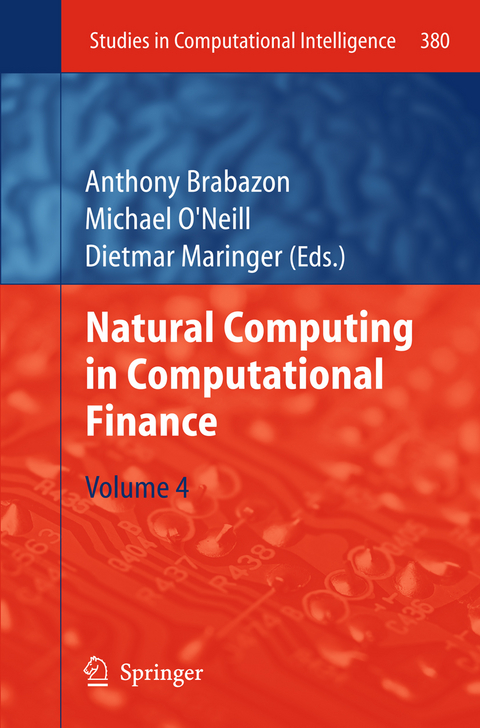
Natural Computing in Computational Finance (eBook)
X, 202 Seiten
Springer Berlin (Verlag)
978-3-642-23336-4 (ISBN)
This book follows on from Natural Computing in Computational Finance Volumes I, II and III. As in the previous volumes of this series, the book consists of a series of chapters each of which was selected following a rigorous, peer-reviewed, selection process. The chapters illustrate the application of a range of cutting-edge natural computing and agent-based methodologies in computational finance and economics. The applications explored include option model calibration, financial trend reversal detection, enhanced indexation, algorithmic trading, corporate payout determination and agent-based modeling of liquidity costs, and trade strategy adaptation. While describing cutting edge applications, the chapters are written so that they are accessible to a wide audience. Hence, they should be of interest to academics, students and practitioners in the fields of computational finance and economics. which was selected following a rigorous, peer-reviewed, selection process. The chapters illustrate the application of a range of cutting-edge natural computing and agent-based methodologies in computational finance and economics. The applications explored include option model calibration, financial trend reversal detection, enhanced indexation, algorithmic trading, corporate payout determination and agent-based modeling of liquidity costs, and trade strategy adaptation. While describing cutting edge applications, the chapters are written so that they are accessible to a wide audience. Hence, they should be of interest to academics, students and practitioners in the fields of computational finance and economics. The applications explored include option model calibration, financial trend reversal detection, enhanced indexation, algorithmic trading, corporate payout determination and agent-based modeling of liquidity costs, and trade strategy adaptation. While describing cutting edge applications, the chapters are written so that they are accessible to a wide audience. Hence, they should be of interest to academics, students and practitioners in the fields of computational finance and economics. written so that they are accessible to a wide audience. Hence, they should be of interest to academics, students and practitioners in the fields of computational finance and economics.
1 Natural Computing in Computational Finance (Volume 4): Introduction.- 2 Calibrating Option Pricing Models with Heuristics.- 3 A Comparison Between Nature-Inspired and Machine Learning Approaches to Detecting Trend Reversals in Financial Time Series.- 4 A soft computing approach to enhanced indexation.- 5 Parallel Evolutionary Algorithms for Stock Market Trading Rule Selection on Many-Core Graphics Processors.- 6 Regime-Switching Recurrent Reinforcement Learning in Automated Trading.- 7 An Evolutionary Algorithmic Investigation of US Corporate Payout Policy Determination.- 8 Tackling Overfitting in Evolutionary-driven Financial Model Induction.- 9 An Order-Driven Agent-Based Artificial Stock Market to Analyze Liquidity Costs of Market Orders in the Taiwan Stock Market.- 10 Market Microstructure: A Self-Organizing Map Approach to Investigate Behavior Dynamics under an Evolutionary Environment.
| Erscheint lt. Verlag | 14.10.2011 |
|---|---|
| Reihe/Serie | Studies in Computational Intelligence |
| Verlagsort | Berlin |
| Sprache | englisch |
| Themenwelt | Technik |
| Schlagworte | Computational Finance • Computational Intelligence • Natural Computing |
| ISBN-10 | 3-642-23336-8 / 3642233368 |
| ISBN-13 | 978-3-642-23336-4 / 9783642233364 |
| Informationen gemäß Produktsicherheitsverordnung (GPSR) | |
| Haben Sie eine Frage zum Produkt? |
 PDF (Adobe DRM)
Kopierschutz: Adobe-DRM
Adobe-DRM ist ein Kopierschutz, der das eBook vor Mißbrauch schützen soll. Dabei wird das eBook bereits beim Download auf Ihre persönliche Adobe-ID autorisiert. Lesen können Sie das eBook dann nur auf den Geräten, welche ebenfalls auf Ihre Adobe-ID registriert sind.
Details zum Adobe-DRM
Dateiformat: PDF (Portable Document Format)
Mit einem festen Seitenlayout eignet sich die PDF besonders für Fachbücher mit Spalten, Tabellen und Abbildungen. Eine PDF kann auf fast allen Geräten angezeigt werden, ist aber für kleine Displays (Smartphone, eReader) nur eingeschränkt geeignet.
Systemvoraussetzungen:
PC/Mac: Mit einem PC oder Mac können Sie dieses eBook lesen. Sie benötigen eine
eReader: Dieses eBook kann mit (fast) allen eBook-Readern gelesen werden. Mit dem amazon-Kindle ist es aber nicht kompatibel.
Smartphone/Tablet: Egal ob Apple oder Android, dieses eBook können Sie lesen. Sie benötigen eine
Geräteliste und zusätzliche Hinweise
Buying eBooks from abroad
For tax law reasons we can sell eBooks just within Germany and Switzerland. Regrettably we cannot fulfill eBook-orders from other countries.
aus dem Bereich