


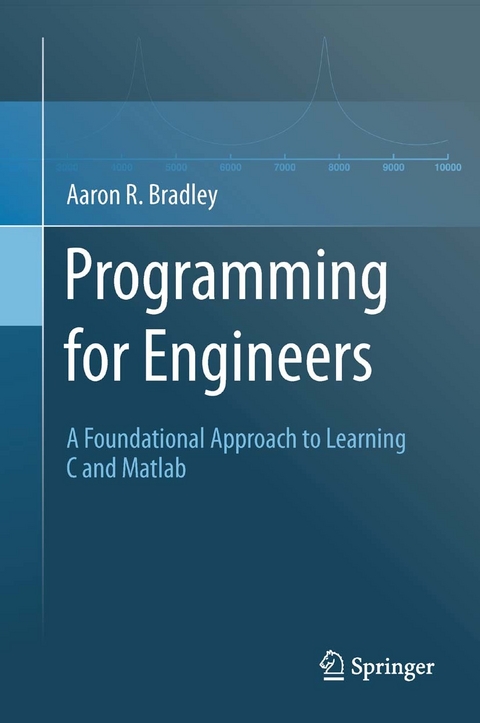
Programming for Engineers (eBook)
XIV, 235 Seiten
Springer-Verlag
9783642233036 (ISBN)
The author departs radically from the typical presentation by teaching concepts and techniques in a rigorous manner rather than listing how to use libraries and functions. He presents pointers in the very first chapter as part of the development of a computational model that facilitates an ab initio presentation of subjects such as function calls, call-by-reference, arrays, the stack, and the heap. The model also allows students to practice the essential skill of memory manipulation throughout the entire course rather than just at the end. As a result, this textbook goes further than is typical for a one-semester course -- abstract data types and linked lists, for example, are covered in depth. The computational model will also serve students in their adventures with programming beyond the course: instead of falling back on rules, they can think through the model to decide how a new programming concept fits with what they already know.
The book is appropriate for undergraduate students of engineering and computer science, and graduate students of other disciplines. It contains many exercises integrated into the main text, and the author has made the source code available online.
Dr. Aaron R. Bradley obtained his PhD in Stanford University under the supervision of Prof. Zohar Manna, with whom he cowrote the graduate textbook 'The Calculus of Computation'. From 2008 to 2011 he was on the staff of the Dept. of Electrical, Computer, and Energy Engineering at the University of Colorado, Boulder where he taught the undergraduate engineering course on programming. He is now on the staff of the Summit Charter Middle School in Boulder, teaching mathematics.
Dr. Aaron R. Bradley obtained his PhD in Stanford University under the supervision of Prof. Zohar Manna, with whom he cowrote the graduate textbook "The Calculus of Computation". From 2008 to 2011 he was on the staff of the Dept. of Electrical, Computer, and Energy Engineering at the University of Colorado, Boulder where he taught the undergraduate engineering course on programming. He is now on the staff of the Summit Charter Middle School in Boulder, teaching mathematics.
Chap. 1, Memory: The Stack.- Chap. 2, Control.- Chap. 3, Arrays and Strings.- Chap. 4, Debugging.- Chap. 5, I/O.- Chap. 6, Memory: The Heap.- Chap. 7, Abstract Data Types.- Chap. 8, Linked Lists.- Chap. 9, Introduction to Matlab.- Chap. 10, Exploring ODEs with Matlab.- Chap. 11, Exploring Time and Frequency Domains with Matlab.- Chap. 12, Index.
| Erscheint lt. Verlag | 26.10.2011 |
|---|---|
| Sprache | englisch |
| Themenwelt | Mathematik / Informatik ► Informatik ► Software Entwicklung |
| Informatik ► Theorie / Studium ► Algorithmen | |
| Technik | |
| Schlagworte | Abstract Data Types • Arrays • Control • Debugging • i/o • Linked lists • MATLAB • Memory • Octave • programming • Strings |
| ISBN-13 | 9783642233036 / 9783642233036 |
| Informationen gemäß Produktsicherheitsverordnung (GPSR) | |
| Haben Sie eine Frage zum Produkt? |
 PDF (Wasserzeichen)
Größe: 2,3 MB
DRM: Digitales Wasserzeichen
Dieses eBook enthält ein digitales Wasserzeichen und ist damit für Sie personalisiert. Bei einer missbräuchlichen Weitergabe des eBooks an Dritte ist eine Rückverfolgung an die Quelle möglich.
Dateiformat: PDF (Portable Document Format)
Mit einem festen Seitenlayout eignet sich die PDF besonders für Fachbücher mit Spalten, Tabellen und Abbildungen. Eine PDF kann auf fast allen Geräten angezeigt werden, ist aber für kleine Displays (Smartphone, eReader) nur eingeschränkt geeignet.
Systemvoraussetzungen:
PC/Mac: Mit einem PC oder Mac können Sie dieses eBook lesen. Sie benötigen dafür einen PDF-Viewer - z.B. den Adobe Reader oder Adobe Digital Editions.
eReader: Dieses eBook kann mit (fast) allen eBook-Readern gelesen werden. Mit dem amazon-Kindle ist es aber nicht kompatibel.
Smartphone/Tablet: Egal ob Apple oder Android, dieses eBook können Sie lesen. Sie benötigen dafür einen PDF-Viewer - z.B. die kostenlose Adobe Digital Editions-App.
Buying eBooks from abroad
For tax law reasons we can sell eBooks just within Germany and Switzerland. Regrettably we cannot fulfill eBook-orders from other countries.
aus dem Bereich


