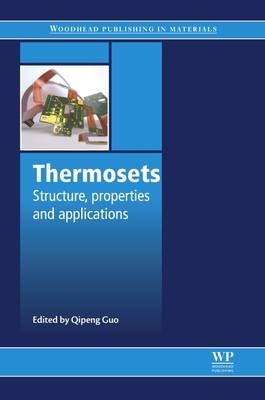
Thermosets
Woodhead Publishing Ltd (Verlag)
978-0-85709-086-7 (ISBN)
- Titel erscheint in neuer Auflage
- Artikel merken

Thermosets are a key group of polymers. Understanding how their chemistry and structure affects their properties is essential to their manufacture and use in a range of applications. Thermosets: Structure, properties and applications reviews both factors affecting thermoset properties and how this understanding can be used to engineer thermosets for particular uses.Part one reviews mechanical and thermal properties, the use of chemorheology to characterise and model thermoset flow behaviour, and the role of nanostructures in thermoset toughening. Applications of thermosets are the focus of part two, including the use of thermosets in the building and construction industry, aerospace technology and as insulation materials. Thermoset adhesives, including epoxy resins, acrylates and polyurethanes are also discussed, followed by a final review of thermosets for electrical applications.With its distinguished editor and international team of expert contributors, Thermosets: Structure, properties and applications is an essential guide for engineers, chemists, physicists and polymer scientists involved in the development, production and application of thermosets, as well as providing a useful review for academic researchers in the field.
Professor Qipeng Guo holds a personal chair in polymer science and technology at Deakin University, Australia. He is a Fellow of The Royal Society of Chemistry and has an international reputation for his polymer research.
Contributor contact details
Preface
Part I: Structure and properties of thermosets
Chapter 1: Overview of thermosets: structure, properties and processing for advanced applications
Abstract:
1.1 Introduction
1.2 Network formation in thermosets
1.3 Gelation, vitrification and transformation diagrams
1.4 Thermoset formulations and compounds
1.5 Processing of thermosets
1.6 Advanced materials based on thermosets
1.7 Conclusions
Chapter 2: Mechanical properties of thermosets
Abstract:
2.1 Introduction
2.2 Overview of thermoset classes
2.3 Thermal properties
2.4 Mechanical properties
2.5 Conclusions
Chapter 3: Thermal properties of thermosets
Abstract:
3.1 Introduction
3.2 Thermal conductivity
3.3 Thermal stability
3.4 Flammability and smoke property
3.5 Thermal cure characteristics
3.6 Glass transition temperature (Tg)
3.7 The influence of thermal properties on application
3.8 Thermal properties of toughened thermoset and composites
3.9 Conclusion
Chapter 4: Rheology of thermosets: the use of chemorheology to characterise and model thermoset flow behaviour
Abstract:
4.1 Introduction
4.1 Thermoset flow simulation and key material properties required
4.3 Thermoset processes and chemorheological models
4.4 Conclusions and future trends
4.5 Sources of further information and advice
Chapter 5: Nanostructures and the toughening of thermosets
Abstract:
5.1 Introduction
5.2 Nanostructure formation during polymerisation
5.3 Nanostructure formation by self-assembly before phase separation
5.4 Nanostructure formation by reaction-induced micro-phase separation (RIMPS)
5.5 Nanostructure formation by addition of nanoparticles
5.6 Nanostructure formation by addition of reactive polymers
5.7 Mechanism of toughening thermosets by nanostructuring
5.8 Conclusions
5.9 Acknowledgements
Part II: Applications of thermosets
Chapter 6: The use of thermosets in the building and construction industry
Abstract:
6.1 Introduction
6.2 Thermal insulation
6.3 Applications of thermosets for piping and roofing
6.4 Other applications of unreinforced thermosets
6.5 Fiber-reinforced plastics (FRPs)
6.6 Applications of fiber-reinforced plastics (FRPs)
6.7 Polymer flammability
6.8 Future trends and development priorities
6.9 Sources of further information and advice
6.10 Acknowledgments
Chapter 7: The use of thermosets in aerospace applications
Abstract:
7.1 Introduction
7.2 Key requirements of materials used in the aerospace industry
7.3 The resin matrix
7.4 Applications and examples of thermosets for the aerospace industry
7.5 Composite tooling
7.6 Future trends and conclusions
7.7 Sources of further information and advice
7.8 Acknowledgements
Chapter 8: Thermoset adhesives: epoxy resins, acrylates and polyurethanes
Abstract:
8.1 Introduction
8.2 Epoxy-based thermosets
8.3 Polyurethane adhesives
8.4 Structural acrylic adhesives
8.5 Automotive and transportation applications of thermoset adhesives
8.6 Other applications of thermoset adhesives
8.7 Future trends
8.8 Acknowledgements
Chapter 9: Thermoset insulation materials in appliances, buildings and other applications
Abstract:
9.1 Introduction: the importance of energy conservation
9.2 Thermal insulation properties of thermoset foams
9.3 Thermoset polymers used in thermal insulation
9.4 Key requirements of thermoset insulation materials and products
9.5 Fabrication processes: pour-in-place and reaction injection molding
9.6 Fabrication processes: continuous lamination
9.7 Other fabrication processes
9.8 Applications and examples of thermoset insulation materials
9.9 Future trends and development priorities
Chapter 10: Thermosets for electrical applications
Abstract:
10.1 Introduction
10.2 Properties of thermosets
10.3 Oxidation, moisture and chemical resistance
10.4 Thermosets for electrical applications
10.5 Conclusions and future trends
Index
| Verlagsort | Cambridge |
|---|---|
| Sprache | englisch |
| Maße | 156 x 234 mm |
| Gewicht | 640 g |
| Themenwelt | Technik |
| ISBN-10 | 0-85709-086-0 / 0857090860 |
| ISBN-13 | 978-0-85709-086-7 / 9780857090867 |
| Zustand | Neuware |
| Informationen gemäß Produktsicherheitsverordnung (GPSR) | |
| Haben Sie eine Frage zum Produkt? |
aus dem Bereich