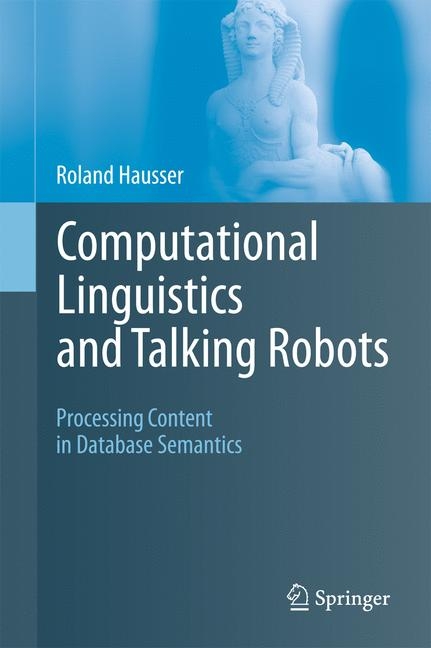
Computational Linguistics and Talking Robots (eBook)
XII, 286 Seiten
Springer Berlin (Verlag)
978-3-642-22432-4 (ISBN)
The practical task of building a talking robot requires a theory of how natural language communication works. Conversely, the best way to computationally verify a theory of natural language communication is to demonstrate its functioning concretely in the form of a talking robot, the epitome of human-machine communication. To build an actual robot requires hardware that provides appropriate recognition and action interfaces, and because such hardware is hard to develop the approach in this book is theoretical: the author presents an artificial cognitive agent with language as a software system called database semantics (DBS). Because a theoretical approach does not have to deal with the technical difficulties of hardware engineering there is no reason to simplify the system - instead the software components of DBS aim at completeness of function and of data coverage in word form recognition, syntactic-semantic interpretation and inferencing, leaving the procedural implementation of elementary concepts for later.
In this book the author first examines the universals of natural language and explains the Database Semantics approach. Then in Part I he examines the following natural language communication issues: using external surfaces; the cycle of natural language communication; memory structure; autonomous control; and learning. In Part II he analyzes the coding of content according to the aspects: semantic relations of structure; simultaneous amalgamation of content; graph-theoretical considerations; computing perspective in dialogue; and computing perspective in text. The book ends with a concluding chapter, a bibliography and an index.
The book will be of value to researchers, graduate students and engineers in the areas of artificial intelligence and robotics, in particular those who deal with natural language processing.
Prof. Dr. Hausser has been Professor for Linguistische Informatik at the University Erlangen-Nürnberg since 1989; he is also director of the Laboratory of Computational Linguistics Uni Erlangen (CLUE). Among his publications are the books 'Foundations of Computational Linguistics -- Human-Computer Communication in Natural Language', 2001, ISBN 978-3-540-42417-8 and 'A Computational Model of Natural Language Communication', 2006, ISBN 978-3-540-35476-5.
Prof. Dr. Hausser has been Professor for Linguistische Informatik at the University Erlangen-Nürnberg since 1989; he is also director of the Laboratory of Computational Linguistics Uni Erlangen (CLUE). Among his publications are the books "Foundations of Computational Linguistics -- Human–Computer Communication in Natural Language", 2001, ISBN 978-3-540-42417-8 and "A Computational Model of Natural Language Communication", 2006, ISBN 978-3-540-35476-5.
Chap. 1.- Introduction: How to Build a Talking Robot.- Part I.- Five Mysteries of Natural Language Communication.- Chap. 2.- Mystery Number One: Using External Surfaces.- Chap. 3.- Mystery Number Two: Cycle of Natural Language Communication.- Chap. 4.- Mystery Number Three: Memory Structure.- Chap. 5.- Mystery Number Four: Autonomous Control.- Chap. 6.- Mystery Number Five: Learning.- Part II.- The Coding of Content.- Chap. 7.- Semantic Relations of Structure.- Chap. 8.- Simultaneous Amalgamation of Content.- Chap. 9.- Graph-Theoretical Considerations.- Chap. 10.- Computing Perspective in Dialogue.- Chap. 11.- Computing Perspective in Text.- Chap. 12.- Conclusion.- Bibliography.
| Erscheint lt. Verlag | 19.8.2011 |
|---|---|
| Zusatzinfo | XII, 286 p. |
| Verlagsort | Berlin |
| Sprache | englisch |
| Themenwelt | Informatik ► Theorie / Studium ► Künstliche Intelligenz / Robotik |
| Technik ► Maschinenbau | |
| Schlagworte | Artificial Intelligence • Cognitive Psychology • Communication • Computational Linguistics • Database Semantics • Dialogue • Human–computer communication • learning • Linguistics • Memory structure • Natural Language Processing • Robotics • robots • Semantics • talking robots |
| ISBN-10 | 3-642-22432-6 / 3642224326 |
| ISBN-13 | 978-3-642-22432-4 / 9783642224324 |
| Informationen gemäß Produktsicherheitsverordnung (GPSR) | |
| Haben Sie eine Frage zum Produkt? |
 PDF (Wasserzeichen)
DRM: Digitales Wasserzeichen
Dieses eBook enthält ein digitales Wasserzeichen und ist damit für Sie personalisiert. Bei einer missbräuchlichen Weitergabe des eBooks an Dritte ist eine Rückverfolgung an die Quelle möglich.
Dateiformat: PDF (Portable Document Format)
Mit einem festen Seitenlayout eignet sich die PDF besonders für Fachbücher mit Spalten, Tabellen und Abbildungen. Eine PDF kann auf fast allen Geräten angezeigt werden, ist aber für kleine Displays (Smartphone, eReader) nur eingeschränkt geeignet.
Systemvoraussetzungen:
PC/Mac: Mit einem PC oder Mac können Sie dieses eBook lesen. Sie benötigen dafür einen PDF-Viewer - z.B. den Adobe Reader oder Adobe Digital Editions.
eReader: Dieses eBook kann mit (fast) allen eBook-Readern gelesen werden. Mit dem amazon-Kindle ist es aber nicht kompatibel.
Smartphone/Tablet: Egal ob Apple oder Android, dieses eBook können Sie lesen. Sie benötigen dafür einen PDF-Viewer - z.B. die kostenlose Adobe Digital Editions-App.
Buying eBooks from abroad
For tax law reasons we can sell eBooks just within Germany and Switzerland. Regrettably we cannot fulfill eBook-orders from other countries.
aus dem Bereich