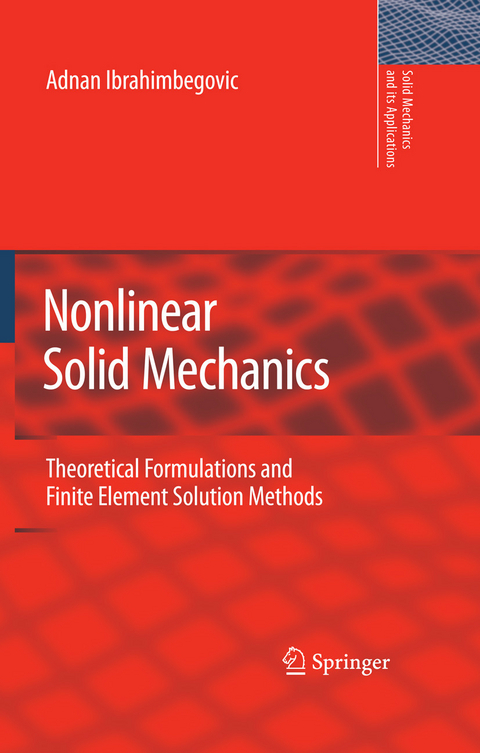
Nonlinear Solid Mechanics (eBook)
XX, 574 Seiten
Springer Netherland (Verlag)
978-90-481-2331-5 (ISBN)
1 Introduction; 1.1 Motivation and objectives; 1.2 Outline of the main topics; 1.3 Further studies recommendations; 1.4 Summary of main notations;
2 Boundary value problem in linear and nonlinear elasticity; 2.1 Boundary value problem in elasticity with small displacement gradients; 2.1.1 Domain and boundary conditions; 2.1.2 Strong form of boundary value problem in 1D elasticity; 2.1.3 Weak form of boundary value problem in 1D elasticity and the principle of virtual work; 2.1.4 Variational formulation of boundary value problem in 1D elasticity and principle of minimum potential energy; 2.2 Finite element solution of boundary value problems in 1D linear and nonlinear elasticity; 2.2.1 Qualitative methods of functional analysis for solution existence and uniqueness; 2.2.2 Approximate solution construction by Galerkin, Ritz and finite element methods; 2.2.3 Approximation error and convergence of finite element method; 2.2.4 Solving a system of linear algebraic equations by Gauss elimination method; 2.2.5 Solving a system of nonlinear algebraic equations by incremental analysis; 2.2.6 Solving a system of nonlinear algebraic equations by Newton's iterative method; 2.3 Implementation of finite element method in ID boundary value problems; 2.3.1 Local or elementary description; 2.3.2 Consistence of finite element approximation; 2.3.3 Equivalent nodal external load vector; 2.3.4 Higher order finite elements; 2.3.5 Role of numerical integration; 2.3.6 Finite element assembly procedure; 2.4 Boundary value problems in 2D and 3D elasticity; 2.4.1 Tensor, index and matrix notations; 2.4.2 Strong form of a boundary value problem in 2D and 3D elasticity; 2.4.3 Weak form of boundary value problem in 2D and 3D elasticity; 2.5 Detailed aspects of the finite element method; 2.5.1 Isoparametric finite elements; 2.5.2 Order of numerical integration; 2.5.3 The patch test; 2.5.4 Hu-Washizu (mixed) variational principle and method of incompatible modes; 2.5.5 Hu-Washizu (mixed)variational principle and assumed strain method for quasi-incompressible behavior;
3 Inelastic behavior at small strains; 3.1 Boundary value problem in thermomechanics; 3.1.1 Rigid conductor and heat equation; 3.1.2 Numerical solution by time-integration scheme for heat transfer problem; 3.1.3 Thermo-mechanical coupling in elasticity; 3.1.4 Thermodynamics potentials in elasticity; 3.1.5 Thermodynamics of inelastic behavior: constitutive models with internal variables; 3.1.6 Internal variables in viscoelasticity; 3.1.7 Internal variables in viscoplasticity; 3.2 1D models of perfect plasticity and plasticity with hardening; 3.2.1 1D perfect plasticity; 3.2.2 1D plasticity with isotropic hardening; 3.2.3 Boundary value problem for 1D plasticity; 3.3 3D plasticity; 3.3.1 Standard format of 3D plasticity model: Prandtl-Reuss equations; 3.3.2 J2 plasticity model with von Mises plasticity criterion; 3.3.3 Implicit backward Euler scheme and operator split for von Mises plasticity; 3.3.4 Finite element numerical implementation in 3D plasticity; 3.4 Refined models of 3D plasticity; 3.4.1 Nonlinear isotropic hardening; 3.4.2 Kinematic hardening; 3.4.3 Plasticity model dependent on rate of deformation or viscoplasticity; 3.4.4 Multi-surface plasticity criterion; 3.4.5 Plasticity model with nonlinear elastic response; 3.5 Damage models; 3.5.1 1D damage model; 3.5.2 3D damage model; 3.5.3 Refinements of 3D damage model; 3.5.4 Isotropic damage model of Kachanov; 3.5.5 Numerical examples: damage model combining isotropic and multisurface criteria; 3.6 Coupled plasticity-damage model; 3.6.1 Theoretical formulation of 3D coupled model; 3.6.2 Time integration of stress for coupled plasticitydamagemodel; 3.6.3 Direct stress interpolation for coupled plasticitydamagemodel;
4 Large displacements and deformations; 4.1 Kinematics of large displacements; 4.1.1 Motion in large displacements; 4.1.2 Deformation gradient; 4.1.3 Large deformation measures; 4.2 Equilibrium equations
| Erscheint lt. Verlag | 2.4.2009 |
|---|---|
| Reihe/Serie | Solid Mechanics and Its Applications |
| Verlagsort | Dordrecht |
| Sprache | englisch |
| Original-Titel | Mécanique des solides déformables: formulation théorique et resolution numérique par éléments finis |
| Themenwelt | Informatik ► Theorie / Studium ► Künstliche Intelligenz / Robotik |
| Mathematik / Informatik ► Mathematik ► Analysis | |
| Mathematik / Informatik ► Mathematik ► Angewandte Mathematik | |
| Technik ► Maschinenbau | |
| Schlagworte | computer programs • Dynamics • finite elements • inelasticity • linear algebra • Mechanics • Model • Modeling • Nonlinear • Operator • solids • Textbook • thermodynamics |
| ISBN-10 | 90-481-2331-3 / 9048123313 |
| ISBN-13 | 978-90-481-2331-5 / 9789048123315 |
| Informationen gemäß Produktsicherheitsverordnung (GPSR) | |
| Haben Sie eine Frage zum Produkt? |
 PDF (Wasserzeichen)
Größe: 14,0 MB
DRM: Digitales Wasserzeichen
Dieses eBook enthält ein digitales Wasserzeichen und ist damit für Sie personalisiert. Bei einer missbräuchlichen Weitergabe des eBooks an Dritte ist eine Rückverfolgung an die Quelle möglich.
Dateiformat: PDF (Portable Document Format)
Mit einem festen Seitenlayout eignet sich die PDF besonders für Fachbücher mit Spalten, Tabellen und Abbildungen. Eine PDF kann auf fast allen Geräten angezeigt werden, ist aber für kleine Displays (Smartphone, eReader) nur eingeschränkt geeignet.
Systemvoraussetzungen:
PC/Mac: Mit einem PC oder Mac können Sie dieses eBook lesen. Sie benötigen dafür einen PDF-Viewer - z.B. den Adobe Reader oder Adobe Digital Editions.
eReader: Dieses eBook kann mit (fast) allen eBook-Readern gelesen werden. Mit dem amazon-Kindle ist es aber nicht kompatibel.
Smartphone/Tablet: Egal ob Apple oder Android, dieses eBook können Sie lesen. Sie benötigen dafür einen PDF-Viewer - z.B. die kostenlose Adobe Digital Editions-App.
Buying eBooks from abroad
For tax law reasons we can sell eBooks just within Germany and Switzerland. Regrettably we cannot fulfill eBook-orders from other countries.
aus dem Bereich