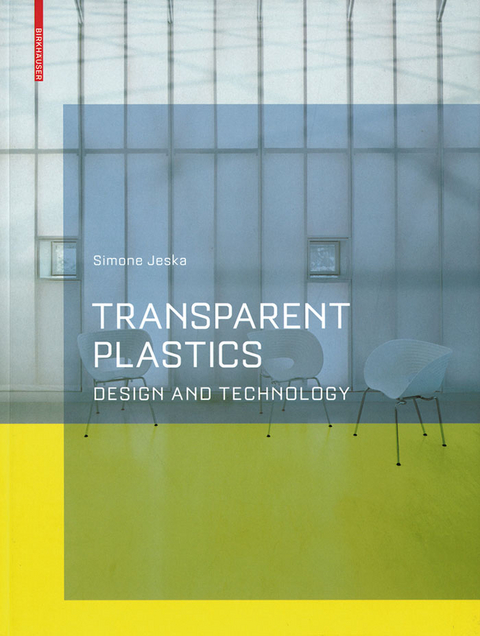
A fascinating guide to building with transparent plastics. Prominent international avant-garde architects such as Shigeru Ban and Herzog & de Meuron frequently use transparent plastic for their structures. Transparent plastic seems ephemeral and thus captures the spirit of the times.
Simone Jeska, geboren 1965, hat Architektur an der Technischen Fachhochschule Nürnberg sowie Architekturtheorie und Architekturgeschichte an der ETH Zürich studiert. Sie hat mehrere Publikationen im Bereich der Architektur vorgelegt; u.a. war sie Ko-Autorin des Entwurfsatlas Bürobau.
lt;P>Simone Jeska, geboren 1965, hat Architektur an der Technischen Fachhochschule Nürnberg sowie Architekturtheorie und Architekturgeschichte an der ETH Zürich studiert. Sie hat mehrere Publikationen im Bereich der Architektur vorgelegt; u.a. war sie Ko-Autorin des Entwurfsatlas Bürobau.
Simone Jeska was born in 1965 and studied architecture at the Technische Fachhochschule in Nürnberg as well as theory and history of architecture at the ETH in Zurich. She is the author of a number of publications on architecture and is co-author of Office Buildings: A Design Manual.
Transparent Plastics berween intellectualisation and trash culture (S. 30-31)
Synthetic materials have re-established themselves in the exper iments of the contemporary architectural avant-gar de in the tension between spirit and matter, form and material. I Digitally generated forms on the one hand and material fetishism on the other favour the use of transparent plastics , which are characte rised by immateriality and ambiguity.
Their random formability plus their versatility bind the synthetic material to the digitally animat ed architectura l form . Flexibility, efficiency and ada ptabi lity - the ess enti al features of synthetic materials - are ideal for so-c alled bionic architecture. Their indifferent properties predispose them for an architecture that regards metaphor as ext remely important, relies on sensuality, ambience and irritation , and takes " removal of barriers " as its key theme - specifically, the removal of barriers between inside and outside, matter and space, loadbearing structure and enclosing envelope, twodimensionality and three -dimensionality, static and dynamic, and between space and time .
PLASTIC IS SPIRIT, PLASTIC IS FORM
Free ly fo rmed, digital architect ures and transparent plastics form a conge nial symbios is in many ways. In an ana logy to the immateriality of digital forms , transparent plastics are a synonym for the su bjugati on of th e material. As transparent and at the same time almost weightless materials, they seem closer to the spiritual world than th e material world. Moulded into bubble-like shapes or designed as cushions of air , they take on spherical dimensions .
The spiritual content, as an intrinsic characteristic of synthetic materials , has from time to time been a theme in the writings of artists and intellectuals over the course of the 20th century. Roland Barthes characterised the new material as the very " spect acl e of its end-products " and defined the spiritual content of plastics by means of their "quick-change artistry". Plastic is "mor e than a substance, plastic is the very idea of its infinite transformation [... ] Plastic , sublimated as movement, ha rdly exists as substance. " The versatility (in terms of both chemistry and form) and the resulting infinite configuration optio ns, which lead to the invention of forms , are features of the computer-generated forms and the artificial materia l alike.
Robert E. Somol has given us a link between digital f orms and synthetic materials based on associations . Responsible for this is "hollowness" as a property of the computer-generated form, making a project appear as if made f rom polystyrene, sponges or aerogels ." Digitally shaped architecture can obviously express it sel f adequately in formal terms in the we ightless world of plastics , an association that is helped by the form of the mostly "anti -architectural" morphogenetic architecture
| Erscheint lt. Verlag | 5.10.2007 |
|---|---|
| Zusatzinfo | 142 b/w and 150 col. ill. |
| Verlagsort | Basel/Berlin/Boston |
| Sprache | englisch |
| Themenwelt | Technik ► Architektur |
| Schlagworte | Architecture • Plastics |
| ISBN-10 | 3-7643-8287-2 / 3764382872 |
| ISBN-13 | 978-3-7643-8287-2 / 9783764382872 |
| Informationen gemäß Produktsicherheitsverordnung (GPSR) | |
| Haben Sie eine Frage zum Produkt? |
 PDF (Wasserzeichen)
Größe: 41,6 MB
DRM: Digitales Wasserzeichen
Dieses eBook enthält ein digitales Wasserzeichen und ist damit für Sie personalisiert. Bei einer missbräuchlichen Weitergabe des eBooks an Dritte ist eine Rückverfolgung an die Quelle möglich.
Dateiformat: PDF (Portable Document Format)
Mit einem festen Seitenlayout eignet sich die PDF besonders für Fachbücher mit Spalten, Tabellen und Abbildungen. Eine PDF kann auf fast allen Geräten angezeigt werden, ist aber für kleine Displays (Smartphone, eReader) nur eingeschränkt geeignet.
Systemvoraussetzungen:
PC/Mac: Mit einem PC oder Mac können Sie dieses eBook lesen. Sie benötigen dafür einen PDF-Viewer - z.B. den Adobe Reader oder Adobe Digital Editions.
eReader: Dieses eBook kann mit (fast) allen eBook-Readern gelesen werden. Mit dem amazon-Kindle ist es aber nicht kompatibel.
Smartphone/Tablet: Egal ob Apple oder Android, dieses eBook können Sie lesen. Sie benötigen dafür einen PDF-Viewer - z.B. die kostenlose Adobe Digital Editions-App.
Zusätzliches Feature: Online Lesen
Dieses eBook können Sie zusätzlich zum Download auch online im Webbrowser lesen.
Buying eBooks from abroad
For tax law reasons we can sell eBooks just within Germany and Switzerland. Regrettably we cannot fulfill eBook-orders from other countries.
aus dem Bereich