Row Houses (eBook)
112 Seiten
Birkhäuser (Verlag)
978-3-7643-7922-3 (ISBN)
To continue developing existing building types in an intelligent way is a crucial task in the field of residential building. A deeper understanding of the underlying types is indispensable for the success of the individual design, as well as for ensuring that tried and tested structures can be utilized, repeated, and varied in a wide variety of situations.
For this typology of residential buildings, the authors have developed systematic new presentations of the most innovative types. Each individual volume lays out the possibilities for using and transforming a particular form of residential structure.
The first volume deals with the various types of the courtyard house, which utilizes the courtyard as an intimate outdoor living space. A presentation of the courtyard as a building block of the city is followed by coverage of the complete spectrum of types - cluster, network, carpet, terraces, etc.
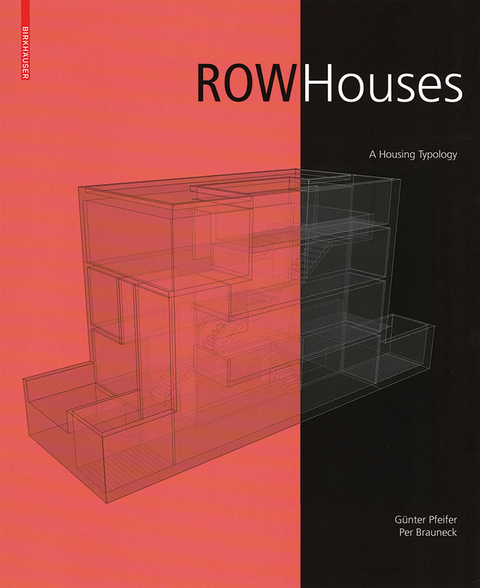
The second volume is devoted to the various types of row house, a particularly widespread form of residential structure. A general discussion of the row as organizing principle - the row as urban building block, linear space, ways of handling corners - is followed by the systematic presentation of the different types.
Within each type, variants are distinguished according to how they organize space, their number of floors, etc. The range of possible solutions is presented in uniform ground plans newly drawn to scale.
To continue developing existing building types in an intelligent way is a crucial task in the field of residential building. A deeper understanding of the underlying types is indispensable for the success of the individual design, as well as for ensuring that tried and tested structures can be utilized, repeated, and varied in a wide variety of situations.
For this typology of residential buildings, the authors have developed systematic new presentations of the most innovative types. Each individual volume lays out the possibilities for using and transforming a particular form of residential structure.
The first volume deals with the various types of the courtyard house, which utilizes the courtyard as an intimate outdoor living space. A presentation of the courtyard as a building block of the city is followed by coverage of the complete spectrum of types - cluster, network, carpet, terraces, etc.
The second volume is devoted to the various types of row house, a particularly widespread form of residential structure. A general discussion of the row as organizing principle - the row as urban building block, linear space, ways of handling corners - is followed by the systematic presentation of the different types.
Within each type, variants are distinguished according to how they organize space, their number of floors, etc. The range of possible solutions is presented in uniform ground plans newly drawn to scale.
Die intelligente Weiterentwicklung von Bautypen ist eine wesentliche Aufgabenstellung im Wohnungsbau. Für den einzelnen Entwurf ebenso wie für die breite Verwendbarkeit, Wiederholbarkeit und Variation von erprobten Strukturen ist das vertiefte Verständnis der zugrunde liegenden Typen unverzichtbar.
Für die Wohnungsbautypologie haben die Autoren neue, systematische Darstellungen über die innovativsten Typen entwickelt. In den einzelnen Bänden werden die Anwendungs- und Transformationsmöglichkeiten jeweils, einer bestimmten Wohnbauform entfaltet.
Der erste Band behandelt die Typen des Hofhauses, die den Hof als intimen Außenraum des Wohnens nutzen. Einer Darstellung des Hofs als Stadtbaustein folgt ein umfassendes Typenspektrum: Cluster, Netz, Teppich, Hofreite, Terrassen etc.
Der zweite Band widmet sich den Typen des Reihenhauses, einer besonders weit verbreiteten Wohnform. Auf die übergreifende Erörterung des Prinzips Reihe - Reihe als Stadtbaustein, der lineare Raum und die Ecklösungen, etc. - folgt die systematische Darstellung der unterschiedlichen Typen.
Innerhalb eines jeden Typs werden Varianten nach verschiedenen Erschließungsformen, Geschossigkeit etc. unterschieden. Das Spektrum der Lösungen ist in einheitlich und maßstäblich neu gezeichneten Grundrissen und Schnitten aufgearbeitet.
Günter Pfeifer is a professor of design and residential building at the Darmstadt University of Technology.
Günter Pfeifer ist Professor für Entwerfen und Wohnungsbau an der Technischen Universität Darmstadt.
Foreword
Introduction
Systematical presentation of different types by means of 50 projects
Appendix:
subject index
illustration credits
| Erscheint lt. Verlag | 5.10.2007 |
|---|---|
| Übersetzer | Usch Engelmann |
| Zusatzinfo | 261 b/w ill. |
| Verlagsort | Basel/Berlin/Boston |
| Sprache | englisch |
| Themenwelt | Technik ► Architektur |
| Schlagworte | Housing • Housing Typology • Row House |
| ISBN-10 | 3-7643-7922-7 / 3764379227 |
| ISBN-13 | 978-3-7643-7922-3 / 9783764379223 |
| Informationen gemäß Produktsicherheitsverordnung (GPSR) | |
| Haben Sie eine Frage zum Produkt? |
 PDF (Wasserzeichen)
Größe: 37,4 MB
DRM: Digitales Wasserzeichen
Dieses eBook enthält ein digitales Wasserzeichen und ist damit für Sie personalisiert. Bei einer missbräuchlichen Weitergabe des eBooks an Dritte ist eine Rückverfolgung an die Quelle möglich.
Dateiformat: PDF (Portable Document Format)
Mit einem festen Seitenlayout eignet sich die PDF besonders für Fachbücher mit Spalten, Tabellen und Abbildungen. Eine PDF kann auf fast allen Geräten angezeigt werden, ist aber für kleine Displays (Smartphone, eReader) nur eingeschränkt geeignet.
Systemvoraussetzungen:
PC/Mac: Mit einem PC oder Mac können Sie dieses eBook lesen. Sie benötigen dafür einen PDF-Viewer - z.B. den Adobe Reader oder Adobe Digital Editions.
eReader: Dieses eBook kann mit (fast) allen eBook-Readern gelesen werden. Mit dem amazon-Kindle ist es aber nicht kompatibel.
Smartphone/Tablet: Egal ob Apple oder Android, dieses eBook können Sie lesen. Sie benötigen dafür einen PDF-Viewer - z.B. die kostenlose Adobe Digital Editions-App.
Zusätzliches Feature: Online Lesen
Dieses eBook können Sie zusätzlich zum Download auch online im Webbrowser lesen.
Buying eBooks from abroad
For tax law reasons we can sell eBooks just within Germany and Switzerland. Regrettably we cannot fulfill eBook-orders from other countries.
aus dem Bereich