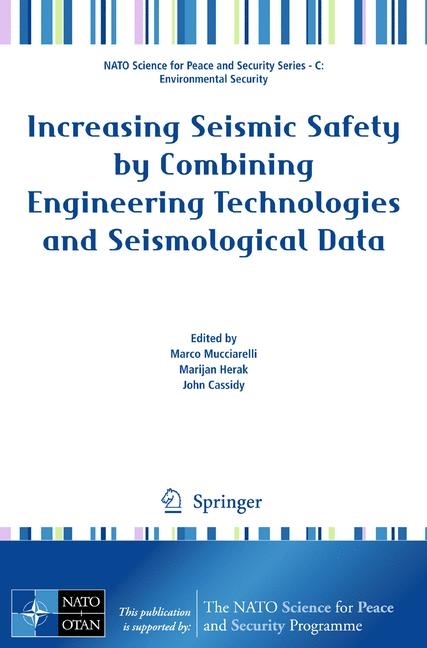
Increasing Seismic Safety by Combining Engineering Technologies and Seismological Data (eBook)
XVII, 382 Seiten
Springer Netherlands (Verlag)
978-1-4020-9196-4 (ISBN)
Dubrovnik,Croatia
19-21 September 2007
The current state-of-the-art allows seismologists to give statistical estimates of the probability of a large earthquake striking a given region, identifying the areas in which the seismic hazard is the highest. However, the usefulness of these estimates is limited, without information about local subsoil conditions and the vulnerability of buildings. Identifying the sites where a local ampli?cation of seismic shaking will occur, and identifying the buildings that will be the weakest under the seismic shaking is the only strategy that allows effective defence against earthquake damage at an affordable cost, by applying selective reinforcement only to the structures that need it. Unfortunately, too often the Earth's surface acted as a divide between seism- ogists and engineers. Now it is becoming clear that the building behaviour largely depends on the seismic input and the buildings on their turn act as seismic sources, in an intricate interplay that non-linear phenomena make even more complex. These phenomena are often the cause of observed damage enhancement during past ear- quakes. While research may pursue complex models to fully understand soil dyn- ics under seismic loading, we need, at the same time, simple models valid on average, whose results can be easily transferred to end users without prohibitive expenditure. Very complex models require a large amount of data that can only be obtained at a very high cost or may be impossible to get at all.
Introduction. Group picture, Participants sketches and names. 1. The Use of Ambient Noise for Building and Soil Characterisation; M. Herak.- The Need for Standardized Approach for Estimating the local Site Effects Based on Ambient Noise Recordings; K Atakan.- Are Transients Carrying Useful Information for Estimating H/V Spectral Ratios? S. Parolai et al.- Basic Structure of QTS (HVSR) and Examples of Applications; Y. Nakamura.- Ambient Noise and Site Response: from Estimation of Site Effects to determination of the Subsoil Structure; F.J. Chavez-Garci.- In-Situ Estimates of Material Damping from Environmental Noise Measurements; D. Albarello and F. Baliva.- Estimates of Vs30 Based on Constrained H/V Ratio Measurements Alone; S. Castellaro, F. Mulargia.- Comparison of Recorded Dynamic Characteristics of Structures and Ground During Strong and Weak Shaking; M. Çelebi.- HVSR Technique Improvement Using Redundant Wavelet Transform; F. Vallianatos, G. Hioupis.- 2. Effect of Buildings on Free-Field Ground Motion; M. Mucciarelli.- Effect of Building-Building Interaction on 'Free-Field' Ground Motion; M. Mucciarelli et al.- 3. Role of Dynamic Properties on Building Vulnerability; A. Masi.- How Far Ambient Noise Measurement may help to Assess Building Vulnerability?C. Boutin, S. Hans.- Assessment of Seismic Capacity of Existing Buildings — Effects of Uncertainties; D. Baros et al.- Estimation of the period of Vibration of Existing RC Building Types Based on Experimental Data and Numerical Results; A. Masi, M. Vona.- Retrofitting and Strengthening Evaluation from Stiffness Variations of a Damaged Building from Ambient Vibration Recordings; M.N. Farsi et al.- 4. State-of-the-Art — Recent Advances and Applications; J.F. Cassidy.- Microtremor Soil-Structure Resonance Study in the Bovec Basin (NW Slovenia) Related to 1998 and 2004 Damaging Earthquakes; A. Gosar.- Recent Earthquake Site Response Studies in Canada; J.F. Cassidy, S. Molnar.-Recent Applications of Ambient Vibration Measurements in Croatia; M. Herak.- Applications to World Heritage Sites; J. Saita.-
Two Applications of the HVSR Technique to Cultural Heritage and Historical Masonry; D. Liberatore et al.- Overview of Seismic Hazard Studies in Tunis City;
N. Bouden-Romdhane et al.- An Empericial Geotechnical Seismic Site Response Procedure; A. Rodriguez-Marek et al.- Conclusions.
| Erscheint lt. Verlag | 30.11.2008 |
|---|---|
| Sprache | englisch |
| Themenwelt | Naturwissenschaften ► Geowissenschaften ► Geologie |
| Naturwissenschaften ► Physik / Astronomie ► Mechanik | |
| Technik ► Bauwesen | |
| Technik ► Maschinenbau | |
| Schlagworte | environmental • NATO • Peace • resonance • Science • security • Sub-Series C • Vibration |
| ISBN-10 | 1-4020-9196-6 / 1402091966 |
| ISBN-13 | 978-1-4020-9196-4 / 9781402091964 |
| Informationen gemäß Produktsicherheitsverordnung (GPSR) | |
| Haben Sie eine Frage zum Produkt? |
 PDF (Adobe DRM)
Kopierschutz: Adobe-DRM
Adobe-DRM ist ein Kopierschutz, der das eBook vor Mißbrauch schützen soll. Dabei wird das eBook bereits beim Download auf Ihre persönliche Adobe-ID autorisiert. Lesen können Sie das eBook dann nur auf den Geräten, welche ebenfalls auf Ihre Adobe-ID registriert sind.
Details zum Adobe-DRM
Dateiformat: PDF (Portable Document Format)
Mit einem festen Seitenlayout eignet sich die PDF besonders für Fachbücher mit Spalten, Tabellen und Abbildungen. Eine PDF kann auf fast allen Geräten angezeigt werden, ist aber für kleine Displays (Smartphone, eReader) nur eingeschränkt geeignet.
Systemvoraussetzungen:
PC/Mac: Mit einem PC oder Mac können Sie dieses eBook lesen. Sie benötigen eine
eReader: Dieses eBook kann mit (fast) allen eBook-Readern gelesen werden. Mit dem amazon-Kindle ist es aber nicht kompatibel.
Smartphone/Tablet: Egal ob Apple oder Android, dieses eBook können Sie lesen. Sie benötigen eine
Geräteliste und zusätzliche Hinweise
Buying eBooks from abroad
For tax law reasons we can sell eBooks just within Germany and Switzerland. Regrettably we cannot fulfill eBook-orders from other countries.
aus dem Bereich