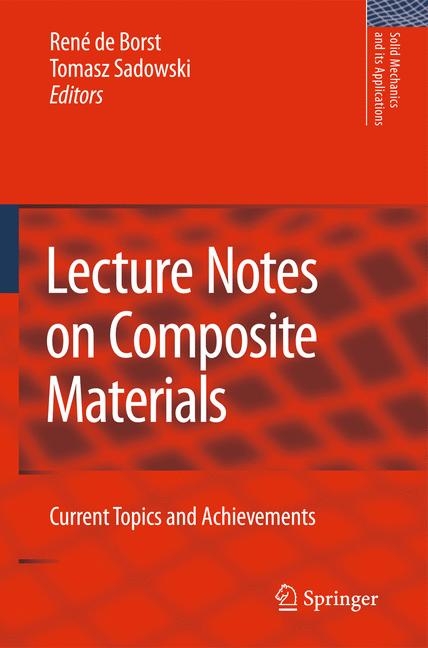
Lecture Notes on Composite Materials (eBook)
XII, 237 Seiten
Springer Netherland (Verlag)
978-1-4020-8772-1 (ISBN)

Composite materials are heterogeneous by nature, and are intended to be, since only the combination of different constituent materials can give them the desired combination of low weight, stiffness and strength. At present, the knowledge has advanced to a level that materials can be tailored to exhibit certain, required properties. At the same time, the fact that these materials are composed of various, sometimes very different constituents, make their mechanical behaviour complex. This observation holds with respect to the deformation behaviour, but especially with respect to the failure behaviour, where complicated and unconventional failure modes have been observed. It is a challenge to develop predictive methods that can capture this complex mechanical behaviour, either using analytical tools, or using numerical me- ods, the ?nite element method being the most widespread among the latter. In this respect, developments have gone fast over the past decade. Indeed, we have seen a paradigm shift in computational approaches to (composite) ma- rial behaviour. Where only a decade ago it was still customary to carry out analyses of deformation and failure at a macroscopic level of observation only - one may call this a phenomenological approach - nowadays this approach is being progressively replaced by multiscale methods. In such methods it is r- ognized a priori that the overall behaviour is highly dependent on local details and ?aws.
Holm Altenbach Analysis of Homogeneous and Non-homogeneous Plates 1 Classification of Structural Models 1.1 Introductional Remarks 1.2 Two-dimensional Structures—Definition, Applications, Some Basic References 1.3 Formulation Principles, Historical Remarks 2 Classical Plate Theories 2.1 Small Deflections 2.2 Large Deflections 2.3 Kirchhoff Plate 2.4 Mindlin Plate 2.5 Von Kármán Plate 3 Laminates and Sandwiches 4 Direct Approach Based Plate Theory 4.1 Motivation 4.2 Direct Approach for Plates and Shells 4.3 Tensors and Their Symmetry Groups 5 Final Remarks References René de Borst Numerical methods for the modelling of debonding in composites 1 Introduction 2 Levels of observation 3 Three-dimensional framework 4 Zero-thickness interface elements 5 Solid-like shell formulation 6 Meshfree methods 7 The partition-of-unity concept 8 Delamination in a solid-like shell element 9 Discontinuous Galerkin methods References Ryszard Pyrz Micromechanics of Composites —Overall Elastic Properties 1 Introduction 2 Representative Volume Element 3 The Eshelby Equivalent Inclusion Method 3.1 Average strain and stress theorems 3.2 Relation between averages 3.3 The Eshelby solution 3.4 Equivalent inclusion method 4 The Mori-Tanaka Theory References Tomasz Sadowski Non-symmetric thermal shock in ceramic matrix composite (CMC) materials 1. Introduction to ceramic and metal matrix composites 2. Thermomechanical properties of CMC’s and MMC’s 2.1 Two-phase CMC with different elastic components 2.2 Two-phase CMC’s with plastic inclusions and MMC’s with elastic inclusions 2.2.1Thermomechanical properties 2.2.2 Modelling of the whole stress-strain curve fro MMC 2.2.3 Constitutive equations for FGM’s in 3-D formulation by self-consistent approach 2.2.3 Constitutive equations for FGM’s in 3-D formulation by self-consistent approach 3. Temperature field under transient thermal loading 3.1 FEA approach for heat transfer equation (26) 3.2 FD approach for heat transfer equation (26) 4. Transient thermal stress state 5. Thermal residual stress due to technological cooling process 5.1 Analytical models 5.2 Numerical models 6. Basic fracture mechanics concepts in functionally graded materials (FGM) 6.1 Rule of mixture to estimate the fracture toughness in FGMs 6.2 Crack-bridging approach to assess the fracture toughness 7. Non-symmetric thermal shock in monolithic ceramic and FGM strip 7.1 Transient temperature distribution during thermal shock 7.2 Thermal and residual stresses 7.3 Thermal stress intensity factor 7.4 Numerical example 8. Two-dimensional thermal shock problem in layered circular plates 8.1 Samples preparation and experimental procedure 8.2 Theoretical formulation 8.2.1 Thermal and mechanical properties of monolithic and FGM material 8.2.2 Heat conduction problem in FGM circular plate specimens 8.2.3 Determination of the thermal stress 8.3 Numerical example 9. Concluding remarks 10. References René de Borst J. Rethore M.-A. Abellan A precis of two-scale approaches for fracture in porous media 1. Introduction 2. Balance equations 3. Constitutive equations 4. Weak form of the balance equations 5. Micro-macro coupling 6. Discontinuities in a two-phase medium 7. Examples: stationary and propagating cracks 8. Concluding
| Erscheint lt. Verlag | 11.12.2008 |
|---|---|
| Reihe/Serie | Solid Mechanics and Its Applications | Solid Mechanics and Its Applications |
| Zusatzinfo | XII, 237 p. |
| Verlagsort | Dordrecht |
| Sprache | englisch |
| Themenwelt | Technik ► Maschinenbau |
| Schlagworte | Ceramics • Composite material • composite materials • Energy • fracture mechanics • Material • Mechanics • Modeling |
| ISBN-10 | 1-4020-8772-1 / 1402087721 |
| ISBN-13 | 978-1-4020-8772-1 / 9781402087721 |
| Informationen gemäß Produktsicherheitsverordnung (GPSR) | |
| Haben Sie eine Frage zum Produkt? |
 PDF (Wasserzeichen)
DRM: Digitales Wasserzeichen
Dieses eBook enthält ein digitales Wasserzeichen und ist damit für Sie personalisiert. Bei einer missbräuchlichen Weitergabe des eBooks an Dritte ist eine Rückverfolgung an die Quelle möglich.
Dateiformat: PDF (Portable Document Format)
Mit einem festen Seitenlayout eignet sich die PDF besonders für Fachbücher mit Spalten, Tabellen und Abbildungen. Eine PDF kann auf fast allen Geräten angezeigt werden, ist aber für kleine Displays (Smartphone, eReader) nur eingeschränkt geeignet.
Systemvoraussetzungen:
PC/Mac: Mit einem PC oder Mac können Sie dieses eBook lesen. Sie benötigen dafür einen PDF-Viewer - z.B. den Adobe Reader oder Adobe Digital Editions.
eReader: Dieses eBook kann mit (fast) allen eBook-Readern gelesen werden. Mit dem amazon-Kindle ist es aber nicht kompatibel.
Smartphone/Tablet: Egal ob Apple oder Android, dieses eBook können Sie lesen. Sie benötigen dafür einen PDF-Viewer - z.B. die kostenlose Adobe Digital Editions-App.
Buying eBooks from abroad
For tax law reasons we can sell eBooks just within Germany and Switzerland. Regrettably we cannot fulfill eBook-orders from other countries.
aus dem Bereich