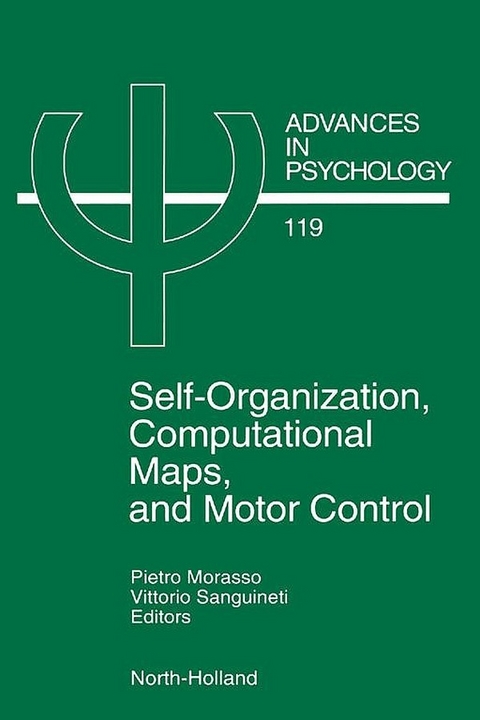
Self-Organization, Computational Maps, and Motor Control (eBook)
634 Seiten
Elsevier Science (Verlag)
9780080540917 (ISBN)
The book is divided into three parts, each characterized by a slightly different focus: in part I, the major theme concerns computational maps which typically model cortical areas, according to a view of the sensorimotor cortex as geometric engine and the site of internal models of external spaces. Part II also addresses problems of self-organization and field computing, but in a simpler computational architecture which, although lacking a specialized cortical machinery, can still behave in a very adaptive and surprising way by exploiting the interaction with the real world. Finally part III is focused on the motor control issues related to the physical properties of muscular actuators and the dynamic interactions with the world.
The reader will find different approaches on controversial issues, such as the role and nature of force fields, the need for internal representations, the nature of invariant commands, the vexing question about coordinate transformations, the distinction between hierachiacal and bi-directional modelling, and the influence of muscle stiffness.
In the study of the computational structure of biological/robotic sensorimotor systems, distributed models have gained center stage in recent years, with a range of issues including self-organization, non-linear dynamics, field computing etc. This multidisciplinary research area is addressed here by a multidisciplinary team of contributors, who provide a balanced set of articulated presentations which include reviews, computational models, simulation studies, psychophysical, and neurophysiological experiments.The book is divided into three parts, each characterized by a slightly different focus: in part I, the major theme concerns computational maps which typically model cortical areas, according to a view of the sensorimotor cortex as "e;geometric engine"e; and the site of "e;internal models"e; of external spaces. Part II also addresses problems of self-organization and field computing, but in a simpler computational architecture which, although lacking a specialized cortical machinery, can still behave in a very adaptive and surprising way by exploiting the interaction with the real world. Finally part III is focused on the motor control issues related to the physical properties of muscular actuators and the dynamic interactions with the world.The reader will find different approaches on controversial issues, such as the role and nature of force fields, the need for internal representations, the nature of invariant commands, the vexing question about coordinate transformations, the distinction between hierachiacal and bi-directional modelling, and the influence of muscle stiffness.
Front Cover 1
Self-Organization,Computational Maps,and Motor Comtrol 4
Copyright Page 5
TABLE OF CONTENTS 8
List of Contributors 10
Prolegomena 14
PART I 20
Chapter 1. Cortical Maps of Sensorimotor Spaces 20
Chapter 2. Field Computation in Motor Control 56
Chapter 3. A Probability Interpretation of Neural Population Coding for Movement 94
Chapter 4. Computational Models of Sensorimotor integration 136
Chapter 5. How Relevant are Subcortical Maps for the Cortical Machinery? An Hypothesis Based on Parametric Study of Extra-Relay Afferents to Primary Sensory Areas 168
PART II 188
Chapter 6. Artificial Force-Field Based Methods in Robotics 188
Chapter 7. Learning Newtonian Mechanics 210
Chapter 8. Motor Intelligence in a Simple Distributed Control System: Walking Machines and Stick Insects 258
Chapter 9. The Dynamic Neural Field Theory of Motor Programming: Arm and Eye Movements 290
Chapter 10. Network Models in Motor Control and Music 330
PART III 376
Chapter 11. Human Arm Impedance in Multi-Joint Movement 376
Chapter 12. Neural Models for Flexible Control of Redundant Systems 402
Chapter 13. Models of Motor Adaptation and Impedance Control in Human Arm Movements 442
Chapter 14. Control of Human Arm and Jaw Motion: Issues Related to Musculo-Skeletal Geometry 502
Chapter 15. Computational Maps and Target Fields for Reaching Movements 526
Chapter 16. From Cortical Maps to the Control of Muscles 566
Chapter 17. Learning to Speak: Speech Production and Sensori-motor representations 612
Author Index 636
Subject Index 650
Cortical Maps of Sensorimotor Spaces
Vittorio Sanguineti*; Pietro Morasso; Francesco Frisone Department of Informatics, Systems and Telecommunications University of Genova, Via Opera Pia 13, 16145 Genova (ITALY)
* F: +39 10 3532154 email address: sangui@dist.unige.it
Abstract
The chapter overviews a computational framework for characterizing the cortical representations and processes which underly the kinematic invariances of movements (the notion of spatial control), also taking into account the new understanding of the cortex as a continuously adapting dynamical system, shaped by competitive and cooperative lateral connections. We show how a coordinate-free representation of sensorimotor spaces can emerge from self-organized learning which builds a topological representing structure, thereby defining the concept of cortical map. This also implies a mixture of local and long-range lateral connections, consistent with known anatomical facts, thus allowing the representation of high-dimensional spaces in an apparently flat anatomy. The dynamics of cortical maps is analyzed taking into account the excitatory nature of the majority of cortical synapses and the puzzling presence of long-range competition without long-range inhibition. A model is proposed which combines a process of diffusion (via the excitatory topologically organized connections) and a process of competitive distribution of activation which tends to sharpen the active map region. The result is a propagating waveform attracted by a target-coding broad input pattern. This is the basis for a field-computing architecture of the interacting cortical processes which underly motor planning and control. We also address the the emergence of a representation of external 3-D space in a multimodal cortical map, possibly allocated in posterior parietal cortex.
1 Spatial control
Behavioral as well as electrophysiological data since the early 80’s (Morasso 1981, Abend et al. 1982, Georgopoulos et al. 1986) clearly suggest that the motor system plans and controls movements to a target using some kind of internal representation of the external space, according to a notion of spatial control of arm movements. However, the interpretation of such data is subtle and can lead to different and/or unwarranted conclusions: for example, one of the many false problems which have vexed the field for many years is the search of the “true” coordinate system in sensorimotor control.
The notion of spatial control, we must stress, in its generality and/or vagueness is not about coordinate systems but about the geometric characteristics of the internal representations which support the process of trajectory formation. Coordinate systems are mathematical abstractions or concise formalisms for describing geometric objects but the association between object and description is arbitrary: not only the same “object” can be described in a number of different ways but the class of descriptions which are based on coordinate systems does not exhaust the range of possibilities. We may label such class with the term lumped and its main merit is conciseness/parsimony, indeed a defining trait of the inventor - René Descartes. It is then possible to identify, by contrast, a class of distributed descriptions which are not concise and parsimonious but require a large (and redundant) number of descriptive elements. The merit of such descriptions, in general, has been discussed so much in the neural network community that we do not need to recall it here. Rather, we wish to focus on the fact that, as pointed out by Sanger (1994) extending previous observations by Mussa-Ivaldi (1988), for certain classes of distributed descriptions we obtain a coordinate-free representation.
1.1 Coordinate-free representations
Consider for example a (stimulus) point P in 3-D space. We may represent it by means of a triplet (x,y,z) of cartesian coordinates or another triplet (ρ, θ, ø) of spherical coordinates but also by means of a large array of variables {u1, u2, …} which are the activity levels of a family of filters or neurons, characterized by a set of response functions {f1(P), f2(P),…} tuned to different values of P. The array → is an acceptable representation of P if it is possible to go both ways in some “natural and easy” way: from P to → and from → to P. This goal can only be achieved for “suitable” filters and for a “well tuned” set of filter parameters, i.e. it is a matter both of design and learning. For this kind of distributed representation of P it is possible to use the term cortical map because, of biological cortical areas, it captures the smooth distribution of receptive field centers which almost universally characterizes the somatotopic organization of neocortex.
The characterization of a cortical map, the design of its structure, the learning process which tunes the parameters of the bank of filters, etc. is the object of following sections but when and if such tuning/training is achieved, we can say that → is a coordinate-free representation of P, neutral with respect to the external description of P, i.e. to the choice of a coordinate system.
From another point of view, the output of each filter can be considered as a coordinate in a vector space (the embedding space of the representation) with as many dimensions as the number n of neurons: →=u1u2…∈Rn. But if such space is meant to reflect the low-dimensional (e.g. three-dimensional) external object P, then → must be “constrained” to vary on a low-dimensional manifold in the embedding space, typically with the same number of dimensions of P: → ⊂ Rn. We suggest that the mechanism adopted by the brain for enforcing such “constraint” is based, in primis, on the structured pattern of lateral connections. Thus, the geometry of the cortical representation of a family of external objects P (say the set of visible and/or reachable points) can be characterized as a curved low-dimensional manifold in a high-dimensional embedding space of cortical activity patterns. The epistemological problem related to this kind of distributed geometric/computational organization is that it is not directly observable at the neuron level (say, by means of standard receptive field studies) and also imaging techniques like PET or fNMR can only give a very indirect and distorted “projection” of the structure.
The bi-directionality of the mapping between → and P is determined by the “design” and “training” of the cortical map, i.e. the phylogenetic/ ontogenetic adaptive processes which must assure that the internal computations make sense with respect to the real world. In the end, the ecological/evolutionary consistency check is performed by the effective recovery of behaviorally vital information from a sparse and apparently random set of multimodal measurements in a way which can be immediately exploited by an equally sparse and apparently chaotic set of actuators. In this sense, we think, it is appropriate to speak of “sensorimotor vectors”, without a clear distinction between the sensory and the motor components, which must co-vary in a coherent way during purposive behavior.
Let us consider the classic experimental data (Georgopoulos et al. 1986) on the directional tuning of neurons in the primary motor cortex (as well as other sensorimotor cortical areas) which support the concept of population coding of sensorimotor variables as a consequence of the observed broad tuning curve of individual filters. In summary, what is observed is a remarkable correlation between neural activity and movement direction (i.e. hand velocity vector ẋ); this is consistent with the suggested hypothesis that movement direction in the external space is the coded variable, but the same data must necessarily be consistent with other geometric entities expressed either in joint coordinates (˙) and/or muscle coordinates (˙), as a consequence of the kinematic structure of the arm1. Thus, instantaneous correlation alone between movement observables and neural activity is not enough to choose one hypothesis or the other. Such correlations can only capture a temporally local aspect whereas the notion of spatial control is intrinsically global. Among other global aspects we think that a relevant one is a criterion of computational parsimony, which can be articulated in a two-pronged argument:
• If we accept the directional tuning hypothesis in the external space, we stil have to pay a big “epistemological ticket” for an unknown but logically necessary neural...
| Erscheint lt. Verlag | 19.3.1997 |
|---|---|
| Sprache | englisch |
| Themenwelt | Geisteswissenschaften ► Psychologie ► Allgemeine Psychologie |
| Geisteswissenschaften ► Psychologie ► Biopsychologie / Neurowissenschaften | |
| Geisteswissenschaften ► Psychologie ► Verhaltenstherapie | |
| Informatik ► Theorie / Studium ► Künstliche Intelligenz / Robotik | |
| Naturwissenschaften | |
| Technik ► Umwelttechnik / Biotechnologie | |
| ISBN-13 | 9780080540917 / 9780080540917 |
| Informationen gemäß Produktsicherheitsverordnung (GPSR) | |
| Haben Sie eine Frage zum Produkt? |
 PDF (Adobe DRM)
Kopierschutz: Adobe-DRM
Adobe-DRM ist ein Kopierschutz, der das eBook vor Mißbrauch schützen soll. Dabei wird das eBook bereits beim Download auf Ihre persönliche Adobe-ID autorisiert. Lesen können Sie das eBook dann nur auf den Geräten, welche ebenfalls auf Ihre Adobe-ID registriert sind.
Details zum Adobe-DRM
Dateiformat: PDF (Portable Document Format)
Mit einem festen Seitenlayout eignet sich die PDF besonders für Fachbücher mit Spalten, Tabellen und Abbildungen. Eine PDF kann auf fast allen Geräten angezeigt werden, ist aber für kleine Displays (Smartphone, eReader) nur eingeschränkt geeignet.
Systemvoraussetzungen:
PC/Mac: Mit einem PC oder Mac können Sie dieses eBook lesen. Sie benötigen eine
eReader: Dieses eBook kann mit (fast) allen eBook-Readern gelesen werden. Mit dem amazon-Kindle ist es aber nicht kompatibel.
Smartphone/Tablet: Egal ob Apple oder Android, dieses eBook können Sie lesen. Sie benötigen eine
Geräteliste und zusätzliche Hinweise
Buying eBooks from abroad
For tax law reasons we can sell eBooks just within Germany and Switzerland. Regrettably we cannot fulfill eBook-orders from other countries.
aus dem Bereich