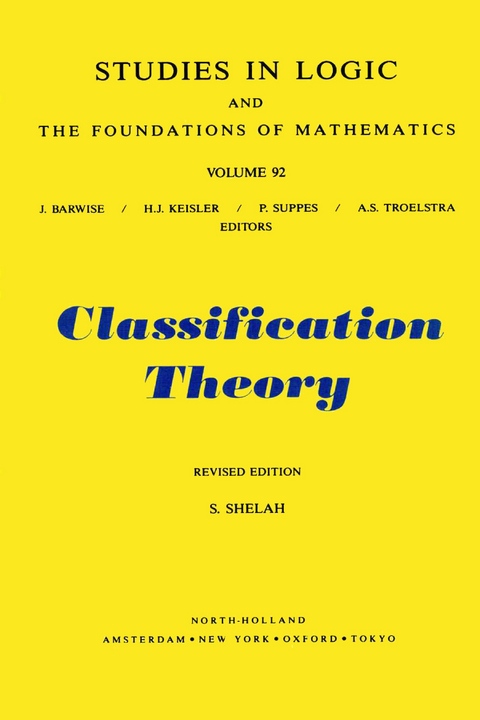
Classification Theory (eBook)
740 Seiten
Elsevier Science (Verlag)
9780080880242 (ISBN)
The additional chapters X - XIII present the solution to countable first order T of what the author sees as the main test of the theory. In Chapter X the Dimensional Order Property is introduced and it is shown to be a meaningful dividing line for superstable theories. In Chapter XI there is a proof of the decomposition theorems. Chapter XII is the crux of the matter: there is proof that the negation of the assumption used in Chapter XI implies that in models of T a relation can be defined which orders a large subset of m/M/. This theorem is also the subject of Chapter XIII.
In this research monograph, the author's work on classification and related topics are presented. This revised edition brings the book up to date with the addition of four new chapters as well as various corrections to the 1978 text.The additional chapters X - XIII present the solution to countable first order T of what the author sees as the main test of the theory. In Chapter X the Dimensional Order Property is introduced and it is shown to be a meaningful dividing line for superstable theories. In Chapter XI there is a proof of the decomposition theorems. Chapter XII is the crux of the matter: there is proof that the negation of the assumption used in Chapter XI implies that in models of T a relation can be defined which orders a large subset of m
Front Cover 1
Classification Theory and the Number of Non-Isomorphic Models 4
Copyright Page 5
Contents 6
Acknowledgements 10
Introduction 12
Introduction to the revised edition 16
Open problems 18
Added in proof 24
Notation 32
Chapter I. Preliminaries 36
0. Introduction 36
1. Preliminaries and saturation 36
2. Order, stability and indiscernibles 44
Chapter II. Ranks and Incomplete Types 53
0. Introduction 53
1. Ranks of types 56
2. Stability, ranks and definability 64
3. Ranks, degrees and superstability 76
4. The f.c.p., the independence property and the strict order property 97
Chapter III. Global Theory 117
0. Introduction 117
1. Forking 119
2. The finite equivalence relation theorem 129
3. The instability spectrum 136
4. Further properties of forking 143
5. The fist stability cardinal 157
6. Imaginary elements 165
7. Instability 172
Chapter IV. Prime Models 185
0. Introduction 185
1. The set of axioms 187
2. Examples of F's 192
3. General properties of F-primary models 209
4. Prime models for stable theories 218
5. Various results 239
Chapter V. More on Types and Saturated Models 258
0. Introduction 258
1. Orthogonality, regularity and minimality of types 265
2. Dimensions and orders between indiscernible sets 275
3. Weighted dimensions and superstability 284
4. Semi-regular and semi-minimal types 302
5. Multi-dimensional theories 319
6. Cardinality-quantifiers and two-cardinal theorems 324
7. Ranks revisited 340
Chapter VI. Saturation of Ultraproducts 356
0. Introduction 356
1. Reduced products and regular filters 359
2. Good filters and compactness of reduced products 368
3. Constructing ultrafilters 380
4. Keisler's order 405
5. Saturation of ultrapowers and categoricity of pseudoelementary classes 414
6. Saturation of ultralimits 425
Chapter VII. Construction of Models 432
0. Introduction 432
1. Skolem functions and generalizations of saturativity 435
2. Generalized Ehrenfeucht-Mostowski models 446
3. On the f.c.p., uniform trees and |D(T)| > |T| = Xo
4. Semi-definability 461
5. Hanf numbers of omitting types 467
Chapter VIII. The Number of Non-Isomorphic Models in Pseudo-Elementary 475
0. Introduction 475
1. Independence of types 479
2. Unsupmtable theories 490
3. Saturated models and the case . = |T1| 499
4. Categoricity, saturation and homogeneity up to a cardinality 506
Chapter IX. Categoricity and the Number of Models in Elementary Classes 514
0. Introduction 514
1. Supratable theories and categoricity 516
2. On the lower parts of the spectrum 532
Chapter X. Classification for Faxo-Saturated Models 543
0. Introduction 543
1. Preliminaries 544
2. The dimensional order property 547
3. The decomposition lemma 555
4. Deepness 562
5. Deep theories have many non-isomorphic models 568
6. Infinite depth 583
7. Trivial types 585
Chapter XI. The Decomposition Theorem 592
0. Introduction 592
1. Stationarization 592
2. The axiomatic treatment 596
3. Specifying the axiomatic treatment 607
Chapter XII. The Main Gap for Countable Theories 625
0. Introduction 625
1. On Fk. and Ff. 626
2. Stable systems 633
3. On good sets 638
4. The otop/existence dichotomy 643
5. From the (X0, 2)-existence property to the (., 2)-existence property 651
6. The book's main theorem 655
Chapter XIII. For Thomas the Doubter 657
0. Introduction 657
1. Can the models be characterized by invariants ? 658
2. On having many models, no one elementarily embeddable into another 662
3. On the Morley conjecture 669
4. I(Xa, T) for a large enough 678
Appendix 688
0. Introduction 688
1. Filters, stationary sets and families of sets 688
2. Partition theorems 694
3. Various results 701
Historical remarks 708
References 719
Index of definitions and abbreviations 726
Index of symbols 738
| Erscheint lt. Verlag | 6.12.1990 |
|---|---|
| Sprache | englisch |
| Themenwelt | Mathematik / Informatik ► Informatik ► Theorie / Studium |
| Mathematik / Informatik ► Mathematik ► Allgemeines / Lexika | |
| Mathematik / Informatik ► Mathematik ► Logik / Mengenlehre | |
| Technik | |
| ISBN-13 | 9780080880242 / 9780080880242 |
| Informationen gemäß Produktsicherheitsverordnung (GPSR) | |
| Haben Sie eine Frage zum Produkt? |
 PDF (Adobe DRM)
Kopierschutz: Adobe-DRM
Adobe-DRM ist ein Kopierschutz, der das eBook vor Mißbrauch schützen soll. Dabei wird das eBook bereits beim Download auf Ihre persönliche Adobe-ID autorisiert. Lesen können Sie das eBook dann nur auf den Geräten, welche ebenfalls auf Ihre Adobe-ID registriert sind.
Details zum Adobe-DRM
Dateiformat: PDF (Portable Document Format)
Mit einem festen Seitenlayout eignet sich die PDF besonders für Fachbücher mit Spalten, Tabellen und Abbildungen. Eine PDF kann auf fast allen Geräten angezeigt werden, ist aber für kleine Displays (Smartphone, eReader) nur eingeschränkt geeignet.
Systemvoraussetzungen:
PC/Mac: Mit einem PC oder Mac können Sie dieses eBook lesen. Sie benötigen eine
eReader: Dieses eBook kann mit (fast) allen eBook-Readern gelesen werden. Mit dem amazon-Kindle ist es aber nicht kompatibel.
Smartphone/Tablet: Egal ob Apple oder Android, dieses eBook können Sie lesen. Sie benötigen eine
Geräteliste und zusätzliche Hinweise
Buying eBooks from abroad
For tax law reasons we can sell eBooks just within Germany and Switzerland. Regrettably we cannot fulfill eBook-orders from other countries.
aus dem Bereich