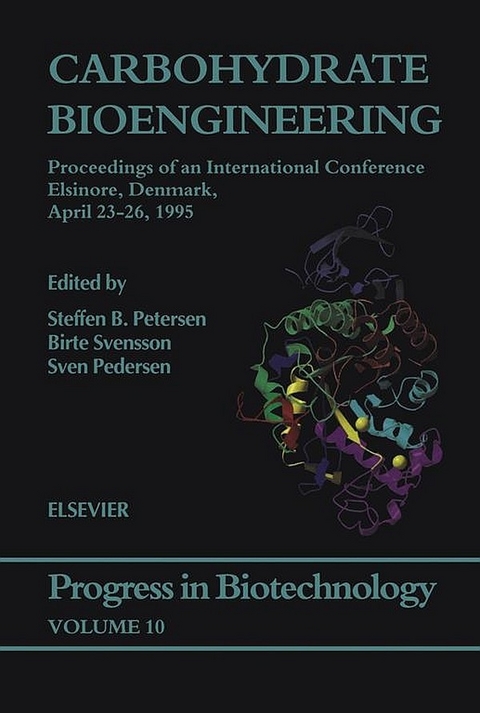
Carbohydrate Bioengineering (eBook)
376 Seiten
Elsevier Science (Verlag)
978-0-08-052851-9 (ISBN)
The first chapters address glycoconjugates as modulatory and recognition molecules, structure determination using NMR and mass spectrometry, and microdialysis-chip enzyme-based sensors. Active site mutations coupled with crystal structures and synthetic substrate analogue interactions as well as new three-dimensional structures and binding domains for biotechnological applications are included in the chapters. Carbohydrate active enzymes turned out to be a predominant topic.
The rapid development in glycobiology and glycotechnology has resulted in an enormous increase in our knowledge on the structure conversion, and application of carbohydrates in industry and medicine.
The Carbohydrate Bioengineering Meeting held in Elsinore, Denmark, April 23-26, 1995, gathered 230 scientists, mostly from Europe, with interest in carbohydrate analysis and structure; carbohydrates in medicine and glycopathology; structure, function, application, and protein engineering of carbohydrate active enzymes; oligo- and polysaccharides of industrial interest; and production of carbohydrate containing new materials.The first chapters address glycoconjugates as modulatory and recognition molecules, structure determination using NMR and mass spectrometry, and microdialysis-chip enzyme-based sensors. Active site mutations coupled with crystal structures and synthetic substrate analogue interactions as well as new three-dimensional structures and binding domains for biotechnological applications are included in the chapters. Carbohydrate active enzymes turned out to be a predominant topic.The rapid development in glycobiology and glycotechnology has resulted in an enormous increase in our knowledge on the structure conversion, and application of carbohydrates in industry and medicine.
Cover 1
Table of Contents 12
Chapter 1. Glycans of glycoconjugates as modulatory and recognition molecules 16
Chapter 2. NMR studies of the structure and dynamics of carbohydrates in aqueous solution 30
Chapter 3. Linkage analysis by mass spectrometry of chemically modified oligo-saccharides from glycosphingolipids and glycoproteins 44
Chapter 4. Development of a novel enzyme based glucose sensor 64
Chapter 5. Carbohydrate binding at the active site of Escherichia coli maltodextrin phosphorylase 74
Chapter 6. The chitinolytic system of Streptomyces olivaceoviridis 86
Chapter 7. Properties and production of the ß-glycosidase from the thermophilic Archaeon Sulfolobus solfataricus expressed in mesophilic hosts 92
Chapter 8. Contribution of subsites to catalysis and specificity in the extended binding cleft of Bacillus 1,3-1,4-ß-D-glucan 4-glucanohydrolases 100
Chapter 9. Probing of glycosidase active sites through labeling, mutagenesis and kinetic studies 112
Chapter 10. Thiooligosaccharides: toys or tools for the studies of glycanases 128
Chapter 11. Mutational analysis of catalytic mechanism and specificity in amylolytic enzymes 140
Chapter 12. The structure and function relationship of Schizophyllum commune xylanase A 162
Chapter 13. Protein engineering of cyclodextrin glycosyltransferase from Bacillus circulans strain 251 180
Chapter 14. Oxidation stable amylases for detergents 190
Chapter 15. Electrostatic studies of carbohydrate active enzymes 196
Chapter 16. Effects of glycosylation on protein folding, stability and solubility. Studies of chemically modified or engineered plant and fungal peroxidases 220
Chapter 17. Modes of action of two Trichoderma reesei cellobiohydrolases 226
Chapter 18. Structural studies on fungal endoglucanases from Humicola insolens 240
Chapter 19. The catalytic domain of endoglucanase A from Clostridium cellulolyticum belonging to family 5: a/ß-barrel enzyme 254
Chapter 20. Celluosome domains for novel biotechnological application 266
Chapter 21. Interactions of cellulases from Cellulomonas fimi with cellulose 276
Chapter 22. Transgenic plants as a tool to understand starch biosynthesis 286
Chapter 23. Targeted expression of microbial cellulases in transgenic animals 294
Chapter 24. Mechanism and action of glucansucrases 310
Chapter 25. Studies of recombinant amylosucrase 328
Chapter 26. Application of cloned monocomponent carbohydrases for modification of plant materials 336
Chapter 27. Fatty acid esters of ethyl glucoside, a unique class of surfactants 358
Chapter 28. A wide range of carbohydrate modifications by a single microorganism: leuconostoc mesenteroides 366
Index 374
NMR studies of the structure and dynamics of carbohydrates in aqueous solution
Herman van Halbeek; Shuqun Sheng Complex Carbohydrate Research Center and Departments of Chemistry and Biochemistry, The University of Georgia, 220 Riverbend Road, Athens, Georgia 30602-4712, USA
Abstract
Notable recent developments in NMR methodology for studying carbohydrate structure and dynamics include the increased information gained from the observation of hydroxyl proton signals in supercooled water as well as improved measurements of long-range heteronuclear scalar couplings and 13C relaxation rates. This chapter presents an example of recent progress in each of those categories. (1) A 2-D homonuclear rotating-frame exchange experiment is proposed as a suitable means under supercooled aqueous conditions to detect transient intramolecular hydrogen bonds in the flexible disaccharide sucrose. (2) A modified 2-D 1H-detected heteronuclear multiple-quantum experiment is introduced for speedy and accurate measurement of nJCH (n ≥ 2); the application of the so-called HSMBC experiment is illustrated for sialyllactose. (3) The quantitative aspects of the dynamics of the hexasaccharide headgroup of ganglioside GD1a embedded in a perdeuterated mixed micelle in aqueous solution are assessed by 1H-detected natural-abundance 13C T1ρ measurements; the data are interpreted according to the Lipari-Szabo model-free approach which reveals relatively fast internal motions in the outer region of the hexasaccharide.
1 INTRODUCTION
A detailed NMR analysis of the solution conformations and dynamics of a carbohydrate encompasses the following steps:
• complete assignment of 1H and 13C NMR spectra of the carbohydrate;
• establishment of spatial (distance and/or torsion angle) constraints between atoms from dipolar and scalar correlation NMR measurements;
• measurement of 1H and 13C relaxation parameters (that is, T1, T2, T1ρ, homo- and heteronuclear cross-relaxation rates).
Despite the efforts typically involved in conducting the pertinent NMR experiments [1, 2], the experimentally measurable constraints may fall short in determining the complete conformation and dynamic behavior of an oligosaccharide. Evaluation of the experimental data with computational strategies is then a necessity, typically by using potential energy calculations and molecular dynamics (MD) simulations [3-5]. However, in favorable cases, the NMR study yields a sufficiently large number of constraints to broadly define the conformation of the oligosaccharide in aqueous solution. Often one finds that not all the obtained NMR constraints are compatible with the existence of a single rigid structure, implying that the oligosaccharide is dynamic with respect to torsional vibrations around each glycosidic bond. The past few years have witnessed a vast increase in the number of efforts aimed at the measurement of NMR parameters directly related to the flexibility of carbohydrates, including 1H and 13C T1 and T1ρ, homo- and heteronuclear cross-relaxation rates, and global and local correlation times (reviewed in [6]). It is gradually becoming clear that very few oligosaccharides adopt a single, fully constrained ("rigid") conformation. The ability of most carbohydrates to present one covalent structure to their environment in many different ways may very well contribute to their versatility in biological functions. NMR spectroscopy not only helps to narrow the conformational space accessible to a flexible oligosaccharide, it also can provide information about the relative populations of and the rate of interconversion between different energetically favored conformers. We will discuss below three examples of this role for NMR in carbohydrate conformational analysis, namely, to aid in restricting the theoretically possible ensemble of conformations for a given oligosaccharide. We present a couple of recently developed NMR methods that provide either additional (hydrogen bond) or more accurately determined (3JCH) parameters to restrain the oligosaccharide structure in question. Also, a quantitative evaluation of 13C relaxation data is presented for a glycolipid system mimicking physiologic cell-surface conditions.
2 HYDROGEN BONDING
Hydroxyl proton resonances in aqueous solutions of sugars were first observed over 15 years ago [7], but the value of these protons in the conformational analysis of carbohydrates has been demonstrated only recently [8-11]. Hydroxyl resonances have the potential to provide a wealth of structural information in the form of chemical shifts, 3JH-C-OH couplings, nuclear Overhauser effects (NOEs), and exchange rates. However, this information is accessible only if the intermolecular exchange of OH protons with solvent H2O can be slowed sufficiently. At room temperature, hydroxyl protons in aqueous solutions of carbohydrates engage in chemical exchange with water, the rate of which is very fast on the NMR time scale. Researchers at first applied mixed solvents (water/acetone and water/methanol) to study OH groups at low temperatures (– 5 to – 10 °C) (see, e.g., [9]). More recently, 1H NMR studies have been reported of hydroxyl groups in dilute solutions of mono-and disaccharides in pure H2O under supercooled (– 15 to – 20 °C) conditions [10]. The chemical exchange rates under these conditions are reduced to such an extent that signals can be observed for each hydroxyl site; thus, all hydroxyl proton resonances can be assigned on the basis of (scalar or dipolar) connectivities to non-labile aliphatic protons. The line widths, temperature shift coefficients, and coupling constants of OH protons are valuable hydration and hydrogen-bonding probes in NMR studies [11]. Also, H/D isotope effects of hydroxyl protons/deuterons on 13C resonances can be used to obtain indirect evidence of the involvement of OH groups in intra- or interresidue hydrogen bonds [12]. Furthermore, protruding farther from the glycosyl ring systems than most CH protons, OH protons may serve as long-range sensor conformational probes which can be interrogated by NOESY and ROESY experiments on the carbohydrate in aqueous solution [8, 9]. In order to use OH protons as conformational probes for oligosaccharides, special NMR techniques for water suppression must be utilized [13-16]. We report below on the study of intramolecular hydrogen bonds in the disaccharide sucrose in aqueous solution.
The three-dimensional structure of sucrose [Fruf-β(2↔l)α-Glup] (Fig. 1), particularly the conformation of its glycosidic linkage, has been the subject of numerous investigations. Data obtained by NMR analyses and MD simulations on sucrose in solution have led to uncertainties concerning the degree of rigidity of the linkage conformation in solution [17-21], raising the question whether it is the same as in the crystal structure [22]. Careful 13C T1 measurements for sucrose revealed very fast and small-amplitude torsional and vibrational motions at different sucrose ring positions [23, 24] and mobilities of the exocyclic groups different from the ring skeletons [25]; however, on the basis of this type of measurements the glycosidic linkage was judged to be rigid and similar in conformation to that observed in the crystalline state. In 1992, inspired by the work of Pérez c.s. [20], we reinvestigated the solution conformation of sucrose applying new NMR methods to reveal 1H/1H NOE contacts explicitly including OH protons [26]. The results of our quantitative NOE measurements are compiled in Table 1. Interestingly, all NOE connectivities found for sucrose in water solution can be explained in terms of a single conformation, which is virtually identical to the crystal structure. However, based on a quantitative analysis of the magnetic field strength dependence of 1H/1H NOE data, we questioned [26] the rigidity in solution of the sucrose glycosidic bond. The NOEs between protons on different rings proved to be magnetic field strength-dependent, while this did not seem to be the case for NOEs between protons within the glucopyranose ring. We interpreted this observation as evidence of rearrangements occurring around the glycosidic bond between the glucosyl and fructosyl residue that take place much more quickly than the tumbling rate of the molecule in solution. This type of internal motion is transparent to relaxation parameters (including 13C T1) if it occurs on the same time scale as overall molecular tumbling; this seems to be the case for sucrose at ambient temperature. Thus, we demonstrated that sucrose in solution more than likely experiences fast internal motion around its glycosidic bond.
| Erscheint lt. Verlag | 8.12.1995 |
|---|---|
| Sprache | englisch |
| Themenwelt | Naturwissenschaften ► Biologie ► Biochemie |
| Naturwissenschaften ► Chemie ► Organische Chemie | |
| Technik ► Umwelttechnik / Biotechnologie | |
| ISBN-10 | 0-08-052851-1 / 0080528511 |
| ISBN-13 | 978-0-08-052851-9 / 9780080528519 |
| Informationen gemäß Produktsicherheitsverordnung (GPSR) | |
| Haben Sie eine Frage zum Produkt? |
 PDF (Adobe DRM)
Kopierschutz: Adobe-DRM
Adobe-DRM ist ein Kopierschutz, der das eBook vor Mißbrauch schützen soll. Dabei wird das eBook bereits beim Download auf Ihre persönliche Adobe-ID autorisiert. Lesen können Sie das eBook dann nur auf den Geräten, welche ebenfalls auf Ihre Adobe-ID registriert sind.
Details zum Adobe-DRM
Dateiformat: PDF (Portable Document Format)
Mit einem festen Seitenlayout eignet sich die PDF besonders für Fachbücher mit Spalten, Tabellen und Abbildungen. Eine PDF kann auf fast allen Geräten angezeigt werden, ist aber für kleine Displays (Smartphone, eReader) nur eingeschränkt geeignet.
Systemvoraussetzungen:
PC/Mac: Mit einem PC oder Mac können Sie dieses eBook lesen. Sie benötigen eine
eReader: Dieses eBook kann mit (fast) allen eBook-Readern gelesen werden. Mit dem amazon-Kindle ist es aber nicht kompatibel.
Smartphone/Tablet: Egal ob Apple oder Android, dieses eBook können Sie lesen. Sie benötigen eine
Geräteliste und zusätzliche Hinweise
Buying eBooks from abroad
For tax law reasons we can sell eBooks just within Germany and Switzerland. Regrettably we cannot fulfill eBook-orders from other countries.
aus dem Bereich