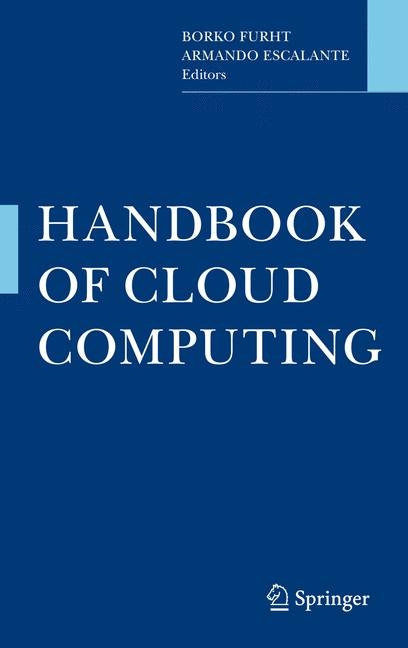
Handbook of Cloud Computing (eBook)
XIX, 634 Seiten
Springer US (Verlag)
9781441965240 (ISBN)
Cloud computing has become a significant technology trend. Experts believe cloud computing is currently reshaping information technology and the IT marketplace. The advantages of using cloud computing include cost savings, speed to market, access to greater computing resources, high availability, and scalability.
Handbook of Cloud Computing includes contributions from world experts in the field of cloud computing from academia, research laboratories and private industry. This book presents the systems, tools, and services of the leading providers of cloud computing; including Google, Yahoo, Amazon, IBM, and Microsoft. The basic concepts of cloud computing and cloud computing applications are also introduced. Current and future technologies applied in cloud computing are also discussed. Case studies, examples, and exercises are provided throughout.
Handbook of Cloud Computing is intended for advanced-level students and researchers in computer science and electrical engineering as a reference book. This handbook is also beneficial to computer and system infrastructure designers, developers, business managers, entrepreneurs and investors within the cloud computing related industry.
Borko Furht is a professor and chairman of the Department of Computer & Electrical Engineering and Computer Science at Florida Atlantic University (FAU) in Boca Raton, Florida. Professor Furht received his Ph.D. in electrical and computer engineering from the University of Belgrade. His current research is in multimedia systems, video coding and compression, 3D video and image systems, video databases, wireless multimedia, and Internet computing. He is a founder and editor-in-chief of the Journal of Multimedia Tools and Applications (Springer). He has received several technical and publishing awards, and has consulted for many high-tech companies including IBM, Hewlett-Packard, Xerox, General Electric, JPL, NASA, Honeywell, and RCA, and has been an expert witness for Cisco and Qualcomm. He has given many invited talks, keynote lectures, seminars, and tutorials, and served on the Board of Directors of several high-tech companies.
Armando J. Escalante is SVP & Chief Technology Officer of Risk Solutions for the LexisNexis Group, a division of Reed Elsevier. In this position, Escalante is responsible for technology development, information systems and operations. Previously, Escalante was Chief Operating Officer for Seisint, a privately owned, Boca based company, which was purchased by LexisNexis in 2004. In this position, he was responsible for Technology, Development and Operations. Prior to 2001, Escalante served as Vice President of Engineering and Operations for Diveo Broadband Networks where he led world class Data Centers located in the U.S. and Latin America. Before Diveo Broadband Networks, Escalante was VP for one of the fastest growing divisions of Vignette Corporation, an eBusiness software leader. Escalante earned his bachelor's degree in electronic engineering at the USB in Caracas, Venezuela and a master's degree in computer science from Steven Institute of Technology as well as a master's in business administration from West Coast University.
Cloud computing has become a significant technology trend. Experts believe cloud computing is currently reshaping information technology and the IT marketplace. The advantages of using cloud computing include cost savings, speed to market, access to greater computing resources, high availability, and scalability. Handbook of Cloud Computing includes contributions from world experts in the field of cloud computing from academia, research laboratories and private industry. This book presents the systems, tools, and services of the leading providers of cloud computing; including Google, Yahoo, Amazon, IBM, and Microsoft. The basic concepts of cloud computing and cloud computing applications are also introduced. Current and future technologies applied in cloud computing are also discussed. Case studies, examples, and exercises are provided throughout. Handbook of Cloud Computing is intended for advanced-level students and researchers in computer science and electrical engineering as a reference book. This handbook is also beneficial to computer and system infrastructure designers, developers, business managers, entrepreneurs and investors within the cloud computing related industry.
Borko Furht is a professor and chairman of the Department of Computer & Electrical Engineering and Computer Science at Florida Atlantic University (FAU) in Boca Raton, Florida. Professor Furht received his Ph.D. in electrical and computer engineering from the University of Belgrade. His current research is in multimedia systems, video coding and compression, 3D video and image systems, video databases, wireless multimedia, and Internet computing. He is a founder and editor-in-chief of the Journal of Multimedia Tools and Applications (Springer). He has received several technical and publishing awards, and has consulted for many high-tech companies including IBM, Hewlett-Packard, Xerox, General Electric, JPL, NASA, Honeywell, and RCA, and has been an expert witness for Cisco and Qualcomm. He has given many invited talks, keynote lectures, seminars, and tutorials, and served on the Board of Directors of several high-tech companies.Armando J. Escalante is SVP & Chief Technology Officer of Risk Solutions for the LexisNexis Group, a division of Reed Elsevier. In this position, Escalante is responsible for technology development, information systems and operations. Previously, Escalante was Chief Operating Officer for Seisint, a privately owned, Boca based company, which was purchased by LexisNexis in 2004. In this position, he was responsible for Technology, Development and Operations. Prior to 2001, Escalante served as Vice President of Engineering and Operations for Diveo Broadband Networks where he led world class Data Centers located in the U.S. and Latin America. Before Diveo Broadband Networks, Escalante was VP for one of the fastest growing divisions of Vignette Corporation, an eBusiness software leader. Escalante earned his bachelor’s degree in electronic engineering at the USB in Caracas, Venezuela and a master’s degree in computer science from Steven Institute of Technology as well as a master’s in business administration from West Coast University.
Preface 4
Contents 6
Contributors 9
About the Editors 14
Part I Technologies and Systems 17
1 Cloud Computing Fundamentals 18
1.1 Introduction 18
1.1.1 Layers of Cloud Computing 19
1.1.2 Types of Cloud Computing 22
1.1.3 Cloud Computing Versus Cloud Services 23
1.2 Enabling Technologies 24
1.2.1 Virtualization 24
1.2.2 Web Service and Service Oriented Architecture 25
1.2.3 Service Flow and Workflows 25
1.2.4 Web 2.0 and Mashup 25
1.3 Cloud Computing Features 26
1.3.1 Cloud Computing Standards 26
1.3.2 Cloud Computing Security 27
1.4 Cloud Computing Platforms 28
1.4.1 Pricing 28
1.4.2 Cloud Computing Components and Their Vendors 30
1.5 Example of Web Application Deployment 31
1.6 Cloud Computing Challenges 32
1.6.1 Performance 32
1.6.2 Security and Privacy 32
1.6.3 Control 33
1.6.4 Bandwidth Costs 33
1.6.5 Reliability 33
1.7 Cloud Computing in the Future 33
References 34
2 Cloud Computing Technologies and Applications 35
2.1 Cloud Computing: IT as a Service 35
2.2 Cloud Computing Security 38
2.3 Cloud Computing Model Application Methodology 39
2.3.1 Cloud Computing Strategy Planning Phase 39
2.3.2 Cloud Computing Tactics Planning Phase 41
2.3.3 Cloud Computing Deployment Phase 41
2.4 Cloud Computing in Development/Test 42
2.5 Cloud-Based High Performance Computing Clusters 44
2.6 Use Cases of Cloud Computing 46
2.6.1 Case Study: Cloud as Infrastructure for an Internet Data Center (IDC) 46
2.6.1.1 The Bottleneck on IDC Development 47
2.6.1.2 Cloud Computing Provides IDC with a New Infrastructure Solution 48
2.6.1.3 The Value of Cloud Computing for IDC Service Providers 48
2.6.1.4 The Value Brought by Cloud Computing for IDC Users 49
2.6.1.5 Cloud Computing Can Make Fixed Costs Variable 50
2.6.1.6 An IDC Cloud Example 51
2.6.1.7 The Influence of Cloud Computing in 3G Era 51
2.6.2 Case Study -- Cloud Computing for Software Parks 52
2.6.2.1 Cloud Computing Architecture 55
2.6.2.2 Outsourcing Software Research and Development Platform 55
2.6.3 Case Study -- an Enterprise with Multiple Data Centers 56
2.6.3.1 Overall Design of the Cloud Computing Platform in an Enterprise 57
2.6.4 Case Study: Cloud Computing Supporting SaaS 59
2.7 Conclusion 59
3 Key Enabling Technologies for Virtual Private Clouds 60
3.1 Introduction 60
3.2 Virtual Private Clouds 62
3.3 Virtual Data Centers and Applications 64
3.3.1 Virtual Data Centers 64
3.3.2 Virtual Applications 67
3.4 Policy-Based Management 68
3.4.1 Policy-Based Deployment 69
3.4.2 Policy Compliance 71
3.5 Service-Management Integration 73
3.6 Conclusions 75
References 76
4 The Role of Networks in Cloud Computing 77
4.1 Introduction 77
4.2 Cloud Deployment Models and the Network 78
4.2.1 Public Cloud 79
4.2.2 Private Cloud 79
4.2.3 Hybrid Cloud 80
4.2.4 An Overview of Network Architectures for Clouds 81
4.2.4.1 Data Center Network 81
4.2.4.2 Data Center Interconnect Network 84
4.3 Unique Opportunities and Requirements for Hybrid Cloud Networking 85
4.3.1 Virtualization, Automation and Standards -- The Foundation 86
4.3.2 Latency, Bandwidth, and Scale -- The Span 87
4.3.3 Security, Resiliency, and Service Management -- The Superstructure 88
4.4 Network Architecture for Hybrid Cloud Deployments 89
4.4.1 Cloud-in-a-Box 90
4.4.2 Network Service Node 91
4.4.3 Data Center Network and Data Center Interconnect Network 92
4.4.4 Management of the Network Architecture 92
4.5 Conclusions and Future Directions 93
References 93
5 Data-Intensive Technologies for Cloud Computing 95
5.1 Introduction 95
5.1.1 Data-Intensive Computing Applications 96
5.1.2 Data-Parallelism 97
5.1.3 The ''Data Gap'' 98
5.2 Characteristics of Data-Intensive Computing Systems 98
5.2.1 Processing Approach 99
5.2.2 Common Characteristics 100
5.2.3 Grid Computing 101
5.2.4 Applicability to Cloud Computing 102
5.3 Data-Intensive System Architectures 103
5.3.1 Google MapReduce 104
5.3.2 Hadoop 107
5.3.3 LexisNexis HPCC 112
5.3.4 ECL 117
5.4 Hadoop vs. HPCC Comparison 121
5.4.1 Terabyte Sort Benchmark 121
5.4.2 Pig vs. ECL 123
5.4.3 Architecture Comparison 137
5.5 Conclusions 138
References 146
6 Survey of Storage and Fault Tolerance Strategies Used in Cloud Computing 149
6.1 Introduction 149
6.1.1 Theme 1: Voluminous Data 149
6.1.2 Theme 2: Commodity Hardware 150
6.1.3 Theme 3: Distributed Data 150
6.1.4 Theme 4: Expect Failures 150
6.1.5 Theme 5: Tune for Access by Applications 150
6.1.6 Theme 6: Optimize for Dominant Usage 151
6.1.7 Theme 7: Tradeoff Between Consistency and Availability 151
6.2 xFS 152
6.2.1 Failure Model 152
6.2.2 Replication 152
6.2.3 Data Access 152
6.2.4 Integrity 153
6.2.5 Consistency and Guarantees 153
6.2.6 Metadata 154
6.2.7 Data placement 154
6.2.8 Security 154
6.3 Amazon S3 154
6.3.1 Data Access and Management 154
6.3.2 Security 155
6.3.3 Integrity 155
6.4 Dynamo 155
6.4.1 Checkpointing 156
6.4.2 Replication 156
6.4.3 Failures 157
6.4.4 Accessing Data 157
6.4.5 Data Integrity 157
6.4.6 Consistency and Guarantees 158
6.4.7 Metadata 158
6.4.8 Data Placement 158
6.4.9 Security 159
6.5 Google File System 159
6.5.1 Checkpointing 159
6.5.2 Replication 160
6.5.3 Failures 160
6.5.4 Data Access 160
6.5.5 Data Integrity 161
6.5.6 Consistency and Guarantees 161
6.5.7 Metadata 161
6.5.8 Data Placement 161
6.5.9 Security Scheme 162
6.6 Bigtable 162
6.6.1 Replication 163
6.6.2 Failures 163
6.6.3 Accessing Data 164
6.6.4 Data Integrity 164
6.6.5 Consistency and Guarantees 164
6.6.6 Metadata 165
6.6.7 Data Placement 165
6.6.8 Security 165
6.7 Microsoft Azure 165
6.7.1 Replication 166
6.7.2 Failure 166
6.7.3 Accessing Data 167
6.7.4 Consistency and Guarantees 167
6.7.5 Data Placement 167
6.7.6 Security 167
6.8 Transactional and Analytics Debate 168
6.9 Conclusions 168
References 169
7 Scheduling Service Oriented Workflows Inside Clouds Using an Adaptive Agent Based Approach 171
7.1 Introduction 171
7.2 Related Work on DS Scheduling 173
7.3 Scheduling Issues Inside Service Oriented Environments 175
7.3.1 Estimating Task Runtimes and Transfer Costs 175
7.3.2 Service Discovery and Selection 177
7.3.3 Negotiation Between Service Providers 177
7.3.4 Overcoming the Internal Resource Scheduler 178
7.3.5 Trust in Multi-cloud Environments 179
7.4 Workflow Scheduling 180
7.5 Distributed Agent Based Scheduling Platform Inside Clouds 181
7.5.1 The Scheduling Platform 182
7.5.2 Scheduling Through Negotiation 186
7.5.3 Prototype Implementation Details 190
7.6 Conclusions 191
References 192
8 The Role of Grid Computing Technologies in Cloud Computing 195
8.1 Introduction 195
8.2 Basics of Grid and Cloud Computing 197
8.2.1 Basics of Grid Computing 197
8.2.2 Basics of Cloud Computing 197
8.2.3 Interaction Models of Grid and Cloud Computing 198
8.2.4 Distributed Computing in the Grid and Cloud 200
8.3 Layered Models and Usage patterns in Grid and Cloud 200
8.3.1 Infrastructure 201
8.3.2 Platform 203
8.3.2.1 Abstraction from Physical Resources 203
8.3.2.2 Programming API to Support New Services 203
8.3.3 Applications 205
8.4 Techniques 205
8.4.1 Service Orientation and Web Services 206
8.4.2 Data Management 207
8.4.3 Monitoring 209
8.4.4 Autonomic Computing 213
8.4.5 Scheduling, Metascheduling, and Resource Provisioning 214
8.4.6 Interoperability in Grids and Clouds 216
8.4.7 Security and User Management 219
8.4.8 Modeling and Simulation of Clouds and Grids 222
8.5 Concluding Remarks 223
References 225
9 Cloudweaver: Adaptive and Data-Driven Workload Manager for Generic Clouds 231
9.1 Introduction 231
9.2 System Overview 233
9.2.1 Components 234
9.2.1.1 Workload Manager 234
9.2.1.2 Cloud Monitor 235
9.2.1.3 Generic Cloud 235
9.3 Workload Manager 236
9.3.1 Terminology 237
9.3.2 Operator Parallelization Status 238
9.3.3 Job Execution Algorithm 239
9.3.4 Dynamic Parallelization for Job Execution 240
9.3.5 Balancing Pipelined Operators 242
9.3.6 Balancing Tiers 243
9.3.7 Scheduling Multiple Jobs 243
9.4 Related Work 244
9.4.1 Parallel Databases 244
9.4.2 Data Processing in Cluster 245
9.5 Conclusion 246
References 247
Part II Architectures 249
10 Enterprise Knowledge Clouds: Architecture and Technologies 250
10.1 Introduction 250
10.2 Business Enterprise Organisation 251
10.3 Enterprise Architecture 253
10.4 Enterprise Knowledge Management 255
10.5 Enterprise Knowledge Architecture 258
10.6 Enterprise Computing Clouds 259
10.7 Enterprise Knowledge Clouds 260
10.8 Enterprise Knowledge Cloud Technologies 261
10.9 Conclusion: Future Intelligent Enterprise 263
References 264
11 Integration of High-Performance Computing into Cloud Computing Services 266
11.1 Introduction 266
11.2 NC State University Cloud Computing Implementation 268
11.3 The VCL Cloud Architecture 273
11.3.1 Internal Structure 275
11.3.1.1 Storage 276
11.3.1.2 Partner's Program 276
11.3.2 Access 277
11.3.2.1 Standard 277
11.3.2.2 Special needs 278
11.3.3 Computational/Data Node Network 278
11.4 Integrating High-Performance Computing into the VCL Cloud Architecture 280
11.5 Performance and Cost 283
11.6 Summary 286
References 286
12 Vertical Load Distribution for Cloud Computing via Multiple Implementation Options 288
12.1 Introduction 288
12.2 Overview 292
12.3 Scheduling Composite Services 294
12.3.1 Solution Space 294
12.3.2 Genetic algorithm 295
12.3.2.1 Chromosome Representation of a Solution 297
12.3.2.2 Chromosome Recombination 298
12.3.2.3 GA Evaluation Function 299
12.3.3 Handling Online Arriving Requests 299
12.4 Experiments and Results 301
12.4.1 Baseline Configuration Results 302
12.4.2 Effect of Service Types 304
12.4.3 Effect of Service Type Instances 305
12.4.4 Effect of Servers (Horizontal Balancing) 307
12.4.5 Effect of Server Performance 308
12.4.6 Effect of Response Variation Control 310
12.4.7 Effect of Routing Against Conservative SLA 312
12.4.8 Summary of Experiments 314
12.5 Related Work 314
12.6 Conclusion 317
References 318
13 SwinDeW-C: A Peer-to-Peer Based Cloud Workflow System 320
13.1 Introduction 320
13.2 Motivation and System Requirement 323
13.2.1 Large Scale Workflow Applications 323
13.2.2 System Requirements 324
13.2.2.1 QoS Management 324
13.2.2.2 Data Management 325
13.2.2.3 Security Management 325
13.3 Overview of SwinDeW-G Environment 326
13.4 SwinDeW-C System Architecture 328
13.4.1 SwinCloud Infrastructure 328
13.4.2 Architecture of SwinDeW-C 329
13.4.3 Architecture of SwinDeW-C Peers 331
13.5 New Components in SwinDeW-C 332
13.5.1 QoS Management in SwinDeW-C 333
13.5.2 Data Management in SwinDeW-C 334
13.5.3 Security Management in SwinDeW-C 335
13.6 SwinDeW-C System Prototype 336
13.7 Related Work 337
13.8 Conclusions and Feature Work 339
References 340
Part III Services 344
14 Cloud Types and Services 345
14.1 Introduction 345
14.2 Cloud Types 347
14.2.1 Public Cloud 347
14.2.2 Private Cloud 348
14.2.3 Hybrid Cloud 349
14.2.4 Community Cloud 349
14.3 Cloud Services and Cloud Roles 349
14.4 Infrastructure as a Service 350
14.4.1 Amazon Elastic Compute Cloud (EC2) 350
14.4.2 GoGrid 351
14.4.3 Amazon Simple Storage Service (S3) 352
14.4.4 Rackspace Cloud 353
14.5 Platform as a Service 353
14.5.1 Google App Engine 353
14.5.2 Microsoft Azure 354
14.5.3 Force.com 355
14.6 Software as a Service 356
14.6.1 Desktop as a Service 356
14.6.2 Google Apps 357
14.6.3 Salesforce 357
14.6.4 Other Software as Service Examples 358
14.7 The Amazon Family 358
14.7.1 RightScale: IaaS Based on AWS 361
14.7.2 HeroKu: Platform as a Service Using Amazon Web Service 362
14.7.3 Animoto Software as Service Using AWS 362
14.7.4 SmugMug Software as Service Using AWS 362
14.8 Conclusion 363
References 363
15 Service Scalability Over the Cloud 366
15.1 Introduction 366
15.2 Foundations 368
15.2.1 History on Enterprise IT Services 368
15.2.2 Warehouse-Scale Computers 372
15.2.3 Grids and Clouds 374
15.2.4 Application Scalability 378
15.2.5 Automating Scalability 379
15.3 Scalable Architectures 381
15.3.1 General Cloud Architectures for Scaling 381
15.3.2 A Paradigmatic Example: Reservoir Scalability 383
15.4 Conclusions and Future Directions 384
References 385
16 Scientific Services on the Cloud 387
16.1 Introduction 387
16.1.1 Outline 388
16.2 Service Oriented Atmospheric Radiances (SOAR) 388
16.3 Scientific Programming Paradigms 389
16.3.1 MapReduce 390
16.3.1.1 MapReduce Merge 392
16.3.2 Dryad 392
16.3.3 Remote Sensing Geo-Reprojection 394
16.3.3.1 Remote Sensing Geo-Reprojection with MapReduce 395
16.3.3.2 Remote Sensing Geo-reprojection with Dryad 396
16.3.4 K-Means Clustering 397
16.3.4.1 K-Means Clustering with MapReduce 398
16.3.4.2 K-Means Clustering with Dryad 399
16.3.5 Singular Value Decomposition 400
16.3.5.1 Singular Value Decomposition with MapReduce 401
16.3.5.2 Singular Value Decomposition with Dryad 402
16.4 Delivering Scientific Computing services on the Cloud 404
16.4.1 Service Requirements 404
16.4.2 Service Discovery 407
16.4.3 Service Negotiation 407
16.4.4 Service Composition 409
16.4.5 Service Consumption and Monitoring 409
16.5 Summary/Conclusions 411
References 412
17 A Novel Market-Oriented Dynamic Collaborative Cloud Service Platform 414
17.1 Introduction 414
17.2 Related Works 416
17.3 A Dynamic Collaborative Cloud Services Platform 417
17.4 Proposed Combinatorial Auction Based Cloud Market (CACM) Model to Facilitate a DC Platform 419
17.4.1 Market Architecture 419
17.4.2 Additional Components of a CP to Form a DC Platform in CACM 421
17.4.3 Formation of a DC Platform in CACM Model 422
17.4.4 System Model for Auction in CACM 424
17.4.4.1 Single and Group Bidding Functions of CPs 424
17.4.4.2 Payoff Function of the User/Consumer 426
17.4.4.3 Profit of the CPs to form a Group 426
17.5 Model for Partner Selection 427
17.5.1 Partner Selection Problem 427
17.5.2 MO Optimization Problem for Partner Selection 428
17.5.3 Multi-objective Genetic Algorithm 429
17.6 Evaluation 431
17.6.1 Evaluation Methodology 431
17.6.1.1 Simulation Examples 432
17.6.2 Simulation Results 434
17.6.2.1 Appropriate Approach to Develop the MOGA-IC 434
17.6.2.2 Performance comparison of MOGA-IC with MOGA-I in CACM Model 437
17.7 Conclusion and Future Work 438
References 439
Part IV Applications 442
18 Enterprise Knowledge Clouds:Applications and Solutions 443
18.1 Introduction 443
18.2 Enterprise Knowledge Management 444
18.2.1 EKM Applications 445
18.3 Knowledge Management in the Cloud 447
18.3.1 Knowledge Content 447
18.3.2 Knowledge Users 448
18.3.3 Enterprise IT 449
18.3.3.1 Problem Solving 450
18.3.3.2 Monitoring, Tuning and Automation 451
18.3.3.3 Business Intelligence and Analytics 452
18.3.3.4 Decision Making 453
18.3.4 The Intelligent Enterprise 455
18.4 Moving KM Applications to the Cloud 456
18.5 Conclusions and Future Directions 456
References 458
19 Open Science in the Cloud: Towards a Universal Platform for Scientific and Statistical Computing 459
19.1 Introduction 459
19.2 An Open Platform for Scientific Computing, the Building Blocks 462
19.2.1 The Processing Capability 463
19.2.2 The Mathematical and Numerical Capability 464
19.2.3 The Orchestration Capability 464
19.2.4 The Interaction Capability 464
19.2.5 The Persistence Capability 465
19.3 Elastic-R and Infrastructure-as-a-Service 466
19.3.1 The Building Blocks of a Traceable and Reproducible Computational Research Platform 467
19.3.2 The Building Blocks of a Platform for Statistics and Applied Mathematics Education 468
19.4 Elastic-R, an e-Science Enabler 469
19.4.1 Lowering the Barriers for Accessing on-Demand Computing Infrastructures. Local/Remote Transparency 469
19.4.2 Dealing with the Data Deluge 469
19.4.3 Enabling Collaboration Within Computing Environments 470
19.4.4 Science Gateways Made Easy 471
19.4.5 Bridging the Gap Between Existing Scientific Computing Environments and Grids/Clouds 471
19.4.6 Bridging the Gap Between Mainstream Scientific Computing Environments 471
19.4.7 Bridging the Gap Between Mainstream Scientific Computing Environments and Workflow Workbenches 471
19.4.8 A Universal Computing Toolkit for Scientific Applications 472
19.4.9 Scalability for Computational Back-Ends 473
19.4.10 Distributed Computing Made Easy 474
19.5 Elastic-R, an Application Platform for the Cloud 475
19.5.1 The Elastic-R Plug-ins 475
19.5.2 The Elastic-R Spreadsheets 476
19.5.3 The Elastic-R extensions 477
19.6 Cloud Computing and Digital Solidarity 478
19.7 Conclusions and Future Directions 479
References 479
20 Multidimensional Environmental Data Resource Brokering on Computational Grids and Scientific Clouds 481
20.1 Introduction 481
20.2 Resource Discovery and Selection Using a Resource Broker Service 484
20.3 Anagram Based GrADS Data Distribution Service 485
20.4 Hyrax Based Five Dimension Distribution Data Service 486
20.5 Design and Implementation of an Instrument Service for NetCDF Data Acquisition 489
20.6 A Weather Forecast Quality Evaluation Scenario 492
20.7 Implementation of the Grid Application 494
20.8 Conclusions and Future Work 496
References 498
21 HPC on Competitive Cloud Resources 499
21.1 Introduction 499
21.2 Related Work 501
21.3 Background 502
21.3.1 Overview of Amazon EC2 Setup 503
21.3.2 Overview of HPL 505
21.4 Intranode Scaling 505
21.4.1 DGEMM Single Node Evaluation 506
21.4.2 HPL Single Node Evaluation 510
21.5 Internode Scaling 512
21.5.1 HPL Minimum Evaluation 513
21.5.2 HPL Average Evaluation 518
21.6 Conclusions 520
References 521
22 Scientific Data Management in the Cloud: A Survey of Technologies, Approaches and Challenges 523
22.1 Introduction 523
22.2 Data Management Issues Within Scientific Experiments 524
22.3 Data Clouds: Emerging Technologies 525
22.4 Case Studies: Harnessing the Data Cloud for Scientific Data Management 528
22.4.1 Pan-STARRS Data with GrayWulf 528
22.4.2 GEON Workflow with the CluE Cluster 529
22.4.3 SciDB 530
22.4.4 Astrophysical Data Analysis with Pig/Hadoop 530
22.4.5 Public Data Hosting by Amazon Web Services 531
22.5 A Gap Analysis of Data Cloud Capabilities 532
22.5.1 The Impedance Mismatch 532
22.5.2 Fault Tolerance 532
22.5.3 Scientific Data Format and Analysis Tools 532
22.5.4 Integration with the Object Oriented Programming Model 533
22.5.5 Working with Legacy Software 533
22.5.6 Real-Time Data 534
22.5.7 Programmable Interfaces to Performance Optimizations 534
22.5.8 Distributed Database Issues 535
22.5.9 Security and Privacy 535
22.6 Conclusions 535
References 535
23 Feasibility Study and Experience on Using Cloud Infrastructure and Platform for Scientific Computing 540
23.1 Introduction 540
23.2 Scientific Compute Tasks 541
23.3 Scientific Computing in the Cloud 544
23.3.1 Cloud Architecture as Foundation of Cloud-Based Scientific Applications 544
23.3.2 Emergence of Cloud-Based Scientific Computational Applications 547
23.4 Building Cloud Infrastructure for Scientific Computing 549
23.4.1 Setup and Experiment on Tiny Cloud Infrastructure and Platform 550
23.4.2 On Economical Use of the Enterprise Cloud 551
23.5 Toward Integration Of Private and Public Enterprise Cloud Environment 553
23.6 Conclusion 554
References 555
24 A Cloud Computing Based Patient Centric Medical Information System 557
24.1 Introduction 557
24.2 Potential Impact of Proposed Medical Informatics System 559
24.3 Background and Related Work 560
24.4 Brief Discussion of Medical Standards 563
24.5 Architecture Description and Research Methods 565
24.5.1 Objective 1: A Service Oriented Architecture for Interfacing Medical Messages 565
24.5.2 Objective 2: Lossless Accelerated Presentation Layer for Viewing DICOM Objects on Cloud 567
24.5.3 Objective 3: Web Based Interface for Patient Health Records 568
24.5.4 Objective 4: A Globally Distributed Dynamically Scalable Cloud Based Application Architecture 569
24.5.4.1 Distributed Data Consistency Across Clouds 571
24.5.4.2 Higher availability and application scalability 571
24.5.4.3 Concerning Low Level Security 573
References 575
25 Cloud@Home: A New Enhanced Computing Paradigm 578
25.1 Introduction 578
25.2 Why Cloud@Home? 582
25.2.1 Aims and Goals 583
25.2.2 Application Scenarios 585
25.3 Cloud@Home Overview 587
25.3.1 Issues, Challenges and Open Problems 587
25.3.2 Basic Architecture 588
25.3.3 Frontend Layer 588
25.3.4 Virtual Layer 589
25.3.5 Physical Layer 590
25.3.6 Management Subsystem 591
25.3.7 Resource Subsystem 593
25.4 Ready for CloudHome? 596
References 596
26 Using Hybrid Grid/Cloud Computing Technologies for Environmental Data Elastic Storage, Processing,and Provisioning 598
26.1 Introduction 598
26.2 Distributing Multidimensional Environmental Data 599
26.3 Environmental Data Storage on Elastic Resources 600
26.3.1 Amazon Cloud Services 601
26.3.2 Multidimensional Environmental Data Standard File Format 602
26.3.3 Enhancing the S3 APIs 603
26.3.4 Enabling the NetCDF Java Interface to S3 606
26.4 Cloud and Grid Hybridization: The NetCDF Service 608
26.4.1 The NetCDF Service Architecture 608
26.4.2 NetCDF Service Deployment Scenarios 611
26.5 Performance Evaluation 613
26.5.1 Parameter Selection for the S3-Enhanced Java Interface 613
26.5.2 Evaluation of S3- and EBS-Enabled NetCDF Java Interfaces 614
26.5.3 Evaluation of NetCDF Service Performance 616
26.6 Conclusions and Future Directions 618
References 620
Index 622
| Erscheint lt. Verlag | 11.9.2010 |
|---|---|
| Zusatzinfo | XIX, 634 p. |
| Verlagsort | New York |
| Sprache | englisch |
| Themenwelt | Mathematik / Informatik ► Informatik ► Netzwerke |
| Mathematik / Informatik ► Informatik ► Web / Internet | |
| Informatik ► Weitere Themen ► Hardware | |
| Technik ► Nachrichtentechnik | |
| Wirtschaft ► Betriebswirtschaft / Management ► Wirtschaftsinformatik | |
| Schlagworte | Cloud architectures • Cloud computin • Cloud Computing • Cloud computing networks • Cloud platforms • Cloud standards • Cloud Storage • currentjm • Enterprise knowledge clouds • grid computing • Private Cloud • Scheduling cloud workflows • Scientific cloud computing • virtualization technologies • Web semantics in t • Web semantics in the clouds |
| ISBN-13 | 9781441965240 / 9781441965240 |
| Informationen gemäß Produktsicherheitsverordnung (GPSR) | |
| Haben Sie eine Frage zum Produkt? |
 PDF (Wasserzeichen)
DRM: Digitales Wasserzeichen
Dieses eBook enthält ein digitales Wasserzeichen und ist damit für Sie personalisiert. Bei einer missbräuchlichen Weitergabe des eBooks an Dritte ist eine Rückverfolgung an die Quelle möglich.
Dateiformat: PDF (Portable Document Format)
Mit einem festen Seitenlayout eignet sich die PDF besonders für Fachbücher mit Spalten, Tabellen und Abbildungen. Eine PDF kann auf fast allen Geräten angezeigt werden, ist aber für kleine Displays (Smartphone, eReader) nur eingeschränkt geeignet.
Systemvoraussetzungen:
PC/Mac: Mit einem PC oder Mac können Sie dieses eBook lesen. Sie benötigen dafür einen PDF-Viewer - z.B. den Adobe Reader oder Adobe Digital Editions.
eReader: Dieses eBook kann mit (fast) allen eBook-Readern gelesen werden. Mit dem amazon-Kindle ist es aber nicht kompatibel.
Smartphone/Tablet: Egal ob Apple oder Android, dieses eBook können Sie lesen. Sie benötigen dafür einen PDF-Viewer - z.B. die kostenlose Adobe Digital Editions-App.
Buying eBooks from abroad
For tax law reasons we can sell eBooks just within Germany and Switzerland. Regrettably we cannot fulfill eBook-orders from other countries.
aus dem Bereich