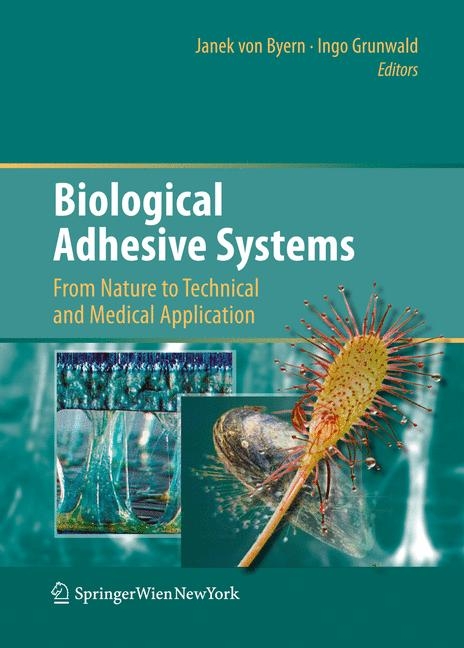
Biological Adhesive Systems (eBook)
XI, 305 Seiten
Springer Wien (Verlag)
978-3-7091-0286-2 (ISBN)
Dr. Dipl.-Biol. Janek von Byern:
While he was studying at the Johann W. Goethe University in Frankfurt/Main and during several research stays at the private marine research station IFMB in Giglio, Italy, cephalopods and their complexity (flexibility, color adaptation, and intelligence) aroused Janek von Byern's interest. With his diploma thesis he focused on the pharmacology and histology of the blood circulation system in Sepia officinalis.
Inspired by Uwe Piatkowski from the IFM-GEOMAR institute he began to consider the abstract thought that cephalopods could also produce glue. During further marine research stays he met Prof. Dr. J. Ott from the Department of Marine Biology of the University of Vienna and finally moved in 2003 to their Core Cell Imaging and Ultrastructure research facility.
In his PhD he characterized the adhesive system of the pygmy squid Idiosepius and started to analyze the glue components biochemically. Sampling led him to South Africa, Mozambique, Thailand, Indonesia, Japan and Australia where he collected different species, which raised new knowledge of other glue-producing animals and their attachment behavior.
Dr. Dipl.-Biol. Ingo Grunwald:
is a research associate and project manager in the 'Biomolecular Surfaces and Materials Design' work group at the Fraunhofer Institute for Manufacturing Technology and Advanced Materials (IFAM) in Bremen, Germany. The Fraunhofer IFAM is the largest independent research organization in Europe in the area of industrial adhesive bonding technology. Ingo Grunwald's work at the Fraunhofer IFAM focuses on biomimetic materials and biofunctionalized surfaces. He studied biology at University of Hanover (Germany), with biochemistry and molecular biology being his main areas of interest. His Ph.D. work concerned the purification, characterization, and molecular cloning of a new sugar-binding protein. Research time spent at Cancer Research UK and at the TECHNION in Israel broadened his interest in protein interactions, protein analysis, and proteomics. He studied the functionality of material surfaces with designed proteins in the field of nanobiotechnology as part of postdoctoral work at the University of Stuttgart (Germany). Ingo Grunwald has a lectureship in bioanalytical methods and surface biofunctionalization at the University of Bremen (Germany).
Dr. Dipl.-Biol. Janek von Byern:While he was studying at the Johann W. Goethe University in Frankfurt/Main and during several research stays at the private marine research station IFMB in Giglio, Italy, cephalopods and their complexity (flexibility, color adaptation, and intelligence) aroused Janek von Byern’s interest. With his diploma thesis he focused on the pharmacology and histology of the blood circulation system in Sepia officinalis.Inspired by Uwe Piatkowski from the IFM-GEOMAR institute he began to consider the abstract thought that cephalopods could also produce glue. During further marine research stays he met Prof. Dr. J. Ott from the Department of Marine Biology of the University of Vienna and finally moved in 2003 to their Core Cell Imaging and Ultrastructure research facility.In his PhD he characterized the adhesive system of the pygmy squid Idiosepius and started to analyze the glue components biochemically. Sampling led him to South Africa, Mozambique, Thailand, Indonesia, Japan and Australia where he collected different species, which raised new knowledge of other glue-producing animals and their attachment behavior.Dr. Dipl.-Biol. Ingo Grunwald:is a research associate and project manager in the "Biomolecular Surfaces and Materials Design" work group at the Fraunhofer Institute for Manufacturing Technology and Advanced Materials (IFAM) in Bremen, Germany. The Fraunhofer IFAM is the largest independent research organization in Europe in the area of industrial adhesive bonding technology. Ingo Grunwald's work at the Fraunhofer IFAM focuses on biomimetic materials and biofunctionalized surfaces. He studied biology at University of Hanover (Germany), with biochemistry and molecular biology being his main areas of interest. His Ph.D. work concerned the purification, characterization, and molecular cloning of a new sugar-binding protein. Research time spent at Cancer Research UK and at the TECHNION in Israel broadened his interest in protein interactions, protein analysis, and proteomics. He studied the functionality of material surfaces with designed proteins in the field of nanobiotechnology as part of postdoctoral work at the University of Stuttgart (Germany). Ingo Grunwald has a lectureship in bioanalytical methods and surface biofunctionalization at the University of Bremen (Germany).
Title Page 2
Copyright Page 3
Foreword 4
Table of Contents 6
Part A 11
1 Bonding Single Pollen Grains Together: How and Why? 12
1.1 The Anther Tapetum as a GlandularTissue in Seed Plants 12
1.1.1 The Tapetum Types 12
1.1.2 Pollen-connecting Agents: Nature, Function, and Systematic Distribution 14
1.1.2.1 Pollenkitt and Tryphine, the Principal Formsof Pollen Coatings 14
1.1.2.2 Tryphine 14
1.1.3 Pollenkitt: Function and Origin 15
1.1.3.1 Function 15
1.1.3.2 Pollenkitt Ontogenesis (Adaptedfrom Hesse, 1993, with Additions) 15
1.1.3.3 Pollen-gluing Agents not Formedby Pollenkitt 17
1.1.4 Filiform Pollen-connecting Structures 18
1.1.5 Acetolysis-resistant, SporopolleninPollen-connecting Threads 18
1.1.6 Pollen-connecting Threads not Consistingof Sporopollenin 20
Acknowledgments 21
References 21
2 Deadly Glue – Adhesive Trapsof Carnivorous Plants 23
Abstract 23
2.1 Introduction 24
2.1.1 Carnivorous Plants 24
2.1.2 Evolution and Diversity of Adhesive Traps 24
2.2 Glues and Their Production 26
2.2.1 Morphology and Anatomyof Glue-Producing Glands 26
2.2.2 Physical and Chemical Properties of Glues 28
2.2.3 Cytological Aspects of Glue Production 29
2.3 Interactions of Adhesive Trapsand Animals 30
2.3.1 Prey Capture 30
2.3.2 Life on Adhesive Traps 32
2.4 Future Aspects and PracticalApplications 33
Acknowledgments 33
References 33
3 Bonding Tactics in Ctenophores –Morphology and Functionof the Colloblast System 37
3.1 Introduction 37
3.2 General Tentacle Morphology 39
3.3 Colloblast Organization 40
3.3.1 Head (Collosphere) and Spheroidal Body 40
3.3.2 Stalk (Collopod) and Spiral Filament 42
3.3.2.1 Stalk 42
3.3.2.2 Spiral Filament 42
3.3.2.3 Root 42
3.3.3 Secretion Granules 42
3.3.3.1 Internal Granules 42
3.3.3.2 External Granules 42
3.4 Colloblast Development 43
3.4.1 Stage 1 43
3.4.2 Stage 2 44
3.4.3 Stage 3 44
3.5 Colloblast Polymorphisms 44
3.6 Capture Phenomenon 45
3.6.1 Capture Behavior 45
3.6.2 Capture Mechanism 46
3.6.3 Sensory Cells 47
3.6.4 Glue Composition 47
Abbreviations 47
Acknowledgments 47
References 48
4 Gastropod Secretory Glandsand Adhesive Gels 49
4.1 Introduction 49
4.2 Background 50
4.3 Limpets and Limpet-Like Molluscs 51
4.3.1 True Limpets 51
4.3.2 Abalone 52
4.3.3 Slipper Shells 53
4.4 Periwinkle Snails 53
4.5 Land Snails 54
4.6 Terrestrial Slugs 55
4.7 Summary 57
References 58
5 Characterization of the Adhesive Systemsin Cephalopods 60
5.1 Introduction 61
5.2 Euprymna 61
5.2.1 Introduction 61
5.2.2 Systematics 62
5.2.3 Ecology 62
5.2.4 Gland Morphology 62
5.2.4.1 Earlier Studies 63
5.2.4.2 Recent Re-characterization 64
5.2.4.3 Histochemistry 66
5.2.5 Bonding Mechanism 68
5.3 Idiosepius 68
5.3.1 Systematics 69
5.3.2 Ecology 69
5.3.3 Gland Morphology 69
5.3.3.1 The Adhesive Organ 70
5.3.3.2 The Regular Mantle Epithelium 71
5.3.4 Development of the Adhesive Organ 72
5.3.5 Process of Secretion and BondingMechanisms 73
5.4 Nautilus 73
5.4.1 Systematics 73
5.4.2 Ecology 74
5.4.3 Tentacles 75
5.4.4 Gland Morphology 76
5.4.4.1 Oral Side 77
5.4.4.1.1 Thick Epithelium 77
5.4.4.1.2 Thin Epithelium 77
5.4.4.2 Aboral Surface 77
5.4.5 Mechanism of Bonding 80
5.5 Sepia 80
5.5.1 Description of the Glue-producingSepiida Species 81
5.5.1.1 Sepia papillata (Quoy and Gaimard, 1832) 81
5.5.1.2 Sepia pulchra (Roeleveld and Liltved, 1985) 81
5.5.1.3 Sepia tuberculata (de Lamarck, 1798) 81
5.5.1.4 Sepia typica (Steenstrup, 1875a, b) 82
5.5.2 Gland Morphology 82
5.5.2.1 The Adhesive Area 82
5.5.2.2 The Regular Mantle Epithelium 83
5.5.3 Mechanism of Bonding 84
Conclusion 85
Abbreviations 88
Acknowledgments 89
References 89
6 Unravelling the Sticky Threads of Sea Cucumbers – A Comparative Studyon Cuvierian Tubule Morphology and Histochemistry 94
6.1 Introduction 94
6.2 Morphology of Cuvierian Tubules 95
6.2.1 Structure of Quiescent Tubules 95
6.2.2 Structure of Elongated Tubules 99
6.2.3 Interspecifi c Diversity in Cuvierian TubuleMorphology 100
6.3 Glue Composition 102
6.4 Discussion 104
Acknowledgments 105
References 105
7 Adhesion Mechanisms Developed by Sea Stars: A Review of the Ultrastructure and Composition of Tube Feetand Their Secretion 106
7.1 Introduction 106
7.2 Comparative Morphology of Sea StarTube Feet 107
7.2.1 Knob-ending Tube Feet 108
7.2.2 Simple Disk-ending Feet 108
7.2.3 Reinforced Disk-ending Tube Feet 108
7.3 Ultrastructure of Tube FootAdhesive Areas 109
7.3.1 Adhesive Cells 110
7.3.2 De-adhesive Cells 111
7.3.3 Other Cells 111
7.4 Structure of the Adhesive Material 111
7.5 Composition of Footprint Material 111
7.6 A Model for Temporary Tube Foot Adhesion 113
Abbreviations 115
Acknowledgments 115
References 116
8 Adhesive Exocrine Glands in Insects: Morphology, Ultrastructure, and Adhesive Secretion 117
Abstract 117
8.1 Introduction 128
8.2 Function and Distribution of Adhesive Glands in Insects 129
8.3 Histological and Ultrastructural Characteristics of Adhesive Glandsin Insects 130
8.3.1 Glands Employed in Locomotion 131
8.3.2 Glands Employed in Prey Capture 133
8.3.3 Glands Employed in Defence 135
8.3.4 Glands Employed in Body Anchorage 138
8.3.5 Glands Employed in Retreat Building 138
8.3.6 Conclusions on the Ultrastructural Characteristics of Adhesive Glands in Insects 139
8.4 Chemical Identity and Functional Aspects of Insect Adhesive Secretion 140
8.4.1 Aliphatic Compounds 141
8.4.2 Carbohydrates 144
8.4.3 Aromatic Compounds 144
8.4.4 Isoprenoids (Terpenes and Steroids) 145
8.4.5 Heterocyclic Compounds 146
8.4.6 Amino Acids, Peptides, and Proteins 146
8.4.6.1 Proteins Employed in Egg Anchorage 146
8.4.6.2 Proteins Employed in Terrestrial Cocoon Building 147
8.4.6.3 Proteins Employed in Underwater Retreat Building 147
8.4.7 Other Systems 148
Abbreviations 148
Acknowledgments 149
References 149
9 Mechanisms of Adhesion in Adult Barnacles 159
9.1 General Introduction 159
9.2 Peduncular Structure and the AdultGlue Apparatus 161
9.2.1 Structural Differences Between Acorn and Stalked Barnacles 161
9.2.2 Gland Cells (Acorn and Stalked Barnacles) 161
9.2.3 Canal System in Stalked Barnacles 162
9.2.4 Canal System in Acorn Barnacles and “Secondary Glue” Production 162
9.2.5 Movement of Liquid Glue in the Canal System 164
9.2.6 Cuticular Origins of the Glandular Apparatus 165
9.3 Glue Production at Cellular Levelin Adult Barnacles 166
9.3.1 Glue Secretion Pathways in Acorn Barnacles 166
9.3.2 Glue Secretion Pathways in Stalked Barnacles 166
9.3.3 Basis Type and Mode of Glue Discharge (Acorn and Stalked Barnacles) 166
9.3.4 Regulation of Protein Secretion 167
9.4 Glue Composition and Molecular Adhesion 168
9.4.1 Involvement of Physical Adhesive Forces 168
9.4.2 Cement Solubility 168
9.4.3 Cement Proteins in Acorn Barnacles 168
9.4.4 Cement Proteins in Stalked Barnacles 169
9.4.5 Cement Versus Uncured Glue 169
9.4.6 Post-translation Modifi cations and Comparison with Other Adhesive Models 170
9.4.7 Quinone-type Crosslinking 170
9.4.8 Possible Implications of Moulting and Hemolymph Systems 170
9.5 Conclusions 171
Acknowledgments 172
References 172
10 Morphology of the Adhesive System in the Sandcastle Worm, Phragmatopoma californica 175
10.1 Introduction 175
10.2 Sandcastle Worm Morphology 176
10.2.1 The Building Organ 177
10.2.2 The Adhesive Gland 178
10.2.2.1 Granule Composition 182
10.2.2.2 Stimulated Secretion 184
10.3 Adhesive Models 184
10.4 Materials and Methods 184
10.4.1 Animal Preparation 184
10.4.2 Scanning Electron Microscopy 185
10.4.3 Fluorescent Microscopy 185
10.4.4 Histological Staining 185
References 185
11 Adhesive Dermal Secretions of the Amphibia, with Particular Reference to the Australian Limnodynastid Genus Notaden 186
11.1 Introduction 186
11.2 Anuran Dermal Structure 187
11.2.1 Breviceps Species 187
11.2.2 Notaden Species 187
11.3 Range of Adhesive Activity of Notaden Secretions 189
11.3.1 Inorganic Material 189
11.3.2 Surgical Adhesives 189
Appendix 1 191
Acknowledgments 191
References 191
Part B 192
12 Renewable (Biological) Compounds in Adhesives for Industrial Applications 193
12.1 Introduction 193
12.2 Renewable Biobased “Chemical Raw Materials” 194
12.2.1 Renewable Biobased Raw Materials in Industrial Adhesives 194
12.2.2 Requirements for Adhesive Raw Materials 195
12.2.3 Requirements for Renewable Raw Materials 195
12.3 Polymers 195
12.3.1 Renewable Biopolymers as Adhesive Raw Materials 195
12.4 Application of Adhesives Based on Renewable Biopolymers 196
12.4.1 Production of Corrugated Board 196
12.4.2 Labeling of Glass Bottles 196
12.4.3 Making of Books 197
12.4.4 Lamination (Ply Adhesion) of Tissue Products 197
12.4.5 Core Winding of Tubes 198
12.4.6 Production of Envelopes 198
12.4.7 Tapes and Plaster 198
12.4.8 Cigarette Manufacturing/Packaging 199
12.5 Polymer from Renewable Biobased Building Blocks 199
12.6 Application of Adhesives Based on Polymers from Renewable Biobased Building Blocks 200
12.6.1 Laminating Adhesives 200
12.6.2 Two-component Polyurethane Adhesives 200
12.6.3 Thermoplastic Polyamide Adhesives 200
12.7 Reactive Adhesives 201
12.7.1 Reactive System from Renewable Biobased Raw Materials 201
12.8 Additives in Adhesives 201
12.8.1 Additives on Renewable Biobased Raw Materials 201
12.9 Application of Adhesives with Biobased Additives 202
12.9.1 Resins for Hot Melt Adhesives 202
12.9.2 Hot Melt Adhesives for Packaging Applications 202
12.9.3 Hot Melt Adhesives for Bookbinding Applications 202
12.9.4 Hot Melt Adhesives for Woodworking Applications 203
12.9.5 Plasticizer for Dispersion Adhesives 203
12.10 Summary 203
References 203
13 Bio-inspired Polyphenolic Adhesives for Medical and Technical Applications 204
13.1 Introduction 204
13.2 Phenolic Adhesives in Mytilus edulis 205
13.3 Synthetic Phenolic Resins and Their Applications 207
13.4 Tannins and Their Application in Adhesives 209
13.5 Phenolic Adhesives for Medical Applications 210
13.6 Special Applications: Space Exploration 212
13.7 Conclusion 212
Acknowledgment 212
References 213
14 Medical Products and Their Application Range 215
14.1 Objectives, Application, and Sources of Medicinal Adhesives 215
14.1.1 Objectives 215
14.1.2 The State of the Art 216
14.1.3 Historical Sources and Applications of Medicinal Adhesives 216
14.2 Adhesion in Medical Systems 218
14.2.1 Defi nitions 218
14.2.2 Cohesive Properties 218
14.2.3 Adhesion Properties 218
14.2.4 Medical Bonding Sites 220
14.2.5 Topical Tissues/Organs (Tissues/Organs Exposed to the Outside) 220
14.2.5.1 Skin 220
14.2.5.2 Teeth 221
14.2.5.3 Gingiva 221
14.2.6 Internal Tissues/Organs 221
14.2.6.1 Eye 221
14.2.6.2 Connective Tissues: Bones, Cartilages,and Ligaments 222
14.2.6.3 Cardiovascular System (Blood Vessels) 222
14.2.6.4 Muscles 222
14.2.7 Summary of Parameters for Adhesive Bonding on Human Tissues 223
14.3 The Healing Process 223
14.3.1 Wound Healing 223
14.3.2 A Critical View on Existing Medicinal Adhesives 224
14.3.3 A Blueprint for Medicinal Adhesives 225
14.4 Conclusion 226
References 226
15 Fibrin: The Very First Biomimetic Glue –Still a Great Tool 227
15.1 Introduction 227
15.2 Mechanisms 228
15.2.1 Role of Fibrin in Wound Healing 229
15.2.2 Degradation 229
15.3 Clinical Use of Fibrin Sealants 230
15.3.1 Hemostasis 230
15.3.1.1 Combination of Fibrin with Collagen and Other Carriers 232
15.3.2 Sealing 232
15.3.2.1 Nerves 232
15.3.2.2 Skin Grafts 232
15.3.2.3 Hernia 232
15.4 Preparation and Application of Fibrin Sealant 232
15.5 Fibrin as a Biomatrix 233
15.5.1 Fibrin as a Delivery System for Substances (Medication) 233
15.5.2 Fibrin as a Delivery System for Growth Factors 234
15.5.3 Fibrin as a Matrix for Cells 234
15.5.4 Fibrin as a Carrier for Osteoconductive Materials 234
15.6 Conclusion 234
Acknowledgment 235
References 235
16 Properties and Potential Alternative Applications of Fibrin Glue 239
16.1 Characterization of Fibrin as Matrix 239
16.1.1 The Components of Fibrin Gels and Their Influence on Morphology and Function 239
16.1.1.1 Fibrinogen 240
16.1.1.2 Thrombin 242
16.1.1.3 Clot Irregularities 242
16.1.1.4 Lot Variations 243
16.1.1.5 Additives – Salts 243
16.1.1.6 Additives – Fibrinolysis Inhibitors 244
16.1.1.7 Clot Casting 244
16.1.1.8 Fibrinolysis – Clot Dissolution 245
16.2 Fibrin as Matrix for Cells 246
16.2.1 General Characterization of Cell Culture on and in Fibrin 247
16.2.1.1 Adhesion 247
16.2.1.2 Proliferation 248
16.2.1.3 Migration 248
16.2.2 Soft Tissue Engineering Using Adiposederived Stem Cells in 3D Fibrin Matrix of Low Component Concentration 250
16.2.3 Electrospun Fibrin Nanofiber Matrices 253
16.3 Fibrin as Matrix for Substances 255
16.3.1 Release of Substances and Drugs(Tatjana J. Morton, Martijn van Griensven and Heinz Redl) 255
16.3.2 Gene-activated Matrix(Georg A. Feichtinger, Heinz Redland Martijn van Griensven) 256
Acknowledgments 257
References 257
17 Biodegradable (Meth)acrylate-based Adhesives for Surgical Applications 262
17.1 Introduction 262
17.2 General Features of (Meth)acrylate Polymerization 263
17.3 Oligo- and Polylactone-based (Meth)acrylate Adhesives 264
17.4 Biopolymer-based (Meth)acrylate Adhesives 269
17.4.1 Protein-based Systems 269
17.4.2 Polysaccharide-based Systems 270
17.4.3 Glycosaminoglycan-based Systems 270
17.5 Concluding Remarks 271
References 272
18 Byssus Formation in Mytilus 274
18.1 Introduction 274
18.2 Overview of Byssogenesis 274
18.2.1 Secretion of the Byssal Thread 276
18.2.2 Spatial Distribution of the Glands 276
18.2.3 Temporal Sequence of Adhesive Protein Secretion 278
18.3 Proteins of the Byssal Thread 278
18.3.1 The Core: Precollagens 278
18.3.2 The Core: Thread Matrix Proteins 279
18.3.3 The Cuticle: Foot Protein-1 279
18.3.4 The Cuticle: Polyphenol Oxidase 280
18.4 Proteins of the Byssal Plaque 280
18.4.1 Thread-Plaque Junction: Foot Protein-4 280
18.4.2 Plaque Foam Matrix: Foot Protein-2 280
18.4.3 Plaque Primer Layer: Foot Proteins-3,-5, and -6 280
18.5 Chemistry of Adhesion at the Byssal Thread-substrate Interface 281
18.6 Immunolocalization of Byssal Proteins 282
18.7 Concluding Remarks 282
Acknowledgments 283
References 283
19 Wet Performance of Biomimetic Fibrillar Adhesives 285
19.1 Introduction 285
19.2 Gecko Mimetic Fibrillar Wet Adhesives 285
19.2.1 Gecko: A Prototypical Biological Fibrillar Adhesive 285
19.2.2 Coated Gecko Mimetic Adhesives 286
19.2.3 Gecko/Mussel Mimetic Adhesives with poly(DMA-co-MEA) Coating 287
19.3 Beetle-inspired Fibril Design 290
19.4 Tree Frog-inspired Wet Adhesives 291
19.5 Cricket-inspired Wet Adhesives 292
19.6 Conclusions and Outlook 292
Acknowledgment 292
References 292
Subject Index 295
List of Contributors 301
| Erscheint lt. Verlag | 27.1.2011 |
|---|---|
| Zusatzinfo | XI, 305 p. |
| Verlagsort | Vienna |
| Sprache | englisch |
| Themenwelt | Technik ► Maschinenbau |
| Schlagworte | animals • Chemistry • Insects • Morphology • System • tissue |
| ISBN-10 | 3-7091-0286-3 / 3709102863 |
| ISBN-13 | 978-3-7091-0286-2 / 9783709102862 |
| Informationen gemäß Produktsicherheitsverordnung (GPSR) | |
| Haben Sie eine Frage zum Produkt? |
 PDF (Wasserzeichen)
DRM: Digitales Wasserzeichen
Dieses eBook enthält ein digitales Wasserzeichen und ist damit für Sie personalisiert. Bei einer missbräuchlichen Weitergabe des eBooks an Dritte ist eine Rückverfolgung an die Quelle möglich.
Dateiformat: PDF (Portable Document Format)
Mit einem festen Seitenlayout eignet sich die PDF besonders für Fachbücher mit Spalten, Tabellen und Abbildungen. Eine PDF kann auf fast allen Geräten angezeigt werden, ist aber für kleine Displays (Smartphone, eReader) nur eingeschränkt geeignet.
Systemvoraussetzungen:
PC/Mac: Mit einem PC oder Mac können Sie dieses eBook lesen. Sie benötigen dafür einen PDF-Viewer - z.B. den Adobe Reader oder Adobe Digital Editions.
eReader: Dieses eBook kann mit (fast) allen eBook-Readern gelesen werden. Mit dem amazon-Kindle ist es aber nicht kompatibel.
Smartphone/Tablet: Egal ob Apple oder Android, dieses eBook können Sie lesen. Sie benötigen dafür einen PDF-Viewer - z.B. die kostenlose Adobe Digital Editions-App.
Buying eBooks from abroad
For tax law reasons we can sell eBooks just within Germany and Switzerland. Regrettably we cannot fulfill eBook-orders from other countries.
aus dem Bereich