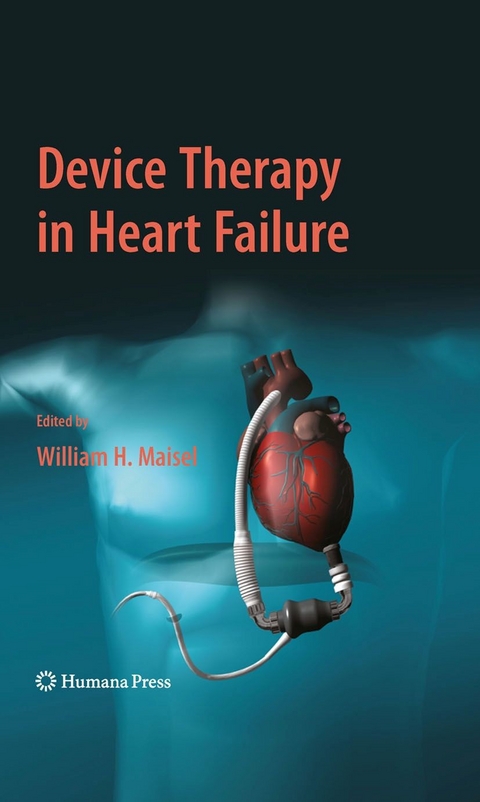
Device Therapy in Heart Failure (eBook)
X, 400 Seiten
Humana Press (Verlag)
978-1-59745-424-7 (ISBN)
Heart failure affects over 5 million patients in the United States alone, and is a chronic and debilitating disease. While a number of pharmacologic therapies have shown varying degrees of effectiveness, many recent advances in the treatment of heart failure has focused on device based therapies. In Device Therapy in Heart Failure, William H. Maisel and a panel of authorities on the use and implementation of device based therapies provide a comprehensive overview of the current and developing technologies that are used to treat heart failure. Individual chapters provide an in-depth analysis of devices such as CRT's and ICD's, while broader topics such as the pathophysiology of heart failure and its current medical therapies are also discussed. Additional topics include Pacing and Defibrillation for Atrial Arrhythmias, Atrial Fibrillation Ablation, and Percutaneous Treatment of Coronary Artery Disease.
Heart failure affects over 5 million patients in the United States alone, and is a chronic and debilitating disease. While a number of pharmacologic therapies have shown varying degrees of effectiveness, many recent advances in the treatment of heart failure has focused on device based therapies. In Device Therapy in Heart Failure, William H. Maisel and a panel of authorities on the use and implementation of device based therapies provide a comprehensive overview of the current and developing technologies that are used to treat heart failure. Individual chapters provide an in-depth analysis of devices such as CRT's and ICD's, while broader topics such as the pathophysiology of heart failure and its current medical therapies are also discussed. Additional topics include Pacing and Defibrillation for Atrial Arrhythmias, Atrial Fibrillation Ablation, and Percutaneous Treatment of Coronary Artery Disease.
Preface 6
Contents 7
Contributors 8
1 Pathophysiology of Heart Failure 10
1 The Pathophysiology of Compensatory Systems in Heart Failure 11
1.1 Normal Cardiac Function 11
1.2 The Frank--Starling Mechanism in HF 12
1.3 Chronic Ventricular Remodeling 13
1.3.1 Myocardial Hypertrophy and Remodeling 14
1.4 Neurohormones in Heart Failure 17
1.4.1 The Sympathetic Nervous System 18
1.4.2 The Renin--Angiotensin--Aldosterone System 19
1.4.3 Arginine Vasopressin 21
1.4.4 Endothelin 21
1.4.5 Nitric Oxide 22
1.4.6 Natriuretic Peptides 23
1.4.7 Inflammatory Cytokines 24
2 Molecular Mechanisms Affecting Cardiac Arrhythmogenesis 24
2.1 Calcium Cycling in Normal and Failing Cardiac Myocytes 25
2.2 Prolongation of the Cardiac Action Potential 27
2.3 Abnormalities in Conduction 28
3 Atrial Fibrillation in HF 29
4 Conclusions 29
References 30
2 Medical Therapy for Heart Failure 37
1 Introduction 37
2 Digitalis Glycosides 38
3 Diuretic Therapy for Heart Failure 41
4 Vasodilator Therapy 45
4.1 Angiotensin-Converting Enzyme (ACE) Inhibitors 45
4.2 Angiotensin Receptor Blockers (ARBs) 50
4.3 Other Vasodilators 55
5 Aldosterone Receptor Antagonists 57
6 Beta-Adrenergic Receptor Blockers 59
7 Anticoagulation 64
8 Statins 65
9 Medications to Avoid 66
10 Consensus Statements 68
References 69
3 Device Trials in Chronic Heart Failure: Implications of Trial Design 77
1 Introduction 78
2 Tenets of Good Clinical Trial Design 78
2.1 The Question 78
3 Current Trial Designs in Heart Failure Populations 82
3.1 The Endpoint: Symptom Relief in Acute DecompensatedHeart Failure 82
3.2 The Endpoint: Functional Improvement and Quality of Life 83
4 Impact of Trial Design on Outcome 91
5 Newer Approaches to Clinical Trial Design for Devices in Patients with Heart Failure 93
6 Conclusions 93
References 94
4 The FDA Perspective on Heart Failure Devices 96
1 Introduction 97
2 Device Development, Evaluation, Approval, and Postmarket Surveillance 98
2.1 Regulatory Terminology and Submission Types 98
2.2 Device Labeling 102
2.3 Product Recalls 103
2.4 Premarket vs. Postmarket Review 104
3 Considerations in Clinical Trial Design 104
3.1 Choosing a Control Group 104
3.2 Selecting the Appropriate Endpoints 106
3.3 Utilizing Quality Control Measures 110
3.4 Methods for Handling Missing Data 111
3.5 Gender Bias 111
4 Review Paradigms for Heart Failure Devices 112
4.1 Cardiac Resynchronization Therapy 112
4.2 Ventricular Assist Devices and Total Artificial Hearts 113
4.3 Hemodynamic Monitoring Technologies 117
5 Role of the Circulatory System Devices Advisory Panel 118
6 Interactions with External Stakeholders and Government Partners 119
7 Conclusions 121
References 121
5 Hemodynamic Monitoring in Heart Failure 125
1 Introduction 126
2 Clinical Assessment of Hemodynamic Profiles 126
2.1 Symptoms 126
2.2 Physical Examination 127
3 Laboratory Evaluation of Elevated Filling Pressures 128
4 Modalities of Hemodynamic Monitoring 130
5 Invasive Modalities of Hemodynamic Monitoring 130
5.1 The Pulmonary Artery Catheter 130
5.1.1 Indications for the Use of the Pulmonary Artery Catheter 131
5.1.2 Use of the Pulmonary Artery Catheter to ''Tailor Therapy'' in Heart Failure 132
5.1.3 Controversy Surrounding the Use of Pulmonary Artery Catheters 133
5.1.4 Safety and Efficacy of the Pulmonary Artery Catheter in Advanced Decompensated Heart Failure: The Escape Trial 138
5.1.5 Recommendations for the Use of Pulmonary Artery Catheters in Heart Failure 139
5.2 Implantable Hemodynamic Monitors (IHM) 140
5.2.1 The Medtronic Chronicle ® Implantable Hemodynamic Monitor Design 141
5.2.2 Validation of the Chronicle ® Implantable Hemodynamic Monitor 142
5.2.3 Clinical Trials with the Chronicle ® Implantable Hemodynamic Monitor in Heart Failure 144
5.3 Other Investigational Implantable Hemodynamic Monitoring Devices 146
6 Non-Invasive Methods of Hemodynamic Monitoring 147
6.1 Non-invasive Assessment of Hemodynamics by Echocardiography 148
6.2 Bioimpedance Cardiography 148
6.3 Non-invasive Measurement of Left Ventricular End-Diastolic Pressure Based on the Arterial Blood Pressure Response to the Valsalva Maneuver 153
7 Summary 155
References 156
6 Implantable Cardioverter-Defibrillators 161
1 Sudden Cardiac Death in Heart Failure 161
2 Indications for ICD Implantation in Patients with HF 162
2.1 Secondary Prevention Trials 162
2.2 Primary Prevention Trials 165
2.3 Benefit of the ICD in Patients with Advanced Heart Failure 171
3 ICD Function and Technology 177
3.1 Treatment 177
3.2 Detection 180
3.3 Management Issues in the Care of the CHF Patient with an ICD 182
3.3.1 Programming of the ICD: Bradycardia Pacing 182
3.4 Management of Frequent Shocks 183
3.5 Device Malfunction 183
3.6 Management of the ICD in End-of-Life Care 184
4 Conclusions 184
References 185
7 Cardiac Resynchronization Therapy 191
1 Pathophysiology of Dyssynchrony and Definitions 192
1.1 Context 192
1.2 Electrical Timing 193
1.3 CRT Compared with Other Methods of Increasing Cardiac Output (Inotropes) 194
1.4 Mitral Regurgitation 195
1.5 LV vs. BiV Pacing 195
2 Imaging Modalities to Identify Patients 196
2.1 Echocardiography 196
2.2 Other Imaging Techniques 196
3 Clinical Evidence 197
3.1 Trials 197
3.2 Patient Characteristics/Subsets 201
3.3 QRS Morphology 202
3.4 Atrial Fibrillation 204
3.5 Cost-Effectiveness 204
4 Hardware 204
4.1 Leads and Delivery Systems 204
4.2 Technical Considerations 205
4.3 Devices 207
4.3.1 Pacing Configurations 207
4.3.2 Maximizing LV Pacing 207
4.3.3 Other Diagnostics 209
4.4 CRT Defibrillators vs. CRT Pacemakers 210
5 Troubleshooting/Optimization 210
5.1 ECG Patterns 210
5.2 AV Optimization 211
5.3 VV Optimization 213
5.4 Additional Evaluation 213
6 Guidelines 213
7 Conclusions 215
References 215
8 Pacing and Defibrillation for Atrial Arrhythmias 220
1 Mechanisms of Atrial Arrhythmias and Interaction with Electrical Pacing 221
2 Atrial Fibrillation in Patients with Pacemakers 222
3 Diagnosis of Atrial Arrhythmias in Patients with Pacemakers 224
4 Alternate Site Atrial Pacing 226
5 Pacing Algorithms to Prevent Atrial Fibrillation 229
6 Termination of Atrial Arrhythmias: Antitachycardia Pacing and Cardioversion 231
7 Conclusions 233
References 234
9 Atrial Fibrillation Ablation 240
1 Atrial Fibrillation Prevalence and Morbidity 240
2 Treatment Options 241
2.1 Pharmacologic Therapy 241
2.2 Nonpharmacologic Therapy 242
3 Catheter Ablation of Atrial Fibrillation 242
3.1 Clinical Guidelines for Atrial Fibrillation Ablation 244
3.2 Devices Used for Catheter Ablation of AF 244
3.2.1 Intracardiac Echocardiography 245
3.2.2 Brockenbrough Transseptal Puncture Needle 247
3.2.3 Transseptal Sheaths 247
3.2.4 Nonfluoroscopic Three-Dimensional Mapping Techniques 249
3.2.5 Carto 249
3.2.6 EnSite NavX 252
3.2.7 LocaLisa 254
3.2.8 Remote Magnetic Catheter Navigation 254
3.2.9 Multielectrode Catheters for Electrical Mapping of the Pulmonary Veins 256
3.2.10 Ablation Catheters 258
4 Conclusion 262
References 262
10 Percutaneous Treatment of Coronary Artery Disease 267
1 A Historical Perspective 267
2 Balloon Angioplasty 268
3 Stenting 269
4 Drug-Eluting Stents 270
4.1 Cypher Stent 272
4.2 TAXUS Stent 273
5 The Controversy of Des 274
6 Coronary Artery Disease And Heart Failure 275
7 No-option Patients 277
7.1 Spinal Cord Stimulation (SCS) 278
7.2 Enhanced External Counterpulsation (EECP) 278
8 Conclusions 279
References 279
11 Percutaneous Management of Peripheral Arterial Disease 291
1 Introduction 291
2 Lower Extremity 292
2.1 Aortoiliac Disease 293
2.2 Femoropopliteal 295
2.3 Infrapopliteal 298
3 Renal Artery 299
4 Carotid Artery 301
5 Conclusion 303
References 304
12 Percutaneous Management of Valvular Heart Disease 308
1 Introduction 309
1.1 Valvular Heart Disease and Heart Failure -- Scope of the Problem and Challenges for the Therapy 309
2 Percutaneous Treatment of Pulmonic Valvular Disease 309
2.1 Balloon Valvotomy 309
2.2 Percutaneous Pulmonic Valve Implantation (PPVI) 310
2.2.1 Historical Perspective and Initial Valve Design 310
2.2.2 Indications 310
2.2.3 Clinical Outcome of Percutaneous Pulmonary Valve Implantation 310
2.2.4 Limitations of the Approach and Future Directions 313
3 Percutaneous Treatment of Aortic Valve Disease 314
3.1 Aortic Stenosis 314
3.2 Indications for Intervention 314
3.3 Balloon Aortic Valvuloplasty (BAV) 315
3.4 Percutaneous Aortic Valve Replacement 316
3.4.1 Aortic Percutaneous Valve Designs and Preliminary Clinical Results 316
3.4.2 Limitations and Future Direction 319
4 Percutaneous Treatment of Mitral Valve Disease 321
4.1 Mitral Stenosis and Valvuloplasty 321
4.2 Percutaneous Mitral Valve Repair for Mitral Regurgitation 322
4.2.1 Primary Versus Secondary Mitral Regurgitation and Indications for Intervention 322
4.2.2 Anatomic Challenges Associated with Mitral Regurgitation and Left Ventricular Dilatation 323
4.2.3 Approaches to Repair of Primary Valvular Pathology 323
5 Percutaneous Atrioventricular Valve Replacement Preliminary Results 332
6 Guidelines for Percutaneous Valve Interventions 333
7 Future Directions and Challenges 333
References 337
13 Ventricular Assist Devices and Total Artificial Hearts 341
1 Background 342
2 Physiologic Considerations 343
3 The Devices 345
4 Short-Term Devices (1 Month of Support) 345
4.1 Tandemheart Percutaneous Ventricular Assist ® 345
4.2 Impella Recover ® 346
4.3 Abiomed BVS 5000 ® and AB 5000 ® 347
4.4 Levitronix CENTriMAG ® 348
5 Long-Term Devices (1 Month of Support) 349
5.1 Thoratec ® Paracorporeal and Intracorporeal Ventricular Assist Devices (PVAD/IVAD) 349
5.2 Heartmate ® LVAD 350
5.3 Novacor ® 351
6 Second-Generation Devices: Axial Flow Pumps 352
6.1 Debakey VAD ® 352
6.2 Heartmate II ® 353
6.3 Jarvik 2000 ® 354
7 Third-Generation Devices: Maglev Technology 354
8 Total Artificial Hearts (TAH) 355
9 Patient and Device Selection 356
10 Clinical Experiences 357
10.1 Acute Cardiogenic Shock 357
10.2 Postcardiotomy Cardiogenic Shock 358
10.3 Bridge to Decision and Bridge to Bridge 359
10.4 Bridge to Transplantation (BTT) 359
10.5 Bridge to Recovery 362
10.6 Destination Therapy (DT) 363
10.7 Complications 365
11 Conclusions 368
References 369
14 Device Therapy for Left Ventricular Dysfunction 374
1 Introduction 374
2 History of Left Ventricular Remodeling Surgery 377
3 Left Ventricular Device Therapies 378
3.1 Tethers 379
3.2 Socks 379
3.3 Cardiac Support Devices 380
3.4 Mitral Valve Interventions 382
4 A Regulatory Perspective 385
5 Conclusions 386
References 386
Subject Index 389
| Erscheint lt. Verlag | 1.1.2010 |
|---|---|
| Reihe/Serie | Contemporary Cardiology | Contemporary Cardiology |
| Zusatzinfo | X, 400 p. 140 illus., 46 illus. in color. |
| Verlagsort | Totowa |
| Sprache | englisch |
| Themenwelt | Medizinische Fachgebiete ► Innere Medizin ► Kardiologie / Angiologie |
| Technik ► Medizintechnik | |
| Schlagworte | Atrial Fibrillation • Cardiac Resynchronization Therapy • CRT • Defibrillator • Heart Failure • hemodynamic monitoring • Implantable Cardioverter-Defibrillators • Monitor • pathophysiology • Physiology • Ventricular Assist Devices |
| ISBN-10 | 1-59745-424-9 / 1597454249 |
| ISBN-13 | 978-1-59745-424-7 / 9781597454247 |
| Informationen gemäß Produktsicherheitsverordnung (GPSR) | |
| Haben Sie eine Frage zum Produkt? |
 PDF (Wasserzeichen)
DRM: Digitales Wasserzeichen
Dieses eBook enthält ein digitales Wasserzeichen und ist damit für Sie personalisiert. Bei einer missbräuchlichen Weitergabe des eBooks an Dritte ist eine Rückverfolgung an die Quelle möglich.
Dateiformat: PDF (Portable Document Format)
Mit einem festen Seitenlayout eignet sich die PDF besonders für Fachbücher mit Spalten, Tabellen und Abbildungen. Eine PDF kann auf fast allen Geräten angezeigt werden, ist aber für kleine Displays (Smartphone, eReader) nur eingeschränkt geeignet.
Systemvoraussetzungen:
PC/Mac: Mit einem PC oder Mac können Sie dieses eBook lesen. Sie benötigen dafür einen PDF-Viewer - z.B. den Adobe Reader oder Adobe Digital Editions.
eReader: Dieses eBook kann mit (fast) allen eBook-Readern gelesen werden. Mit dem amazon-Kindle ist es aber nicht kompatibel.
Smartphone/Tablet: Egal ob Apple oder Android, dieses eBook können Sie lesen. Sie benötigen dafür einen PDF-Viewer - z.B. die kostenlose Adobe Digital Editions-App.
Buying eBooks from abroad
For tax law reasons we can sell eBooks just within Germany and Switzerland. Regrettably we cannot fulfill eBook-orders from other countries.
aus dem Bereich