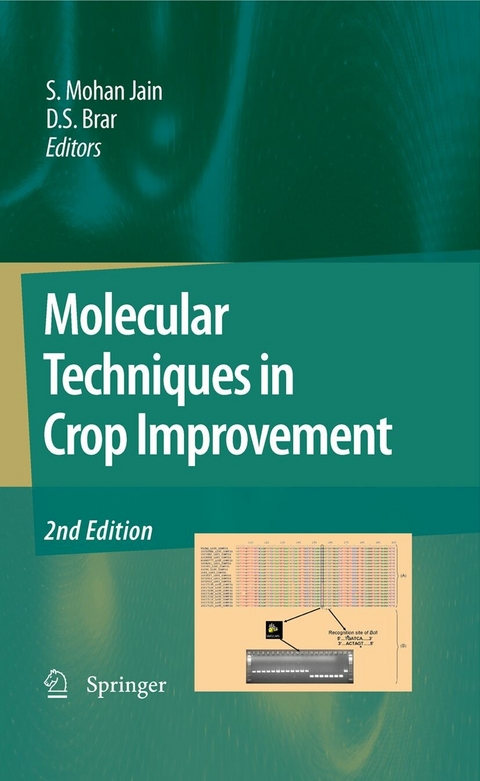
Molecular Techniques in Crop Improvement (eBook)
IX, 772 Seiten
Springer Netherland (Verlag)
978-90-481-2967-6 (ISBN)
This book provides comprehensive information on the latest tools and techniques of molecular genetics and their applications in crop improvement. It thoroughly discusses advanced techniques used in molecular markers, QTL mapping, marker-assisted breeding, and molecular cytogenetics.
Most of the plant breeding programs aim to increase yield, disease and insect resistance, abiotic stress tolerance and to improve quality characteristics. The value of new plant breeding products and varieties in increasing food production has been demonstrated time and again. To meet growing need of ever increasing human population, we need to enhance food production for sustaining food supply. Furthermore, several biotic and abiotic stresses continue to threaten crop product- ity. Moreover with urbanization, land for cultivation is shrinking and several en- ronment concerns involving excessive use of fertilizers and agro-chemicals, soil and water pollution including water scarcity are key issues in increasing crop p- ductivity and food sustainability. Plant breeders therefore, has the major challenge how to increase crop productivity with limited land, limited water, limited che- cals and limited labour particularly in the context of global climate changes. In the genomics era, advances in molecular biology have opened new opportunities to accelerate plant breeding processes and in overcoming some of the above c- straints limiting crop productivity. Molecular markers have become important tools in the hands of plant breeders in marker assisted breeding and for enhancing the selection efficiency for various agronomic traits in precision 'plant' breeding.
Preface 5
Contents 7
Part I Plant Breeding in the Genomics Era 10
Chapter 1 QTL Analysis in Plant Breeding 11
1.1 Introduction 11
1.2 The Scientific Value of QTL Analysis 13
1.3 QTL Analysis for MAS 16
1.4 QTL Analysis for Pre-Breeding 19
1.5 An Example of QTL Analyses for Utilization of Wild Species to Increase Salt Tolerance in Tomato 21
1.6 Concluding Remarks 23
References 25
Chapter 2 Comparative Genomics in Crop Plants 30
2.1 Introduction 30
2.2 Transition in Concept from Wet to Dry Lab 31
2.3 Dimensions of Comparative Genomics 35
2.3.1 Comparative Genome Organization 35
2.3.2 Gene Prediction 36
2.3.3 Synteny and Collinearity 36
2.3.4 Comparison of Sequenced Genomes 37
2.3.5 Conserved Gene Position Does Not Necessarily Mean Conserved Function 37
2.3.6 Comparative Analysis of Small RNA 38
2.3.7 QTL Comparisons Across Taxa 38
2.3.8 Defining Unification in Biological Terminology 40
2.4 Comparative Genomic Studies on Major Crops 40
2.4.1 Poaceae 40
2.4.2 Solanaceae (Tomato Potato
2.4.3 Fabaceae (Leguminosae) 43
2.4.4 Brassicaceae 45
2.4.5 Malvaceae 46
2.5 Flow of Genetic Information from Well-Studied to Less Explored Genomes 47
2.6 Evolutionary Consequences 48
2.6.1 Phylogenomics: Contributions to Developing a Consensus Tree 48
2.6.2 Direct Implications in Gene Loss/Gain for Attaining New Functions 49
2.6.3 Domestications of New Forms 50
2.6.4 Polyploidy: Evolution of New Genomes 50
2.7 Concluding Remarks/Perspectives 53
References 54
Chapter 3 Functional Genomics For Crop Improvement 69
3.1 Introduction 69
3.2 Crop Improvement Strategies 71
3.3 Classical Breeding 72
3.4 Technology-Based Breeding 73
3.5 Expression Profiling 75
3.6 Advantages and Drawbacks of Gene Expression Profiling Techniques 77
3.7 Expression Profiling for Plant Improvement 79
3.8 eQTL, Gene Networks and Pathways 82
3.9 Transgene Technology and Gene Expression Analysis 83
3.10 Choice of Target Tissue for Gene Delivery 86
3.11 Gene Transfer Methods 88
3.12 Transgene Approach to Functional Genomics and Plant Breeding 90
3.13 Prospects and Challenges 91
References 93
Chapter 4 Bioinformatics Tools for Crop Research and Breeding 102
4.1 Introduction 102
4.2 Bioinformatics Resources Available for Crop Research 103
4.2.1 Data Resources 103
4.2.2 Web and Web Services 105
4.2.3 Data Integration and the Semantic Web 106
4.2.4 Bioinformatics Tools for Comparative Genomics 108
4.2.5 Bioinformatics Tools for Functional Genomics 110
4.2.6 Availability of High Performance Clusters and Grid 112
4.2.7 Bioinformatics and Molecular Marker Technology 113
4.3 Closing the Gap to Meet Molecular Breeding Requirements 116
References 119
Part II Molecular Markers and Their Application 122
Chapter 5 Gene-Based Marker Systems in Plants: High Throughput Approaches for Marker Discovery and Genotyping 123
5.1 Introduction 123
5.2 Gene-Based Marker System: Moving from Genes to Genome 124
5.3 Marker Discovery 125
5.3.1 Sanger Sequencing-Based Marker Development 125
5.3.2 Expression Polymorphism-Based Markers 131
5.3.3 Next Generation Sequencing Technologies for Genome-Wide Marker Discovery 132
5.4 Genotyping Assays 135
5.4.1 Low-Throughput and Inexpensive Genotyping Assay 136
5.4.2 High-Throughput Genotyping Assays 137
5.5 Applications of Gene-Based Markers in Crop Improvement 139
5.5.1 Superiority of FMs over Traditional Markers in MAS 139
5.5.2 Utility of Gene-Based Markers for Allele Mining 140
5.6 Conclusions and Prospects 141
References 142
Chapter 6 Automation of DNA Marker Analysis for Molecular Breeding in Crops 147
6.1 Introduction 147
6.2 Plant Breeding and Molecular Markers 148
6.2.1 Molecular Approaches Used in Practical Plant Breeding 149
6.2.2 Need for Molecular Marker Automation 152
6.3 Experience of Automation at Svalöf Weibull Laboratory 152
6.3.1 Characterisation of Breeding Activities 155
6.3.2 Characterisation of Molecular Activities 156
6.3.3 Automation of Analytic-processes 157
6.3.4 Automation Performance 161
6.4 Conclusion 162
References 163
Chapter 7 Pyramiding Genes for Enhancing Tolerance to Abiotic and Biotic Stresses 166
7.1 Introduction 166
7.2 Gene Pyramiding for Biotic Stress Tolerance 167
7.2.1 Gene Pyramiding for Disease Resistance 168
7.2.2 Gene Pyramiding for Insect Resistance 171
7.3 Abiotic Stress Tolerance in Plants 173
7.3.1 Genetic Engineering Strategies to Improve Abiotic Stress Tolerance in Plants 174
7.4 Marker Assisted Gene Pyramiding 177
7.5 Conclusion 181
References 182
Chapter 8 Application of Molecular Markers for Breeding Disease Resistant Varieties in Crop Plants 188
8.1 Introduction 188
8.2 Molecular Marker Technologies 189
8.3 Molecular Markers in Breeding Applications 191
8.4 Efficient Applications of MAS in Breeding for Disease Resistance 192
8.4.1 Cereals 193
8.4.2 Legumes 197
8.4.3 Solanaceae 198
8.5 Future Challenges and Perspectives for MAS 199
References 202
Chapter 9 Molecular Markers Based Approaches for Drought Tolerance 209
9.1 Introduction 209
9.2 Traits Associated with Drought Tolerance 210
9.3 Marker-assisted Selection for Drought Tolerance 212
9.4 Candidate Genes for Drought Tolerance 217
9.5 Fine Mapping and Cloning of Drought Tolerance QTLs 222
9.6 Concluding Remarks 224
References 225
Chapter 10 Molecular Markers for Characterizing and Conserving Crop Plant Germplasm 233
10.1 Introduction 234
10.2 Genetic Characterization and Its Use in Decision-Making for the Conservation of Crop Germplasm: Basic Concepts 234
10.3 Use of Molecular Markers for the Characterization and Conservation of Plant Genetic Resources 236
10.4 Genetic Diversity and Similarity Statistics for Characterizing Plant Germplasm at the Population Level 240
10.5 Using Molecular Marker-assisted Characterization and Conservation of Crop Plant Germplasm: Case Studies 243
10.5.1 Genetic Anatomy of a Patented Yellow Bean (Phaseolus Vulgaris L.) Variety 244
10.5.2 Genetic Variation and Differentiation of Landraces of Lentil (Lens Culinaris Var. Microsperma L.) and Maize (Zea Mays Var. Indurata L.) 245
10.5.3 Genetic Fingerprinting Durum Wheat (Triticum Durum l.) and Bread Wheat (Triticum Aestivum l.) Elite Germplasm Stocks for Multiple Breeding Purposes 248
10.5.4 Effects of Different Conservation Strategies on the Population Genetic Structure of Maize Landraces as Assessed with Molecular Markers 250
10.6 Using Molecular Characterization to Make Informed Decisions on the Conservation of Crop Genetic Resources 251
10.7 Conclusion 254
References 255
Part III Genomics 257
Chapter 11 Rice Genomics Gateway to Future Cereal Improvement 258
11.1 Introduction 258
11.2 Genome Sequence and Annotation 259
11.3 RNA Expression Studies 262
11.4 Small RNA Studies 265
11.5 Proteomics 267
11.6 Metabolomics 269
11.7 Natural and Induced Variants 270
11.8 Insertional Mutants 272
11.9 From Rice to Other Cereals – Comparative Genomics 274
11.10 Challenges and Prospects 275
References 276
Chapter 12 Genomics for Wheat Improvement 281
12.1 Introduction 282
12.2 Genetic Analysis 283
12.2.1 Genetic Maps of Wheat 283
12.2.2 Quantitative Trait Loci and Linkage Disequilibrium 285
12.3 Wheat Gene Discovery 286
12.3.1 Wheat BAC Libraries and Map-based Cloning 287
12.3.2 Comparative Genomics with Model Plant Species and Grasses 288
12.3.3 Wheat Genome Sequencing 289
12.4 Gene Function 290
12.4.1 Transgenics and Overexpression 291
12.4.2 Transgenics and RNA Interference 294
12.4.3 Virus Induced Gene Silencing (VIGS) 294
12.4.4 Targeting Induced Local Lesions in Genomes 295
12.5 Application of Genomics to Wheat Breeding 296
References 297
Chapter 13 TILLING for Mutations in Model Plants and Crops 306
13.1 Introduction 307
13.2 TILLING Method 308
13.2.1 Selecting a Mutagen for TILLING 308
13.2.2 Selecting Tissue for Mutagenesis 312
13.2.3 DNA Extraction, Pooling and Mutation Discovery 315
13.3 Examples of TILLING Projects 319
13.3.1 High-Throughput Services 319
13.3.2 Other TILLING Projects 322
13.4 Challenges for Crops 322
13.5 The Role of TILLING in Orphan Crops 323
13.5.1 The Need to Improve Orphan Crops 324
13.5.2 TILLING Projects in Understudied Crops 324
13.6 Ecotilling 326
13.7 Conclusions 328
References 328
Chapter 14 Microarray Analysis for Studying the Abiotic Stress Responses in Plants 332
14.1 Introduction 332
14.2 Identification of the Genes Upregulated by the Stresses 333
14.3 Transcriptome Analysis for the Stress-Inducible Transcription Factor Genes 334
14.3.1 Stress-Inducible Transcription Factors 334
14.3.2 Identifying the Target Genes of Transcription Factors 335
14.4 Analysis of the Transcriptome Regulated by the Regulatory Proteins 344
14.5 Genetic Engineering of Abiotic Stress Tolerance Using the Stress-Inducible Genes 347
14.6 Conclusions and Future Perspectives 347
References 348
Chapter 15 Roles of MicroRNAs in Plant Abiotic Stress 355
15.1 Introduction 355
15.2 The Biogenesis of miRNAs and the Mechanism of miRNA-Directed Gene Regulation in Plants 356
15.3 Plant Abiotic Stress and miRNAs 356
15.3.1 ABA-Mediated Responses and the miRNAs 357
15.3.2 Oxidative Stress and the miRNAs 360
15.3.3 Water Stress and the miRNAs 361
15.3.4 Nutrient Scarcity and the miRNAs 362
15.3.5 Mechanical Stress Responses and the miRNAs 365
15.3.6 Dynamic Regulation of miRNAs in Response to Abiotic Stresses 365
15.4 Other Small RNAs and Abiotic Stress 366
15.5 MicroRNA, Abiotic Stress, and the Future of Plant Biology 367
References 368
Chapter 16 Molecular Tools for Enhancing Salinity Tolerance in Plants 371
16.1 Introduction 372
16.2 Salt Tolerance Mechanisms at Physiological and Molecular Levels 373
16.2.1 Plant Response to Osmotic Stress Induced by Salinity 374
16.2.2 Plant Response to Ionic Stress Induced by Salinity 375
16.2.3 Plant Response to Oxidative Stress Induced by Salinity 376
16.2.4 Homeostasis and Protection or Damage Repair Induced by Salinity 377
16.3 Breeding for Salinity Tolerance 380
16.3.1 Variability in Salinity Tolerance 380
16.3.2 Determinants Underlying Salinity Tolerance 381
16.3.3 Transmission of Determinants Responsible of Salt Tolerance 384
16.4 Improving Salt Tolerance Trough Gene Transformation 386
16.5 Functional Analysis of Salt Tolerance-Related Genes 388
16.5.1 Complexity of the Trait and Sources of Genetic Variation 390
16.6 Genomic Approaches for Dissection of Salinity Tolerance 391
16.7 Conclusions 393
References 394
Chapter 17 DNA Microarray as Part of a Genomic-Assisted Breeding Approach 404
17.1 Introduction 405
17.1.1 Current Uses: Feed, Brewing and the Emerging Importance in Food 405
17.1.2 Breeding for Quality Traits 409
17.2 Genetic Analysis: Combining Methods 409
17.2.1 Genomic-Assisted Breeding 409
17.2.2 Molecular Genetic-Based Tools Underpinning GAB 410
17.3 Messenger RNA Expression Profiling Using DNA Microarray Technology 414
17.3.1 The Principle of mRNA Expression Profiling: What Can Be Expected? 414
17.3.2 The Development of Array Technology 415
17.3.3 Minimising Random Errors 418
17.3.4 Validation 421
17.3.5 Additional Regulatory Mechanisms in Gene Expression 422
17.3.6 Applications of DNA Microarrays 422
17.4 Specific Example: Studies of Profiling Global Gene Expression During Grain Filling in Monocot 423
17.4.1 Microarray in Plants: Specific Focus on Grain Fillings Studies in Monocots 423
17.4.2 Large Arrays vs Tissue/Pathway Specific Approaches 423
17.4.3 Can Focused Microarray Follow Predicted Changes During Grain Development? 426
17.4.4 Extension of the Study to Field Grown Material: Expression of Alleles Coding Storage Proteins During Grain Development 426
17.4.5 From Microarray to In Silico Plant Design 427
17.5 Conclusion 428
References 428
Chapter 18 Unravelling Gene Function Through Mutagenesis 434
18.1 Introduction 434
18.2 Forward Genetics 435
18.2.1 Gene Mapping and Cloning 438
18.3 Reverse Genetics 439
18.3.1 Arabidopsis Genome Sequence 439
18.3.2 T-DNA as a Mutagen 440
18.3.3 Collections of Insertional Mutants 441
18.3.4 Obtaining and Characterizing T-DNA Tagged Mutants from Publicly Available Collections 442
18.3.5 Activation Tagging Mutagenesis 445
18.3.6 Small RNAs as New Tools for Targeted Mutagenesis in Plants 445
18.3.7 Tilling 446
18.4 Recent Progress in Crop Mutations and Functional Genomics 447
18.4.1 Rice 448
18.4.2 Maize 449
18.4.3 Tomato 450
18.4.4 Other Important Crops and Species 451
18.4.5 Weeds 453
18.5 Conclusions and Perspectives 454
References 455
Chapter 19 Techniques in Plant Proteomics 465
19.1 Introduction 465
19.2 Protein Extractions 466
19.3 Protein Separation 468
19.3.1 Gel-based Proteomics 469
19.3.2 Gel-Free Proteomics 474
19.3.3 Alternative Separation Technologies 478
19.4 Protein Identification 479
19.4.1 Protein Digestion 479
19.4.2 Mass Spectrometry 480
19.4.3 MS Data for Protein Identification 482
19.5 Conclusions 483
References 484
Chapter 20 Metabolomics: Novel Tool for Studying Complex Biological Systems 488
20.1 Introduction 488
20.2 Characteristics of Metabolomics 489
20.3 Plant Metabolomics 491
20.4 Analytical Tools 492
20.4.1 Methodologies Employed 492
20.4.2 Data Processing and Mining 496
20.5 Applications of Plant Metabolomics 498
20.6 Conclusions 501
References 501
Chapter 21 Transcriptomic Analysis of Multiple Enviornmental Stresses in Plants 506
21.1 Introduction 506
21.2 Physiological Studies of Combined Stresses 507
21.3 Molecular Genetics and Genomics 508
21.4 Analysis of Combined Stresses 510
21.4.1 Heat and High Light 510
21.4.2 Drought and Heat 511
21.4.3 Drought and Ozone 512
21.4.4 Carbon Dioxide and Ozone 512
21.4.5 Ozone and Biotic Stress Interactions 513
21.5 Future Directions 514
References 515
Part IV Transgenic Technologies 520
Chapter 22 Marker-Free Targeted Transformation 521
22.1 Introduction 521
22.2 Targeted Transformation Using a Site-Specific Recombination System 522
22.3 Development of Targeted Transformation Methods 524
22.3.1 Modification of Recognition Sequences 524
22.3.2 Control of Recombinase Gene Expression 527
22.3.3 DNA Delivery Methods 529
22.3.4 Selection of Targeted Transgenic Plants 530
22.4 Marker-Free Targeted Transgenic Plants 530
22.5 Reproducibility of Transgene Expression 534
22.6 Conclusion 534
References 535
Chapter 23 Promoter Trapping in Plants Using T-DNA Mutagenesis 538
23.1 Introduction 538
23.2 T-DNA-Based Promoter Trapping: Advantages and Limitations 542
23.3 T-DNA Promoter Trapping 543
23.3.1 Arabidopsis Thaliana 544
23.3.2 Tobacco 545
23.3.3 Other Plants 547
23.4 T-DNA Based Enhancer Trapping in Plants 547
23.5 Promoter Cloning Strategies in Plants 548
23.6 Characterization of Plant Promoters 550
23.6.1 In Silico Analysis 550
23.6.2 Determination of TSS in Plant Promoters 552
23.6.3 Transgenic-Based Promoter Analysis 552
23.7 Conclusions 562
References 563
Chapter 24 Plant Genome Engineering Using Zinc Finger Nucleases 571
24.1 Introduction 571
24.2 Homologous Recombination and Gene Targeting in Plants 572
24.3 Double-Strand Breaks at the Target Site Stimulate Homologous Recombination 574
24.4 Zinc Finger Nucleases 576
24.5 Zfn in Plant Systems 577
24.6 Conclusion and Future Prospects 579
References 579
Chapter 25 Cisgenesis Next Step in Classical Plant Breeding 583
25.1 Introduction 584
25.1.1 Domestication of Crops and Traits 584
25.2 Intragenics, RNAI and Induced Mutation Breeding 587
25.3 Regulation of Cisgenesis and Intragenics 587
25.4 Autogamous Crops 588
25.4.1 Introgression and Pre-Breeding 589
25.4.2 Induced Translocation Breeding 590
25.4.3 Cisgenesis and Its Potential Use in Further Breeding 591
25.5 Hybrid Varieties in Allogamous Crops 592
25.5.1 Male Sterility in Traditional Breeding 592
25.5.2 Transgenesis for Introduction of Male Sterility 593
25.5.3 Cisgenesis and Introduction of Male Sterility 594
25.5.4 Self-Incompatibility and a Possible Role of Cisgenesis 594
25.6 Vegetatively Propagated Crops 595
25.6.1 Traditional Breeding 595
25.6.2 Extension of Genetic Variation 596
25.6.3 Potato–Phytophthora Interaction 596
25.6.4 Cisgenic Approach in Vegetatively Crops 601
25.7 Concluding Remarks 601
References 601
Chapter 26 Gene Stacking 604
26.1 Introduction 604
26.2 Combining Individual Transgenes 606
26.2.1 Cross-Breeding and Re-Transformation 606
26.2.2 Co-Transformation 607
26.3 Polycistronic Transgenes 609
26.3.1 Internal Ribosome Entry Sites (IRES) 609
26.3.2 Chloroplast Transformation 611
26.4 Expression of Multiple Genes from Polyproteins 612
26.4.1 The NIa Protease 612
26.4.2 Linker Sequences 613
26.4.3 FMDV 2A 614
26.4.4 Ubiquitin Vectors 615
26.4.5 Suppression of Multiple Genes via Chimeric Transgenes 616
26.5 Gene Stacking Using Mini-Chromosomes 617
26.6 Conclusions 618
References 618
Chapter 27 Gene Silencing 621
27.1 Introduction 622
27.2 Co-suppression and Gene Silencing 622
27.3 Transgene Silencing 623
27.4 Gene Silencing in Rice 623
27.5 Post-transcriptional Gene Silencing and Virus Resistance 625
27.6 RNA Mediated Gene Silencing 626
27.7 Plant Viruses and RNA Silencing 628
27.8 Virus Induced Gene Silencing (VIGS) 628
27.9 SiRNA and DNA Methylation 629
27.10 microRNA (MiRNA) 630
27.11 RNA Silencing for Crop Improvement 633
27.12 Artificial miRNA (AmiRNA) – an Emerging Approach of Great Promise 633
References 634
Chapter 28 Plant RNAi and Crop Improvement 643
28.1 Introduction 643
28.2 Outline of the RNAi Pathway 644
28.3 Plant RNAi Vectors 646
28.4 RNAi-Mediated Metabolic Engineering 648
28.4.1 Starch Metabolism 648
28.4.2 Improvement of Seed Oils 651
28.4.3 Manipulation of Storage Proteins 652
28.4.4 RNAi-Mediated Reduction of Plant Allergens 653
28.4.5 Engineering of Secondary Metabolism by RNAi 654
28.5 Viral Resistance by RNAi 655
28.6 Control of Plant-Feeding Pests by Host RNAi 656
28.6.1 Nematode-Resistant Crops 656
28.6.2 Insect-Resistant Crops 657
28.7 Caveats and Future Perspectives of RNAi Technology 658
References 659
Chapter 29 Metabolomics in Fruit Development 664
29.1 Introduction 665
29.2 Metabolomics in Plant Science 665
29.2.1 What Is Metabolomics? 665
29.2.2 Analytical Platforms used In Metabolomics Assays 666
29.2.3 Metabolomics Data Processing and Its Mining in a Biological Context 668
29.3 Metabolomics Applications in Fruit Development 669
29.3.1 The Process of Fruit Development 669
29.3.2 Metabolomics in Tomato Fruit Development 671
29.3.3 Metabolomics in Strawberry Fruit Development 674
29.3.4 Comparison of Tomato and Strawberry Metabolite Profiles During Development 676
29.4 Conclusions 680
References 680
Chapter 30 Genetic Engineering in Floriculture 683
30.1 Introduction 683
30.2 Principles of Molecular Breeding 684
30.3 Modification of Flower Color 685
30.3.1 Biosynthetic Pathways 685
30.3.2 Engineering Toward Pelargonidin 685
30.3.3 Engineering Toward Delphinidin 688
30.3.4 Engineering Toward Yellow 690
30.3.5 Modification of the Amount of Anthocyanins 691
30.4 Modification of Scent 691
30.4.1 Scent Compounds and Their Biosynthesis 691
30.4.2 Engineering a Terpenoid Biosynthetic Pathway 692
30.4.3 Benzenoids/Phenylpropanoids 693
30.5 Improvement of Postharvest Quality 694
30.5.1 Values of Long Life 694
30.5.2 Preventing Flower Senescence 694
30.5.3 Preventing Leaf Senescence 695
30.6 Modification of Plant Shapes 696
30.6.1 Plant Morphogenesis 696
30.6.2 Modification of Flower Shape 697
30.6.3 Modification of Plant Form 698
30.7 Control of Flowering – Florigen 699
30.8 Present and Future of Transgenic Flowers 700
References 700
Chapter 31 Transgenesis and Genomics in Forage Crops 706
31.1 Introduction 706
31.2 Transgenesis 707
31.2.1 Biolistic Transformation 708
31.2.2 Agrobacterium-Mediated Transformation 708
31.2.3 Selection Schemes 709
31.2.4 Manipulation of Lignin Biosynthesis 709
31.2.5 Manipulation of Fructan Biosynthesis 710
31.2.6 Gene Flow and Biosafety 710
31.3 Genomics 711
31.3.1 Genome Resources 711
31.3.2 Transcriptomics 712
31.3.3 DNA Markers 712
31.3.4 Genetic Map 714
31.3.5 Trait Dissection 715
31.3.6 Marker-Assist Selection 717
31.3.7 Association Analysis 718
31.4 Candidate Gene Approach – Cold Responsible Genes 719
31.4.1 CBF Genes 719
31.4.2 Fructosyltransferase Genes and Fructan QTL 720
31.4.3 Other Genes 721
31.5 Conclusion 721
References 722
Author Index 732
| Erscheint lt. Verlag | 5.11.2009 |
|---|---|
| Zusatzinfo | IX, 772 p. |
| Verlagsort | Dordrecht |
| Sprache | englisch |
| Themenwelt | Naturwissenschaften ► Biologie ► Botanik |
| Naturwissenschaften ► Biologie ► Genetik / Molekularbiologie | |
| Sozialwissenschaften ► Politik / Verwaltung | |
| Technik ► Umwelttechnik / Biotechnologie | |
| Weitere Fachgebiete ► Land- / Forstwirtschaft / Fischerei | |
| Schlagworte | Biotechnology • Breeding • Crop improvement • crop plants • crops • Fruit • Genetic Engineering • Genetics • genomics • Molecular Techniques • Mutation • Plant Breeding • quality • recombination • seed • Wheat |
| ISBN-10 | 90-481-2967-2 / 9048129672 |
| ISBN-13 | 978-90-481-2967-6 / 9789048129676 |
| Informationen gemäß Produktsicherheitsverordnung (GPSR) | |
| Haben Sie eine Frage zum Produkt? |
 PDF (Wasserzeichen)
DRM: Digitales Wasserzeichen
Dieses eBook enthält ein digitales Wasserzeichen und ist damit für Sie personalisiert. Bei einer missbräuchlichen Weitergabe des eBooks an Dritte ist eine Rückverfolgung an die Quelle möglich.
Dateiformat: PDF (Portable Document Format)
Mit einem festen Seitenlayout eignet sich die PDF besonders für Fachbücher mit Spalten, Tabellen und Abbildungen. Eine PDF kann auf fast allen Geräten angezeigt werden, ist aber für kleine Displays (Smartphone, eReader) nur eingeschränkt geeignet.
Systemvoraussetzungen:
PC/Mac: Mit einem PC oder Mac können Sie dieses eBook lesen. Sie benötigen dafür einen PDF-Viewer - z.B. den Adobe Reader oder Adobe Digital Editions.
eReader: Dieses eBook kann mit (fast) allen eBook-Readern gelesen werden. Mit dem amazon-Kindle ist es aber nicht kompatibel.
Smartphone/Tablet: Egal ob Apple oder Android, dieses eBook können Sie lesen. Sie benötigen dafür einen PDF-Viewer - z.B. die kostenlose Adobe Digital Editions-App.
Buying eBooks from abroad
For tax law reasons we can sell eBooks just within Germany and Switzerland. Regrettably we cannot fulfill eBook-orders from other countries.
aus dem Bereich