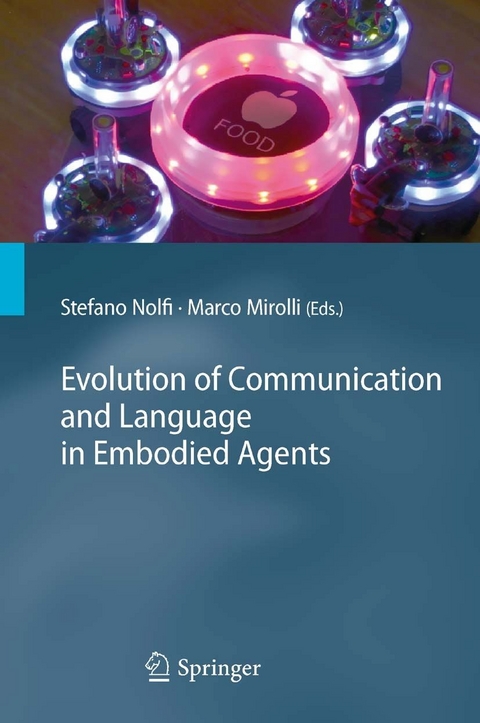
Evolution of Communication and Language in Embodied Agents (eBook)
XI, 313 Seiten
Springer Berlin (Verlag)
978-3-642-01250-1 (ISBN)

This field of research examines how embodied and situated agents, such as robots, evolve language and thus communicate with each other. This book is a comprehensive survey of the research in this emerging field.
The contributions explain the theoretical and methodological foundations of the field, and then illustrate the scientific and technological potentials and promising research directions. The book also provides descriptions of research experiments and related open software and hardware tools, allowing the reader to gain a practical knowledge of the topic.
The book will be of interest to scientists and undergraduate and graduate students in the areas of cognition, artificial life, artificial intelligence and linguistics.
Contents 5
1 A Synthetic Approach to the Study of the Evolution of Communication and Language 12
Introduction 12
Scope and Objectives of the Book 14
Overview 14
Theoretical Aspects of Communication and Language 15
Artificial Organisms with Human Language 15
Evolution of Language as One of the Major Evolutionary Transitions 15
Strategic Aspects of Communication 15
Theoretical Tools in Modeling Communication and Language Dynamics 16
Emergence of Scale-Free Syntax Networks 16
Evolution of Communication 16
Evolving Communication in Embodied Agents: Theory, Methods, and Evaluation 16
Evolutionary Conditions for the Emergence of Communication 16
The Phylogenetic and the Adaptive Problems of Communication: Insights from Modeling 17
Evolution of Signaling in a Multi-Robot System: Categorization and Communication 17
Evolution and Complexification of Implicit and Explicit Communication in Groups of Mobile Robots 17
Evolving Communication in Embodied Agents: Progresses and Open Challenges 17
Evolution of Language 18
Modeling The Formation of Language in Embodied Agents: Methods and Open Challenges 18
Modeling The Formation of Language: Embodied Experiments 18
Mathematical Modeling of Language Games 18
Modeling the Formation of Language in Embodied Agents: Conclusions and Future Research 18
Conclusion 19
Embodied and Communicating Agents: Towards the Establishment of a Solid Theoretical and Methodological Framework 19
Appendix: Software and Hardware Tools 19
Major Objectives 19
Acknowledgements 19
References 20
Part I Theoretical Aspects of Communication and Language 21
2 Artificial Organisms with Human Language 22
Understanding the Behavior of Real Organisms by Constructing Artificial Organisms 22
Artificial Organisms with Human Language 24
Nine Properties of Human Language 25
Linguistic Signals are Arbitrarily Linked to Their Meanings 25
Language is Compositional 27
Language is Culturally Transmitted and Evolved 29
Language is Used to Talk to Oneself and Not Only to Others 30
Language is Used for Communicating About the External Environment 32
Language Uses Displaced Signals 33
Language is Intentional and Requires Recognizing the Intentions of Others 34
Language is the Product of a Complex Nervous System 36
Language Influences Human Cognition 38
Between Them or with Us? 40
References 43
3 Evolution of Language as One of the Major Evolutionary Transitions 45
Introduction 45
Notes on the Neurobiology of Language 48
Towards a Genetic Approach to Language 49
The Status of Recursion in Animals and Human 49
Genetic Assimilation in Language Evolution 51
Prerequisites for Language and the Concept of a Human-Specific Adaptive Suite 51
Selective Scenarios for the Origin of Language 53
What Made Language Origins Difficult? 54
A Possible Modeling Approach 56
Evolutionary Neurogenetic Algorithm (ENGA) 57
The Origin of a Language as a Proper Major Evolutionary Transition 57
References 58
4 Strategic Aspects of Communication 62
Defining the Strategy Concept 62
Strategy Generation 63
A Strategic Approach to Communication 64
Costly Signaling 64
Cooperative Signaling, Antagonistic Co-evolution, and Subversion 67
Animal-Animal Antagonistic Co-evolution 67
Plant-Animal Antagonistic Co-evolution 68
Human-Human Interactions 68
Artificial Agents' Co-evolution 69
Signaling Between "Super-organisms" 69
Summary 70
References 70
5 Theoretical Tools in Modeling Communication and Language Dynamics 73
Introduction 73
Concepts and Tools 75
Order and Disorder: The Ising Paradigm 76
Role of Topology 79
Dynamical Systems Approach 81
Agent-Based Modeling 82
Conclusions 84
References 85
6 Emergence of Scale-Free Syntax Networks 88
Introduction 88
Building Syntactic Networks 90
Evolving Syntax Networks 92
Global Organization 93
Small World Development 93
Scale-Free Topology 96
Modeling Syntactic Network Evolution 96
Simple SO Graph Growth Models 97
Network Growth Model and Analysis 97
Discussion 102
References 104
Part II Evolution of Communication 107
7 Evolving Communication in Embodied Agents: Theory, Methods, and Evaluation 108
Introduction 108
Theory 109
The General Framework: Embodied Cognition 109
Situatedness 109
Embodiment 109
Adaptivity 110
Communication as a Complex Adaptive System 111
Method 112
Adaptive Methods for Designing Self-organizing Communication Systems 112
Evolutionary Algorithms 113
Simulated Annealing 114
Reinforcement Learning 115
Research Methodology 116
Evaluation Criteria 117
Adaptive Role 117
Expressive Power and Organizational Complexity 118
Number of Signals 118
Type of Signals 118
Protocol Regulating Signaling Behaviors 119
Signal Structure 120
Stability, Robustness, and Evolvability 120
Knowledge Gain (Modeling) 121
Summary and Conclusion 121
References 122
8 Evolutionary Conditions for the Emergence of Communication 125
Introduction 125
Experimental Setup 128
The Task 128
Neural Controller 128
Artificial Evolution 130
Quantifying Behavior 130
Honest Communication 131
Deceptive Communication 134
Conclusion 135
References 136
9 Producer Biases and Kin Selection in the Evolution of Communication 137
Introduction 137
Two Problems in the Evolution of Communication 139
The Biological Literature and the Manipulation Bias 139
The Phylogenetic Problem 140
The Adaptive Problem 141
Disentangling the Two Problems 142
Experimental Set-Up 143
The Environment and the Task 143
The Neural Network 144
Individual Life and the Fitness Formula 144
The Genetic Algorithm 145
Measuring Communication System Quality 146
Cognitive, Genetic, and Adaptive Factors in the Evolution of Communication 146
The Kin-Selection Simulation 149
Simulation 149
Results 149
The No-Cognitive-Pressure and No-Communication Simulations 150
Simulations 150
Results 152
Discussion 154
The Producer Bias Hypothesis 155
Adaptive Factors 158
References 159
10 Evolution of Signaling in a Multi-Robot System: Categorization and Communication 162
Introduction 163
Methods 163
Description of the Task 163
The Simulation Model 165
The Controller and the Evolutionary Algorithm 166
The Fitness Function 167
Results 168
A First Series of Post-evaluation Tests 169
Sound Signaling and Communication 170
Behavioral Features and Mechanisms 170
The Role of Sound 172
On the Adaptive Significance of Signaling 173
Functions of Sound Signaling 174
The Social Function of Sound Signaling as a Means to Obtain Robustness 174
Conclusions 177
References 179
11 Evolution of Implicit and Explicit Communication in Mobile Robots 180
Introduction 180
Experimental Setup 181
The Environment and the Robots 182
The Neural Controller 182
The Evolutionary Algorithm 184
Results 186
Symmetrical Strategy 188
Motor and Communication Behaviors Repertoire 188
Communication System 192
Evolutionary Origin of Robots' Communicative and Non-communicative Skills 194
Asymmetrical Strategy 197
Motor and Communication Behaviors Repertoire 197
Communication System 201
Evolutionary Origin of Robots Communicative and Non-communicative Skills 202
Discussion 205
Appendix 211
Sensors and Actuators 211
Update Functions of the Neurons 212
Simulation 212
Criteria Used to Identify the Behavior Exhibited by the Robots Analyzed in Sect. 3.2 213
Supplementary Data 214
References 214
12 Evolving Communication in Embodied Agents: Assessment and Open Challenges 216
Introduction 216
Adaptive Role 216
Expressive Power and Organization Complexity 217
Stability, Robustness, and Evolvability 218
Knowledge Gain (Modeling) 219
Open Questions for Future Research 220
References 220
Part III Evolution of Language 222
13 Modeling The Formation of Language in Embodied Agents: Methods and Open Challenges 223
Introduction 223
Methods 224
Challenges 226
Mechanism Design of Language Games 226
Concept Formation 228
Lexicon Formation 229
Grammar Formation 230
References 232
14 Modeling the Formation of Language: Embodied Experiments 234
Introduction 234
The Grounded Naming Game 235
Sensori-motor Aspects 236
Conceptual Aspects 238
Linguistic Aspects 241
Establishing Object Identity 243
Experimental Results 244
Spatial Language and Perspective Reversal 246
Sensori-motor Aspects 246
Conceptual and Linguistic Aspects 248
Results 249
The Case Experiment 252
Sensori-motor Aspects 253
Linguistic Aspects 254
Conclusion 259
References 260
15 Mathematical Modeling of Language Games 262
Introduction 262
The Naming Game 263
The Minimal Naming Game 264
Macroscopic Analysis 265
Symmetry Breaking: A Controlled Case 267
The Role of the Interaction Topology 268
Variants of the Naming Game 269
The Category Game 269
The Category Game Model 271
Modeling Categories 271
Negotiation Dynamics 271
Hierarchical Coordination 273
Conclusions 277
References 278
16 Modeling the Formation of Language in Embodied Agents: Conclusions and Future Research 281
Introduction 281
Embodiment 281
Language Games 282
Concept Formation 282
Lexicon 283
Grammar 284
Mathematical Modeling 284
References 286
Part IV Conclusion 287
17 Embodied and Communicating Agents: Towards the Establishment of a Solid Theoretical and Methodological Framework 288
References 290
Part V Appendix: Software and Hardware Tools 292
Evorobot* 293
Introduction 293
Evorobot* Features 294
The Evolutionary Algorithm 294
The Neural Network Simulator 294
The Robot/Environmental Simulator 295
The Graphic Interface 296
The Evorobot* Firmware 296
Using Evorobot* 296
Setting up an Experiment 296
Running an Experiment 297
Analyzing Obtained Results 297
Extending the Evorobot* Source Code 297
User Manual, Tutorials & Download Instructions
References 297
E-puck 298
Introduction 298
The E-puck Robot 299
Communication Turrets 299
LED Light Turret 299
Omni-directional Camera Turret 300
Communication Experiments 300
References 301
Babel 302
Introduction 302
Overview 303
Illustration 305
Outlook 308
| Erscheint lt. Verlag | 28.11.2009 |
|---|---|
| Zusatzinfo | XI, 313 p. |
| Verlagsort | Berlin |
| Sprache | englisch |
| Themenwelt | Informatik ► Theorie / Studium ► Künstliche Intelligenz / Robotik |
| Technik | |
| Schlagworte | adaptive behavior • Artificial Intelligence • Artificial Life • Babel • Chemical communication • Communicating Agents • Complex Systems • embodied agents • E-puck • Evorobot* • Grounded communications • Human language • language evolution • Linguistics • Multiagent Systems • Multirobot systems • Robotics • Self-Organization • swarm robotics • Wiener |
| ISBN-10 | 3-642-01250-7 / 3642012507 |
| ISBN-13 | 978-3-642-01250-1 / 9783642012501 |
| Informationen gemäß Produktsicherheitsverordnung (GPSR) | |
| Haben Sie eine Frage zum Produkt? |
 PDF (Wasserzeichen)
DRM: Digitales Wasserzeichen
Dieses eBook enthält ein digitales Wasserzeichen und ist damit für Sie personalisiert. Bei einer missbräuchlichen Weitergabe des eBooks an Dritte ist eine Rückverfolgung an die Quelle möglich.
Dateiformat: PDF (Portable Document Format)
Mit einem festen Seitenlayout eignet sich die PDF besonders für Fachbücher mit Spalten, Tabellen und Abbildungen. Eine PDF kann auf fast allen Geräten angezeigt werden, ist aber für kleine Displays (Smartphone, eReader) nur eingeschränkt geeignet.
Systemvoraussetzungen:
PC/Mac: Mit einem PC oder Mac können Sie dieses eBook lesen. Sie benötigen dafür einen PDF-Viewer - z.B. den Adobe Reader oder Adobe Digital Editions.
eReader: Dieses eBook kann mit (fast) allen eBook-Readern gelesen werden. Mit dem amazon-Kindle ist es aber nicht kompatibel.
Smartphone/Tablet: Egal ob Apple oder Android, dieses eBook können Sie lesen. Sie benötigen dafür einen PDF-Viewer - z.B. die kostenlose Adobe Digital Editions-App.
Buying eBooks from abroad
For tax law reasons we can sell eBooks just within Germany and Switzerland. Regrettably we cannot fulfill eBook-orders from other countries.
aus dem Bereich