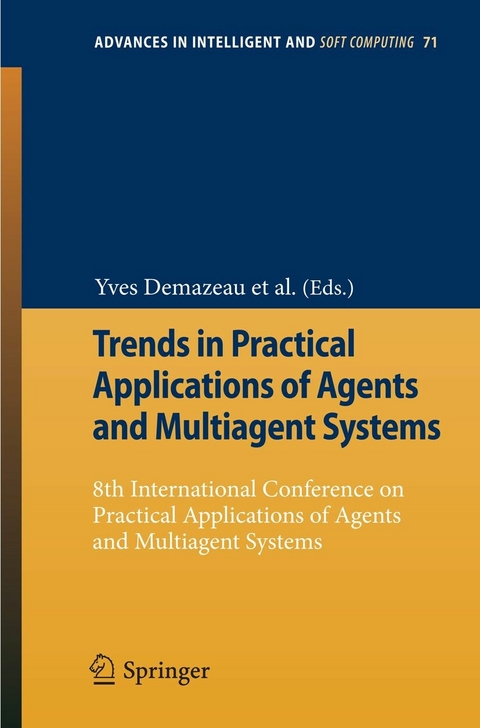
Trends in Practical Applications of Agents and Multiagent Systems (eBook)
700 Seiten
Springer Berlin (Verlag)
978-3-642-12433-4 (ISBN)
Preface 6
Organization 8
Table of Contents 14
Special Session on Adaptive Multiagent Systems 23
Use of Agents to Realize a Federated Searching of Learning Objects 23
Introduction 23
Outline Problem 24
Modeling a Federated Searching of Learning Objects 25
Implementation of Model 26
Related Work 28
Conclusions 29
References 29
MDD for Virtual Organization Design 31
Introduction 31
Related Work 32
Modeling a Virtual Organization 33
Using MDD for VO Design: Development Process 34
Conclusions 38
References 38
Towards Soccer Simulation as a Testbed for Adaptive Systems and Agreement Technologies 40
Introduction 40
Abstract Framework for Soccer Simulation 41
Gameplay Level 42
Institutional Level 43
Basic Soccer Team 44
Agreement Technologies and Adaptation 45
Agreement Technologies 45
Adaptation 46
Conclusions and Future Work 47
References 47
Normative Argumentation 49
Introduction 49
Background 50
Argumentation for Contract Agreement 51
Initial Arguments 51
Attacks 52
Dialogue Game Protocol for Contract Agreement 54
Conclusions and Future Work 56
References 56
Engineering Ambient Intelligence Services by Means of MABS* 57
Introduction 57
AmISim Architecture 58
An Example of AmI Service Development 59
Methodology for Model Learning and Service Building 60
Environment and Agent Models 60
Approaches for Indoor Location 62
An Approach Based on HMM for Location Service 62
Conclusions 63
References 64
Mobile Agent Middleware for Intelligent Management of Communication Infrastructures 65
Introduction 65
Related Works 66
General Description of the Operation Context 66
Middleware Architecture 69
A Case of Use 71
Conclusions 71
References 72
A Multiagent System for Efficient Portfolio Management 73
Introduction 73
Related Work 74
Multiagent System Description 75
The Interface Agent 75
The Analysis Agent 76
Information Agent 77
Experiments 78
Conclusions 79
References 79
Managing Real-TimeWeb Services through Agents 81
Introduction 81
System Architecture to Support Real-TimeWeb Services 82
Real-Time Web Services 83
Service Provider Agent 84
Performance 86
Conclusions and Future Work 88
References 88
Open MAS Architecture. Providing Real Time Solutions 89
Introduction 89
Ovamah 90
Real-Time Agents and Temporal-Bounded Services 91
Extending the Architecture with Real-Time Agents 92
Conclusions 95
References 96
Special Session on Multiagent Systems for Health Care and Bioinformatics 97
PathAgent: Multi-agent System for Updated Pathway Information Integration 97
Introduction 97
PathAgent Architecture 98
Agent Roles 99
Ontology 100
Agent Inter-Communication 102
Results and Discussion 103
Conclusions 104
References 104
Multi-agent System for Mass Spectrometry Analysis 106
Introduction 106
System Design 108
Mass Spectrometry Sample Study 108
Data Model 109
Step Interfaces 109
MaSAS Workflow 109
Web Interface 111
Multi-agent System Architecture 111
Conclusions and Further Work 113
References 113
Multi-agent Personal Memory Assistant 115
Introduction 115
Ageing Factors 116
iGenda: Scheduling and Organization 116
Agents Communication 117
Agenda Manager 118
Conflicts Manager 119
Free Time Manager 119
Interface Manager 120
Conclusions 121
References 121
TENSSION: A Tool for the Medical Patient Follow-Up 123
Introduction 123
Motivations and Related Work 124
Overview of TENSSION 124
Results and Conclusions 130
References 130
Dynamic Planning with Bayesian Network Applied in MAS 131
Introduction 131
Dynaminc Analysis in Multiagent Systems 132
Case Study: A Decision Support System for Patients Diagnosis 136
Services Layer 136
Agents Layer 136
Results and Conclusions 137
Referentes 138
Special Session on Multiagent Systems for Ambient Intelligence 140
Enhancing the Role of Multi-agent Systems in the Development of Intelligent Environments 140
Introduction 140
The Classical Approach 141
The Three Step Approach 142
Our Experience: The VirtualECare Project 145
Conclusions 146
References 147
Towards Distributed Wireless Intelligent Sensor Networks 148
Introduction 148
Structure of the System 149
Fuzzy Rule Based System Adapted to the Sensors 150
Application Communication Protocol 151
Results 152
Conclusions 154
References 155
Context-Aware Agents for Vehicular Networks: An Aspect-Oriented Approach 156
Introduction 156
Related Work 157
Case Study: A Refuel Recommender Service for VANETs 158
A Context-Aware Agent in Malaca 159
Design of a Context-Aware Agent Using Aspect-Orientation 159
Implementation of the Context-Aware Aspects 162
Conclusions and Future Work 163
References 163
Reasoning on a Semantic Web Based Context-Awareness Middleware* 164
Introduction 164
Context Reasoning within OCP 165
AmI Example 169
Related Work 170
Conclusions and Future Work 171
References 171
Agent-Based AmI System Case Study: The Easy Line + Project 173
Introduction 173
Reasons to Apply a Muti-agent System Approach in AmI 174
Systematization of the Easy Line + Project into Agent Domains 175
Agent Specifications in the Easy Line + Project 177
Conclusions and Future Work 179
References 180
Multiagent System for Detecting Passive Students in Problem-Based Learning 181
Introduction 181
Related Works 182
Multiagent Systems 183
Simple Reflex Agents 184
Reflex Agents with Internal State 184
Agent-Based Approach for Detecting Passive Students in Problem-Based Learning 185
Problem Detection Agent 185
Animated Interface Agent 186
FinalRemarks 187
References 188
Context-Aware Agents for People Detection and Stereoscopic Analysis 189
Introduction 189
Background 190
Our Approach 191
Experiment and Results 194
Conclusions and Future Work 196
References 196
Analysis and Design of a SOA-Based Multi-agent Architecture 198
Introduction 198
Problem Description 199
Analysis and Design of FUSION@ 201
Results and Conclusions 204
References 205
Special Session on Multi-Agent Systems for Manufacturing and Supply Chain 206
A Multiagent Scheduling Repair Method for Disruption Management in Complex Socio-technical Organizations 206
Introduction 206
Context, Problematic and Objectives of the Work 206
Cooperative Distributed Scheduling Repair Method for Managing Disruptions in Complex Organizations 207
Repair Operations 208
Strategies for Solving Disruptions 209
Agent Based Modelling for Distributed Problem Solving 209
Agent Modelling 210
Agent Behaviour Design 211
Illustration of the Method on the Case Study 212
Test Platform 212
Conclusion and Future Work 213
References 213
Price Updating in Combinatorial Auctions for Coordination of Manufacturing Multiagent Systems 215
Multiagent Systems in Manufacturing 215
Market Based Coordination Mechanisms and Combinatorial Auctions 216
Proposed Mechanism 217
Combinatorial Auctions and Lagrange Relaxation Techniques 219
Research Line 220
References 220
Study on Integrated Model of Lean and Agile Supply Chain Based on Multi-DPs 222
Introduction 222
Multi-DPs 223
Product Structure Tree Model of Core Enterprise in Supply Chain 224
Location Model of Lean and Agile Supply Chain Based on Multi-DPs 225
Analysis of Location Model of Lean and Agile Supply Chain Based on Multi-DPs 227
Summary 228
References 229
Towards Improving Supply Chain Coordination through Agent-Based Simulation 230
Introduction 230
Background Information 231
A Multiagent-Based Framework for Overall SC Simulation 232
Conceptualising SCM 232
Formalising SCM 233
Simulating SCM 234
Conclusions and Future Work 236
References 237
Using Multi-agent System for Improving and Implementing a New Enterprise Modeling Tool 238
Introduction 238
GRAIXPERT, GRAISUC and GRAIQUAL 239
Multi-agent Systems 242
Combining CBR and Multi-agent Systems 244
Conclusions 245
References 245
Production Process Based on CIMOSA Modeling Approach and Software Agents 246
Introduction 246
The Factory Characteristics 248
CIMOSA Domain Concept 248
Multi-agent Approach 249
Multi-agent Approach for Long Cycle Process 250
Conclusions 253
References 253
A Beehive-Like Approach for Dynamic Generation of Integration Services to Enable Adaptive Supply Chains Using Enterprise Tomography 254
Fundamentals 254
Diversity 254
Enterprise Tomography 255
Semantic Supply Chain Management 256
Problem Definition 257
Approach 258
The Beehive Module 258
The Enterprise Tomograph 259
The Dynamic Interoperability Framework 259
Conclusion 260
References 260
Cooperative Purchasing of Logistics Services among Manufacturing Companies Based on Semantic Web and Multi-agent System 262
Introduction-Project Background 262
MASEW Model 264
Conclusions 269
References 269
Sandbox for Development of Evolving Manufacturing Control Architectures 270
Introduction 270
Background 271
Framework 271
Agent Representation 271
Heterarchical Control Infrastructure 273
Hierarchical Control Infrastructure 275
Comparing Control Structures 275
Example Structure 276
Summary and Future Work 277
References 277
Agent-Based Model of Kanban Flows in the Environment with High Demand Variances 279
Introduction 279
Problem Description and Background 281
Results and Conclusions 284
References 286
Supply Chain with Reverse Flows- Benefiting from Recycled Resources 288
Introduction-Project Background 288
Reverse Flows in Supply Chain and Their Influence on Logistics Operations 290
Problem Definition 290
Data and the Identified Constrains 291
Model 291
Simulation 293
Conclusions 294
References 295
Special Session on Enterprise Application and Information Integration 296
e-Wedding Based on Multi-agent System 296
Introduction 296
Related Works 297
The Methodologies 297
Multi-agent Systems 297
Web Services 298
Ontology 299
Data Mining Techniques 299
The Proposed Architecture of e-Wedding 300
Implementation 301
Conclusion and Future Works 303
References 303
Distributed Computing Using RESTful SemanticWeb Services 305
Introduction 305
Service Model 306
A Process Calculus for RESTful Semantic Services 307
Implementation of RESTful Semantic Web Services 309
Conclusions 311
References 312
Enhancing the Services Integration Mechanism in the HoCa Multi-agent Architecture 313
Introduction 313
Problem Description and Background 314
Communication Protocol to Integrate Web Services and Multiagent Systems 315
Agents with Advanced Services Coordination Abilities 317
Results and Conclusions 318
References 319
Integrating Deep-Web Information Sources* 321
Introduction 321
Form Filling 323
Navigator 324
Information Extractor 325
Verifier 326
Conclusion and Future Work 327
References 328
Ontological Trading in a Multi-agent System 331
Introduction 331
Trading-Based Multiagent System 333
Trading Ontologies 334
An Example of Execution 336
Conclusions and Future Work 338
References 339
An Agent-, Service-Based Platform Supporting Ontological Integration of Proficient Knowledge Managed in Decision Making 340
Introduction 340
Semantic Case Description 341
Technological Platform Supporting Knowledge Integration and Sharing 343
Identification of Actors and Functional Subsystems 343
Architecture 343
Service-Based Agent Coordination 344
Quality Architecture Attributes 345
Conclusions 346
Referentes 347
Special Session on Software Agents in Knowledge Management 348
A Multi-agent Recommender System to Suggest Documents in Communities of Practice 348
Introduction 348
Internal Agent Architecture 349
Social-Deliberative Level 350
Reactive Level 351
A Recommender System 351
Description of the Algorithm 352
Conclusions 354
References 355
AIDeM: Agent-Based Intrusion Detection Mechanism 356
Introduction 356
FUSION@ Architecture and Current Mechanism of Security 357
AIDeM: Agent-Based Intrusion Detection Mechanism 359
Results and Conclusions 361
References 363
A Multi-agent System that Searches for Learning Objects in Heterogeneous Repositories 364
Introduction 364
Searching for Learning Objects in Repositories 365
Learning Objects Repositories 366
Overview of BRENHET 367
BRENHET Search Architecture 368
Results and Conclusions 371
References 371
Application of a Modeling Standard Language on the Definition of Agent Oriented Development Processes 372
Introduction 372
Global Overview of the INGENIAS Process 373
Introduction 373
Description of the Process 374
INGENIAS Metamodel 374
Inception Phase 375
Process Roles 376
Activity Details 376
Conclusions and Further Work 377
References 378
Variable Length-Based Genetic Representation to Automatically Evolve Wrappers 380
Introduction 380
Evolutionary Regular Expression Wrapper 381
Evaluation 383
Conclusions and Future Work 386
References 387
A Case Study on Grammatical-Based Representation for Regular Expression Evolution 388
Introduction 388
Graph-Based Representation for Regex 389
A Brief Introduction to Regular Expressions 389
A Particular Example on Web Data Extraction 390
Nodes Representation 390
Population Representation and Initial Population Generation 391
Mutation and Crossover Operations for Regex Evolution 392
Experimental Results 393
Conclusions 395
References 395
Towards the Automatic Programming of H Systems: jHsys, a Java H System Simulator 396
Motivation 396
Introduction 398
Introduction to Splicing Systems 398
jHSys: A Java Splicing Systems Simulator 399
Conclusions and Future Research 402
References 403
L Systems as Bio-MAS for Natural Language Processing 404
Introduction 404
Lindenmayer Systems 405
L Systems as Bio-inspired Multi-agent Systems 407
Applying L Systems to Natural Language Processing 408
Conclusions 410
References 411
Poetic RNA: Adapting RNA Design Methods to the Analysis of Poetry 412
Introduction 412
Background 413
Constraint Handling Rules (CHR) and Grammars (CHRG) 413
The chrRNA Method for RNA Design 414
Poetic RNA: A Multi-Agent Model 416
Poetic Style 416
Agents in Poetic RNA 416
Concluding Remarks 418
References 419
A Visual Language for Modelling and Simulation of Networks of Evolutionary Processors 420
Introduction 420
Introduction to AToM3 420
Introduction to NEPs 421
Introduction to jNEP and jNEPview 423
NEPs Visual Language 424
User Point of View - How Domain Experts Use It 425
Conclusions and Further Research Lines 426
References 427
An Evolutionary ConfidenceMeasure for Spotting Words in Speech Recognition 428
Introduction 428
Speech Recognition 429
Confidence Measure 431
Feature Selection 431
MLP-Based Classification 432
Evolutionary Algorithm-Based Classification 432
Experiments 432
Experimental Setup 432
Results and Discussion 433
Conclusions 435
References 435
Workshop on Artificial Intelligence and DistributedSystems 437
Intelligent Agents and Wireless Sensor Networks: A Healthcare Telemonitoring System 437
Introduction 437
Problem Description 439
System Description 440
Integration of SYLPH and FUSION@ 441
Implementation of the Healthcare Telemonitoring System 441
Conclusions and Future Work 443
References 444
Indoor Navigation Multi-agent System for the Elderly and People with Disabilities 445
Introduction 445
Appliying User-Centred Design to Guidance Systems 446
Implementation of the Multi-agent System 447
GUIA Routing Algorithm 449
Conclusions 449
References 450
Algorithms of Machine Learning for K-Clustering 451
Introduction 451
Approaches of Genetic Algorithm 452
Representation 452
Fitness Function 453
Crossover 453
Mutation 455
Parameter Values 455
Experiments 456
Data Sets 456
Objective Function 456
Adaptions 457
Results and Conclusions 458
References 459
Monitoring and Adaptation of Assessment Process in Virtual Courses Based in Multi-agent Systems 461
Introduction 461
Adaptive Assessment in Virtual Courses 462
MAS Proposal for Adaptive Assessment 464
SICAd Platform, Intelligent System of Adaptive Courses 466
Conclusions and Future Work 467
References 468
A Model-Based Ambient Agent Providing Support in Handling Desire and Temptation 469
Introduction 469
Desires, Preparations and Feelings 470
The Ambient Agent Model 471
Simulation Results for the Ambient Agent Model 477
Analysis of the Ambient Agent Model by Automated Verification 480
Discussion 481
References 482
Cluster Analysis and Decision Trees of MR Imaging in Patients Suffering Alzheimer’s 484
Introduction 485
Systems and Methods 486
Dataset Source 486
Tissue Classification and Regional Segmentation 486
Cortical Thickness Measurements 487
Variables 487
Analysis 488
Cluster Analysis 488
Decision Trees 490
Discussion and Conclusions 490
References 491
Improving the Quality of Health Service with Smart Communication 492
Introduction 492
Painalli Architecture 494
Architecture Components 494
HC-MAS 1.0 System 496
Agent Platform 497
Results and Conclusions 497
References 499
Multi-agent System (MAS) Applications in Ambient Intelligence (AmI) Environments 500
Introduction 500
MAS Architecture for AmI 502
Case Study I: Airport Scenario 504
Case Study II: Railway Station Scenario 505
Conclusions 505
References 506
Agents to Help Context-Aware System in Home Care 508
Introduction 508
The Interpreter Agent in HCCAC 509
Interpreter Agent Design 510
Applying HCCAC in Context-Aware Environments 512
Results and Conclusions 513
References 514
SDL Ontology for Specifying Systems Based on Finite State Machines 516
Introduction 516
Specification and Description Language Modeling 517
SDL Ontology Core Development 518
SDL Markup Language 519
Case Study: FIPA Request Protocol for Multi-agent Systems 521
Conclusion 523
References 523
Applying Data Mining Techniques to Stock Market Analysis 525
Introduction to the Problem 525
The Data Processing Phase 526
Financial Indicators 527
Processing of the Financial Indicators 529
Transformed Data: The OAT 529
The Data Mining Phase 530
The Evaluation Phase 531
Conclusions and Future Work 532
References 532
Synthesis and Analysis of Classifiers Based on Generalized Model of Identification 534
Introduction 534
Concept and Justification for Mathematical Model 536
Properties of Model 539
Conclusion 540
References 541
Multiagent Based Spectrum Sharing Using Petri Nets 542
Introduction 542
Related Work 544
Cooperative Spectrum Sharing 544
Agent 544
Description of Cooperative Framework 544
Representation of Cooperative Network Using Petri Nets 546
Some Experimental Results 549
Conclusion and Future Perspectives 550
References 551
A Multi Agent Architecture for Tourism Recommendation 552
Introduction 552
Background 553
e-Tourism MAS Architecture Overview 554
UserAgent 555
GRSK Organization 557
PlannerAgent 558
Conclusions and Further Work 558
References 559
Improving Functionalities in a Multi-agent Architecture for Ocean Monitoring 560
Introduction 560
Problem Description and Background 561
Multiagent System for Predicting the Ocean Behaviour 562
Agents with Advanced Prediction Abilities 563
Results and Conclusions 565
References 566
Multiagent Systems in Stock Index Prediction 568
Introduction 568
The Bovespa Index 569
Multiagent Systems for Modeling and Forecasting of the Stock Markets 570
Neural Networks 571
The Agents 571
Prediction a Step Forward 573
Results and Conclusions 575
References 575
Experiments on Robotic Multi-agent System for Hose Deployment and Transportation 577
Introduction 577
Robotic Multi-agent System for Hose Transportation 578
Proof-of-Concept Prototype and Experiment 579
Hardware and Communications 579
Perception 580
Control Heuristic 581
Experiment Realization 583
Conclusions and Discussion 583
References 584
On Cooperative Swarm Foraging for Simple, Non Explicitly Connected, Agents* 585
Introduction 585
Swarm Design 586
Macroscopic Model 588
Experimentation 589
Design of Experiments 590
Results 590
Discussion 591
References 592
Analyzing Large-Scale Crowd Simulations for Building Evacuation* 594
Introduction 594
Architecture and Implementation of Building Evacuation 595
Performance Evaluation 597
Conclusions 600
References 601
Agent Collaboration Framework 602
Introduction 602
Lacks of Collaborative CASE Tools 603
Introduction to a Model 603
Architecture 603
Agents Integration 604
Group Concurrency 605
Ontologies 606
Test Case 606
Conclusions and Future Works 608
References 608
Workshop on Systems, Man, & Cybernetics: SMC-Workshop.- IEEE.- SPANISH CHAPTER
Some Issues and Extensions of JADE to Cope with Multi-agent Operation in the Context of Ambient Intelligence 610
Introduction 610
Improving Agent Communication 612
Multi-agent Declarative Model 615
Conclusions 616
References 617
P300-Based Brain-Computer Interface for Internet Browsing 618
Introduction 618
Brain Computer Protocol 619
EEG Hardware 619
Feature Extraction 619
Classification 620
Implementation 621
Developed Software 621
Graphical Interface 621
Execution Protocol 621
Experimental Test 622
Participants 622
Protocol 623
Experimental Results 623
Conclusions 624
References 624
Modeling Virtual Agent Behavior in a Computer Game to Be Used in a Real Enviroment 626
Introduction 626
Related Works 627
Execution Platform 628
General Game Structure 628
Modeling Game 629
Modeling the State of the Bellboy 629
Cognitive System 630
Behavior System 631
Conclusions 632
References 633
A Legal View of Ambient Assisted Living Developments 634
Introduction 634
Legal Consideration in Biometric User Identification 635
Regulatory Model for AAL Developments 636
An AAL Case of Study 639
References 640
An Intelligent Tutoring System Oriented to the Integration of People with Intellectual Disabilities 642
Introduction 643
Architecture of LAGUNTXO System 643
Evaluation 646
Heuristic Evaluation 646
Pilot Test 647
Concluding Remarks and Future Outlines 649
References 649
An Automatic Programming ACO-Based Algorithm for Classification Rule Mining 651
Introduction 651
The GBAP Algorithm 652
Rules Encoding 653
Pseudocode and Main Characteristics of GBAP 653
Data Sets and Preprocessing 656
Results 657
Conclusions and Future Work 658
References 658
Energy Cost Reduction in the Synchronization of a Pair of Nonidentical Coupled Hindmarsh-Rose Neurons 659
Introduction 659
Four-Dimentional Hindmarsh-Rose Model Energy 661
Synchronization Energy of Two Electrically Coupled Neurons 662
Conclusion 666
References 666
A Color Transformation for Robust Detection of Color Landmarks in Robotic Contexts 667
Introduction 667
Some Properties of the RGB Cube and the DRM 668
Some Properties of RGB 668
Dichromatic Reflection Model (DRM) 668
RGB Features from the DRM Point of View 669
Method 670
Application 670
Experiments 670
Mark Detection 671
Synthetic Images 672
Real Robot Detection 672
Conclusions and Futher Work 673
References 674
Low Quality Data Management for Optimising Energy Efficiency in Distributed Agents 675
Introduction 675
Issues in Low Quality Data Management 677
Enhancing the Energy Efficiency in Distributed Agents with Low Quality Data Management 678
Obtaining Models for Simulation of Lighting Systems 678
Improving the Control Decisions in Lighting 679
Computer Assisted Decision Making 680
Conclusions 680
References 681
Interactive Multimedia Tabletops (IMT) for Casual Users 683
Introduction 683
Review 684
IMTforCasualUsers 685
Perception of Naturalness Is Not Universal 686
Interaction Languages for Casual Users 686
Guiding the User on the Interaction Possibilities 687
Interaction Naturalness Measures for Casual User IMT 687
Conclusions 688
References 688
Emotion Elicitation Oriented to the Development of a Human Emotion Management System for People with Intellectual Disabilities 691
Introduction 692
Human Emotion Analysis 692
Modelling Emotions Physiologically Perceivable 693
Modelling Emotions Physiologically Non-perceivable 694
Experimental Stage 694
Preliminary Results 695
Elicitation Video Database 695
Evaluation 697
Concluding Remarks and Future Outlines 697
References 698
Acoustic Phonetic Decoding Oriented to Multilingual Speech Recognition in the Basque Context 699
Introduction 699
Phonetic Features of the Languages 701
Description of the Language Resources 702
Experimentation 703
Concluding Remarks 705
References 705
A Computer-Aided Decision Support System for Shoulder Pain Pathology 707
Introduction 708
Medical Method 709
Description of the Database 710
Experimentation 711
Concluding Remarks 713
References 714
Unsupervised Visualization of SQL Attacks by Means of the SCMAS Architecture 715
Introduction 715
A Multiagent Solution for SQL Anomaly Visualization 716
Unsupervised Projection Models 718
Experimental Results 719
Dataset 719
Experiments 720
Conclusions and Future Work 721
References 722
Assessing Knowledge Management in the Power Sector through a Connectionist Model 723
Introduction 723
Knowledge Management in the Energy/Power Market 724
Connectionist Projection Model 725
Case Study 726
Description of the Problem under Study 726
Experiments and Results 727
Comparative Study 729
Conclusions and Future Work 730
References 731
Author Index 732
"e-Wedding Based on Multi-agent System (p. 274-275)
Kobkul Kularbphettong, Gareth Clayton, and Phayung Meesad
Abstract. Multi-agent system is continuously utilized in e-Business that want to improve responsiveness and efficiency of systems. In this paper, we propose multi-agent-system and various techniques that are Web service, ontology, and data mining techniques. The multi agent system, which constitutes the backbone of the framework, connects these pieces together and makes them perform properly. JADE is the MAS platform implemented this project. JADE is quite easy to learn and use. Moreover, it supports many agent approaches such as agent communication, protocol, behavior and ontology. This framework has been experimented and evaluated in the realization of a simple, but realistic, prototype of an e-Wedding system. The results, though still preliminary, are quite encouraging.
Keywords: multi-agent system, Web services, ontology, data mining techniques, JADE, e-Wedding.
1 Introduction
Nowadays, the explosion of Internet and the grown-up of e-Commerce have rapidly changed the traditional business operation. Electronic Commerce, commonly known as e-commerce or eCommerce is the development and deployment technology of the commercial transactions electronically so as to meet the ever-growing demands of the modern life. Based on web-based business, the wedding business is one of the important businesses that it be huge and still rapidly expanding.
Booming of wedding business has also propelled the enhance of hotels, wedding studios, car hiring companies, flower shops, music, travel agencies, and even media businesses. Due to overwhelming information widely spread on internet and real world environments, it is very time consuming for couple to search appropriate information. Moreover, almost successful e- Commerce systems are still handled by humans to make the important decisions.
Therefore, with vastly developed advance mechanisms, in this paper we propose the framework of e-Wedding business applied various approaches like multiagent, web services, ontology, and data mining techniques. The remainder of this paper is organized as follows. Section 2 discusses about related literatures and research works. Section 3 presents the methodologies used in this work. Section 4 implements the purposed model with a multi-agent framework. This prototype demonstrates the whole idea of adapt multi-agent in e- Wedding. Finally, we conclude the paper with future research issues in section 5."
| Erscheint lt. Verlag | 16.4.2010 |
|---|---|
| Reihe/Serie | Advances in Intelligent and Soft Computing | Advances in Intelligent and Soft Computing |
| Zusatzinfo | 700 p. 247 illus. |
| Verlagsort | Berlin |
| Sprache | englisch |
| Themenwelt | Informatik ► Theorie / Studium ► Künstliche Intelligenz / Robotik |
| Technik | |
| Schlagworte | Agents • Artificial Intelligence • Bioinformatics • Computational Intelligence • Cybernetics • Knowledge • knowledge management • learning • Management • multi-agent system • Multiagent Systems • Norm • organization • Service • Simulation • Software • software agent |
| ISBN-10 | 3-642-12433-X / 364212433X |
| ISBN-13 | 978-3-642-12433-4 / 9783642124334 |
| Informationen gemäß Produktsicherheitsverordnung (GPSR) | |
| Haben Sie eine Frage zum Produkt? |
 PDF (Wasserzeichen)
DRM: Digitales Wasserzeichen
Dieses eBook enthält ein digitales Wasserzeichen und ist damit für Sie personalisiert. Bei einer missbräuchlichen Weitergabe des eBooks an Dritte ist eine Rückverfolgung an die Quelle möglich.
Dateiformat: PDF (Portable Document Format)
Mit einem festen Seitenlayout eignet sich die PDF besonders für Fachbücher mit Spalten, Tabellen und Abbildungen. Eine PDF kann auf fast allen Geräten angezeigt werden, ist aber für kleine Displays (Smartphone, eReader) nur eingeschränkt geeignet.
Systemvoraussetzungen:
PC/Mac: Mit einem PC oder Mac können Sie dieses eBook lesen. Sie benötigen dafür einen PDF-Viewer - z.B. den Adobe Reader oder Adobe Digital Editions.
eReader: Dieses eBook kann mit (fast) allen eBook-Readern gelesen werden. Mit dem amazon-Kindle ist es aber nicht kompatibel.
Smartphone/Tablet: Egal ob Apple oder Android, dieses eBook können Sie lesen. Sie benötigen dafür einen PDF-Viewer - z.B. die kostenlose Adobe Digital Editions-App.
Buying eBooks from abroad
For tax law reasons we can sell eBooks just within Germany and Switzerland. Regrettably we cannot fulfill eBook-orders from other countries.
aus dem Bereich