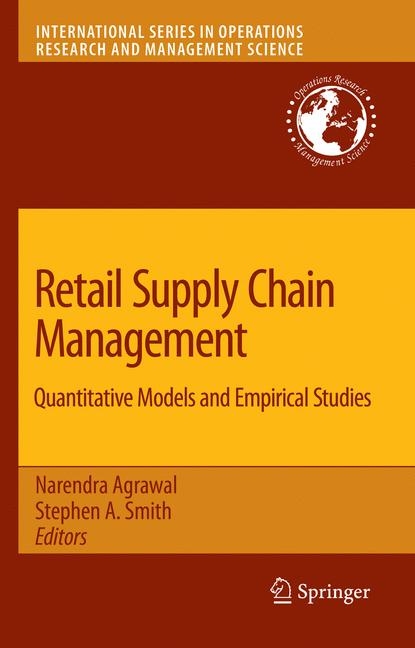
Retail Supply Chain Management (eBook)
XII, 340 Seiten
Springer US (Verlag)
9780387789033 (ISBN)
In today's retail environment, characterized by product proliferation, price competition, expectations of service quality, and advances in technology, many organizations are struggling to maintain profitability. Rigorous analytical methods have emerged as the most promising solution to many of these complex problems. Indeed, the retail industry has emerged as a fascinating choice for researchers in the field of supply chain management.
In Retail Supply Chain Management, leading researchers provide a detailed review of cutting-edge methodologies that address the complex array of these problems. A critical resource for researchers and practitioners in the field of retailing, chapters in this book focus on three key areas: (1) empirical studies of retail supply chain practices, (2) assortment and inventory planning, and (3) integrating price optimization into retail supply chain decisions.
In today's retail environment, characterized by product proliferation, price competition, expectations of service quality, and advances in technology, many organizations are struggling to maintain profitability. Rigorous analytical methods have emerged as the most promising solution to many of these complex problems. Indeed, the retail industry has emerged as a fascinating choice for researchers in the field of supply chain management.In Retail Supply Chain Management, leading researchers provide a detailed review of cutting-edge methodologies that address the complex array of these problems. A critical resource for researchers and practitioners in the field of retailing, chapters in this book focus on three key areas: (1) empirical studies of retail supply chain practices, (2) assortment and inventory planning, and (3) integrating price optimization into retail supply chain decisions.
Foreword 6
Preface 8
Contents 10
Contributors 12
Overview of Chapters 14
1.1 Background 14
1.2 The Focus Of Academic Research In This Volume 15
REFERENCES 21
Supply Chain Planning Processes for Two Major Retailers 23
2.1 Introduction 23
2.2 Supply Chain Description 25
2.3 Supply Chain Planning Processes 27
2.3.1 Product design and assortment planning 29
2.3.2 Sourcing & vendor selection
2.3.3 Logistics planning 31
2.3.4 Distribution planning and inventory management 32
2.3.5 Clearance and markdown optimization 33
2.3.6 Cross-channel optimization 34
2.4 Conclusion 34
REFERENCES 35
The effects of firm size and sales growth rate on inventory turnover performance in the U.S. retail sector 36
3.1 Introduction 36
3.2 Literature Review 39
3.3 Data Description 41
3.4 Adjusted Inventory Turnover 47
3.5 Hypotheses 48
3.5.1 Effect of firm size on inventory turnover 49
3.5.2 Effect of sales ratio on inventory turnover 51
3.6 Model 53
3.7 Results 54
3.8 Conclusions and Directions for Future Research 59
REFERENCES 62
The Role of Execution in Managing Product Availability 64
4.1 Introduction 64
4.2 Retail Execution Problems 65
4.2.1 Inventory record inaccuracy 66
4.2.2 Misplaced products 67
4.2.3 Root causes of execution problems 67
4.3 Factors that Exacerbate Execution Problems 69
4.3.1 Inventory levels 70
4.3.2 Product variety 71
4.3.3 Employee turnover and training 71
4.3.4 Employee workload 72
4.3.5 Employee effort 73
4.4 How Execution Problems Affect Inventory Planning 74
4.4.1 Effect of inventory record inaccuracy on inventory planning 74
4.4.2 Effect of misplaced products on inventory planning 75
4.4.3 Incorporating execution problems into existing research streams 76
4.5 Future Research Opportunities 77
4.1 APPENDIX 1 80
4.1.3 DeHoratius and Raman (2008) 80
4.1.3 Ton and Raman (2006) 82
4.1.3 Ton and Raman (2007) 84
REFERENCES 86
Category captainship practices in the retail industry 89
5.1 Introduction 89
5.1.4 Category captainship implementations in practice 90
5.2 Review of Existing Research on Category Captainship 92
5.2.1 Emergence of category captainship 94
5.2.2 Delegation of the pricing decisions 96
5.2.3 Delegation of the assortment selection decision 100
5.2.4 Antitrust concerns 103
5.3 Impact of Category Captainship Practices on the Retail Industry 104
5.4 Future Research Directions 105
REFERENCES 107
Assortment planning: Review of literature and Industry Practice 109
6.1 Introduction 109
6.2 Related Literature 111
6.2.1 Product variety and product line design 112
6.2.2 Multi-item inventory models 113
6.2.3 Shelf space allocation models 114
6.2.4 Perception of variety 116
6.3 Demand Models 116
6.3.1 Consumer driven substitution 117
6.3.2 Multinomial logit 118
6.3.3 Exogenous demand model 120
6.3.4 Locational choice model 123
6.4 Assortment Selection and Inventory Planning 124
6.4.1 Assortment planning with multinomial logit: The van Ryzin and Mahajan model 124
6.4.1.1 Extensions 126
6.4.2 Assortment planning under exogenous demand models 127
6.4.2.1 Smith and Agrawal model 128
6.4.2.2 Kök and Fisher model 129
6.4.3 Assortment planning under locational choice 133
6.4.4 Assortment planning in decentralized supply chains 135
6.4.5 Dynamic assortment planning 136
6.4.6 Assortment planning models with multiple categories 137
6.5 Demand Estimation 140
6.5.1 Estimation of the MNL 140
6.5.1.1 With panel data 140
6.5.1.2 With sales transaction data 142
6.5.1.3 With sales summary data 142
6.5.2 Estimation of substitution rates in exogenous demand models 145
6.5.2.1 Estimation of stockout-based substitution 145
6.5.2.2 Estimation of assortment-based substitution 146
6.6 Assortment Planning in Practice 147
6.6.1 Best Buy 147
6.6.2 Borders 149
6.6.3 Tanishq 150
6.6.4 Albert Heijn 153
6.6.5 Comparison of academic and industry approaches to assortment planning 154
6.7 Directions for Future Research 156
REFERENCES 159
Managing variety on the retail shelf: Using household scanner panel data to rationalize assortments 164
7.1 Introduction 165
7.2 Literature Review 167
7.3 Consumer Model 171
7.4 The Retailer Assortment and Stocking Problem 174
7.4.1 Basic formulation 174
7.4.2 Modeling no purchase 177
7.4.3 Reformulation 178
7.4.4 Discussion of the optimization model and some special cases 179
7.5 Computational Study 180
7.5.1 Description of household scanner panel data 180
7.5.2 Solution technique for assortment problem 182
7.5.3 Optimal assortment 183
7.6 Summary, Extensions, and Future Work 186
7.1 Appendix 188
7.1.3 Proof of Proposition 4.1 188
REFERENCES 189
Optimizing Retail Assortments for Diverse Customer Preferences 192
8.1 Introduction 192
8.2 Model Description 194
8.2.1 Modeling the Consumer’s Purchase Decision 195
8.2.2 Retailer’s assortment optimization 200
8.2.3 Properties of the optimal assortment 204
8.2.4 Solving the Optimization Problem 206
8.3 Illustrative Application for a DVD Player Data Base 207
8.3.1 Comparing the Model’s Predictions to a Retailer’s Sales Data 208
8.3.2 Comparing the expected revenue of the retailer’s assortment vs. the optimal assortment 209
8.3.3 The impact of customer preference structure 209
8.4 Summary and Conclusion 212
References 213
Multi-Location Inventory Models for Retail Supply Chain Management 215
9.1 Introduction 215
9.2 Modeling Issues 216
9.2.1 The key decision 216
9.2.2 Modeling demand 217
9.2.3 Lead times 219
9.2.4 Allocation policies used at the warehouse 220
9.3 The General Periodic Review Inventory Model 220
9.3.1 Solution methodologies 222
9.3.2 Batch ordering 226
9.3.3 Lost sales 227
9.3.4 Decentralized environments (quantifying the value of information sharing) 228
9.3.5 Lateral pooling 229
9.3.6 Fashion products 233
9.3.7 Transportation issues 234
9.3.8 Additional issues 235
9.4 Conclusions 236
9.5 Appendix: Continuous Review Inventory Systems 237
REFERENCES 239
Manufacturer-to-retailer versus manufacturer-to-consumer rebates in a supply chain 244
10.1 Introduction 245
10.2 Literature Review 248
10.3 Consumer and Retailer Rebates Together 250
10.4 Retailer Rebate Only 254
10.5 Consumer Rebate Only 256
10.6 Numerical Examples 259
10.7 Conclusion 262
10.1 APPENDIX 264
REFERENCES 276
Clearance pricing in retail chains 278
11.1 Introduction 278
11.1.1 Background 278
11.1.1 Trends in retail pricing 278
11.1.1 Mathematical models for clearance pricing 280
11.2 Related Research 280
11.3 Model Specifications and Optimality Conditions 283
11.3.1 Model formulation 284
11.3.1.1 The separable sales rate case 286
11.3.1.2 Compensating prices 287
11.3.1.3 Determining optimal inventory and maximum profit 288
11.4 Discrete Price Changes 288
11.4.1 Solution for the power function form 289
11.4.1.1 Optimal discrete pricing 291
11.4.1.2 Discrete pricing to match the optimal continuous sales 291
11.5 Numerical Examples 292
11.6 Conclusions 296
REFERENCES 297
Markdown Competition 299
12.1 Introduction 299
12.2 The Model 301
12.3 The Case of a Monopolistic Retailer 302
12.4 Markdown Competition 304
12.5 Managerial Implications and Conclusion 309
12.1 APPENDIX: A SKETCHY DERIVATION OF (7) 311
REFERENCES 313
Index 314
| Erscheint lt. Verlag | 29.6.2009 |
|---|---|
| Reihe/Serie | International Series in Operations Research & Management Science | International Series in Operations Research & Management Science |
| Zusatzinfo | XII, 340 p. 30 illus. |
| Verlagsort | New York |
| Sprache | englisch |
| Themenwelt | Technik ► Bauwesen |
| Wirtschaft ► Betriebswirtschaft / Management ► Logistik / Produktion | |
| Wirtschaft ► Betriebswirtschaft / Management ► Marketing / Vertrieb | |
| Wirtschaft ► Betriebswirtschaft / Management ► Planung / Organisation | |
| Wirtschaft ► Betriebswirtschaft / Management ► Unternehmensführung / Management | |
| Schlagworte | assortment planning • business • business logistics • Complexity • Design • Engineering Economics • logistics • Management • markdowns and rebates • Mathematical Modelling • Optimization • quality • Retail • Retail Business • Retailing • Retail sector • search engine marketing (SEM) • Supply Chain Management • Supply Chain Planning |
| ISBN-13 | 9780387789033 / 9780387789033 |
| Informationen gemäß Produktsicherheitsverordnung (GPSR) | |
| Haben Sie eine Frage zum Produkt? |
 PDF (Wasserzeichen)
DRM: Digitales Wasserzeichen
Dieses eBook enthält ein digitales Wasserzeichen und ist damit für Sie personalisiert. Bei einer missbräuchlichen Weitergabe des eBooks an Dritte ist eine Rückverfolgung an die Quelle möglich.
Dateiformat: PDF (Portable Document Format)
Mit einem festen Seitenlayout eignet sich die PDF besonders für Fachbücher mit Spalten, Tabellen und Abbildungen. Eine PDF kann auf fast allen Geräten angezeigt werden, ist aber für kleine Displays (Smartphone, eReader) nur eingeschränkt geeignet.
Systemvoraussetzungen:
PC/Mac: Mit einem PC oder Mac können Sie dieses eBook lesen. Sie benötigen dafür einen PDF-Viewer - z.B. den Adobe Reader oder Adobe Digital Editions.
eReader: Dieses eBook kann mit (fast) allen eBook-Readern gelesen werden. Mit dem amazon-Kindle ist es aber nicht kompatibel.
Smartphone/Tablet: Egal ob Apple oder Android, dieses eBook können Sie lesen. Sie benötigen dafür einen PDF-Viewer - z.B. die kostenlose Adobe Digital Editions-App.
Buying eBooks from abroad
For tax law reasons we can sell eBooks just within Germany and Switzerland. Regrettably we cannot fulfill eBook-orders from other countries.
aus dem Bereich