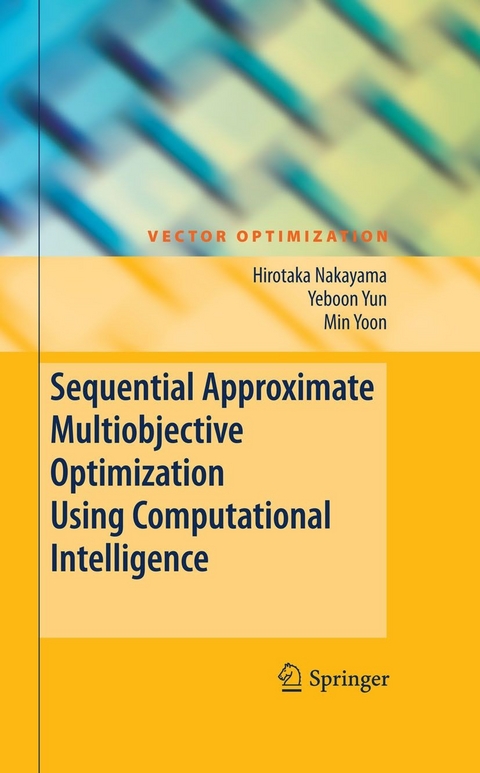
Sequential Approximate Multiobjective Optimization Using Computational Intelligence (eBook)
XVI, 200 Seiten
Springer Berlin (Verlag)
978-3-540-88910-6 (ISBN)
Preface 6
Contents 8
List of Tables 11
List of Figures 12
Chapter 1 Basic Concepts of Multiobjective Optimization 16
1.1 Mathematical Foundations 16
1.2 Preference Order and Domination Set 19
1.3 Scalarization 20
1.4 Scalarization and Trade-o. Analysis 26
Chapter 2 Interactive Programming Methods for Multiobjective Optimization 31
2.1 Goal Programming 31
2.2 Why is the Weighting Method Ine.ective? 34
2.3 Satis.cing Trade-o. Method 36
2.4 Applications 48
2.5 Some Remarks on Applications 56
Chapter 3 Generation of Pareto Frontier by Genetic Algorithms 58
3.1 Evolutionary Multiobjective Optimization 58
3.2 Fitness Evaluation Using DEA 69
3.3 Fitness Evaluation Using GDEA 77
3.4 Comparisons of Several Fitness Evaluations 80
Chapter 4 Multiobjective Optimization and Computational Intelligence 85
4.1 Machine Learning 85
4.2 Radial Basis Function Networks 91
4.3 Support Vector Machines for Pattern Classi.cation 95
4.4 Support Vector Machines for Regression 110
4.5 Combining Predetermined Model and SVR/RBFN 122
Chapter 5 Sequential Approximate Optimization 125
5.1 Metamodels 125
5.2 Optimal Design of Experiments 127
5.3 Distance-Based Criteria for Optimal Design 132
5.4 Incremental Design of Experiments 134
5.5 Kriging and E.cient Global Optimization 138
5.6 Distance-Based Local and Global Information 153
Chapter 6 Combining Aspiration Level Approach and SAMO 162
6.1 Sequential Approximate Multiobjective Optimization Using Satis.cing Trade-o. Method 163
6.2 MCDM with Aspiration Level Method and GDEA 170
6.3 Discussions 178
Chapter 7 Engineering Applications 180
7.1 Reinforcement of Cable-Stayed Bridges 180
7.2 Multiobjective Startup Scheduling of Power Plants 187
References 195
Index 203
| Erscheint lt. Verlag | 12.6.2009 |
|---|---|
| Reihe/Serie | Vector Optimization | Vector Optimization |
| Zusatzinfo | XVI, 200 p. 111 illus. |
| Verlagsort | Berlin |
| Sprache | englisch |
| Themenwelt | Mathematik / Informatik ► Informatik |
| Mathematik / Informatik ► Mathematik ► Wahrscheinlichkeit / Kombinatorik | |
| Technik | |
| Wirtschaft ► Allgemeines / Lexika | |
| Wirtschaft ► Betriebswirtschaft / Management ► Planung / Organisation | |
| Schlagworte | algorithms • Evolutionary Multi-objective Optimization • Genetic algorithms • machine learning • meta-modelling • Modeling • Multi-Objective Optimization • Optimal Design of Experiments • Optimization |
| ISBN-10 | 3-540-88910-8 / 3540889108 |
| ISBN-13 | 978-3-540-88910-6 / 9783540889106 |
| Informationen gemäß Produktsicherheitsverordnung (GPSR) | |
| Haben Sie eine Frage zum Produkt? |
 PDF (Wasserzeichen)
DRM: Digitales Wasserzeichen
Dieses eBook enthält ein digitales Wasserzeichen und ist damit für Sie personalisiert. Bei einer missbräuchlichen Weitergabe des eBooks an Dritte ist eine Rückverfolgung an die Quelle möglich.
Dateiformat: PDF (Portable Document Format)
Mit einem festen Seitenlayout eignet sich die PDF besonders für Fachbücher mit Spalten, Tabellen und Abbildungen. Eine PDF kann auf fast allen Geräten angezeigt werden, ist aber für kleine Displays (Smartphone, eReader) nur eingeschränkt geeignet.
Systemvoraussetzungen:
PC/Mac: Mit einem PC oder Mac können Sie dieses eBook lesen. Sie benötigen dafür einen PDF-Viewer - z.B. den Adobe Reader oder Adobe Digital Editions.
eReader: Dieses eBook kann mit (fast) allen eBook-Readern gelesen werden. Mit dem amazon-Kindle ist es aber nicht kompatibel.
Smartphone/Tablet: Egal ob Apple oder Android, dieses eBook können Sie lesen. Sie benötigen dafür einen PDF-Viewer - z.B. die kostenlose Adobe Digital Editions-App.
Buying eBooks from abroad
For tax law reasons we can sell eBooks just within Germany and Switzerland. Regrettably we cannot fulfill eBook-orders from other countries.
aus dem Bereich