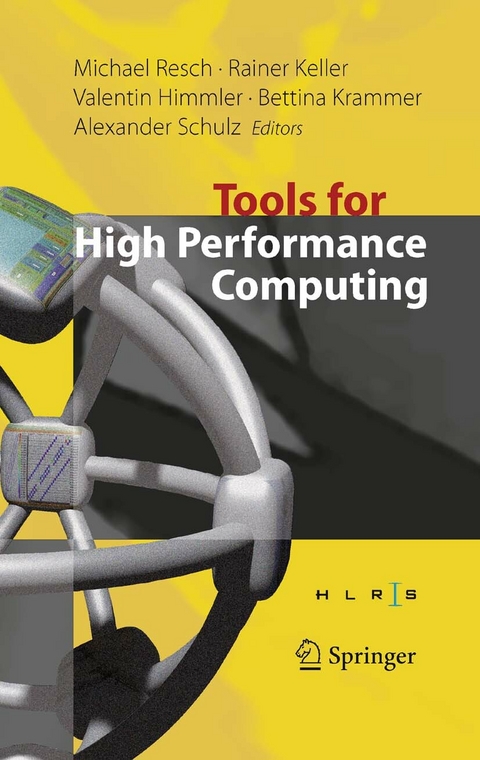
Tools for High Performance Computing (eBook)
XI, 202 Seiten
Springer Berlin (Verlag)
978-3-540-68564-7 (ISBN)
Preface 5
Contents 7
List of Contributors 11
I Integrated Development Environments 12
Sun HPC ClusterTools™ 7+: A Binary Distribution of Open MPI 13
Introduction 13
History 14
Sun-Driven features 15
Sun Product Activity 23
Pros and Cons 25
Future work and conclusions 26
References 27
An Integrated Environment For the Development of Parallel Applications 29
Introduction 29
Challenges 31
Architecture 33
A Simple Case Study 38
Future Directions 41
Conclusion 43
References 44
Debugging MPI Programs on the Grid using g-Eclipse 45
Introduction 45
Related Work 46
Overview of g-Eclipse Approach 47
Remote Builder 48
Grid Application Launchers 49
Trace Viewer 49
Conclusions and Future Work 54
References 54
II Parallel Communication and Debugging 56
Enhanced Memory debugging of MPI-parallel Applications in Open MPI 57
Introduction 57
Overview of Memcheck 58
Design and Implementation 59
Performance Implications 61
Detectable error classes and findings in actual applications 65
Conclusion and future work 67
References 68
MPI Correctness Checking with Marmot 69
Introduction 70
Related Work 70
Design of Marmot 71
Collaboration with other tools 78
Experiences with real Applications 80
How to install and use Marmot 83
Conclusion and Future Work 84
References 84
Memory Debugging in Parallel and Distributed Applications 87
Introduction 87
The Challenges of Memory Debugging in Parallel Development 88
Classifying Memory Errors 88
Detecting Memory Leaks 90
The MemoryScape Debugger 90
MemoryScape Architecture 91
MemoryScape Features 92
MemoryScape Usage Tips 95
MemoryScape User Case Study: SIMULIA Uses MemoryScape to Find and Fix Bugs Quickly 96
Future MemoryScape Product Plans 98
Conclusion 98
III Performance Analysis Tools 99
Sequential Performance Analysis with Callgrind and KCachegrind 100
Introduction 100
Callgrind: a Call-Graph building Online Cache Simulator 104
KCachegrind: Profile Visualization 112
Usage Example 117
Future Development 118
References 120
Improving Cache Utilization Using Acumem VPE 121
Introduction 122
Throughput Study of SPEC CPU 2006 124
First Generation Performance Tools Based on Hardware Counters 126
Enter: The New Performance Tool 128
Utilization Study of the Worst SPEC CPU 2006 Applications 132
Tuning Example: 179.art 134
Tuning Example: Revisiting the Throughput Applications 138
Conclusion 140
References 141
Parallel Performance Analysis Tools 141
The Vampir Performance Analysis Tool-Set 143
Introduction 143
Performance Analysis via Profiling or Tracing 144
Instrumentation with VampirTrace 145
Run-Time Measurement and Event Recording 148
Trace Visualization with Vampir and VampirServer 152
Related Work 158
Conclusions and Future Work 158
References 159
Usage of the SCALASCA toolset for scalable performance analysis of large-scale parallel applications 160
Introduction 160
Overview 161
Instrumentation and Measurement 162
Trace Analysis 165
Understanding Performance Behavior 167
Outlook 169
References 170
Evolution of a Parallel Performance System 171
Introduction 171
TAU Performance System Design and Architecture 172
TAU Instrumentation 174
TAU Measurement 180
TAU Analysis 185
Conclusion and Future Work 188
References 190
Cray Performance Analysis Tools 193
Introduction 193
The Cray Performance Analysis Tools 194
Conclusions and Future Work 200
References 201
Index 202
| Erscheint lt. Verlag | 3.6.2008 |
|---|---|
| Zusatzinfo | XI, 202 p. |
| Verlagsort | Berlin |
| Sprache | englisch |
| Themenwelt | Mathematik / Informatik ► Informatik ► Netzwerke |
| Mathematik / Informatik ► Informatik ► Software Entwicklung | |
| Technik | |
| Schlagworte | Calculus • Cluster • Communication • Complexity • Debugging • Desktop • development tools for high performance compting • Eclipse • linear optimization • object oriented design • parallel debugging • parallel performance analysis • programming • Scala • support infrastructure for parallel and high performance com • support infrastructure for parallel and high performance computing |
| ISBN-10 | 3-540-68564-2 / 3540685642 |
| ISBN-13 | 978-3-540-68564-7 / 9783540685647 |
| Informationen gemäß Produktsicherheitsverordnung (GPSR) | |
| Haben Sie eine Frage zum Produkt? |
 PDF (Wasserzeichen)
DRM: Digitales Wasserzeichen
Dieses eBook enthält ein digitales Wasserzeichen und ist damit für Sie personalisiert. Bei einer missbräuchlichen Weitergabe des eBooks an Dritte ist eine Rückverfolgung an die Quelle möglich.
Dateiformat: PDF (Portable Document Format)
Mit einem festen Seitenlayout eignet sich die PDF besonders für Fachbücher mit Spalten, Tabellen und Abbildungen. Eine PDF kann auf fast allen Geräten angezeigt werden, ist aber für kleine Displays (Smartphone, eReader) nur eingeschränkt geeignet.
Systemvoraussetzungen:
PC/Mac: Mit einem PC oder Mac können Sie dieses eBook lesen. Sie benötigen dafür einen PDF-Viewer - z.B. den Adobe Reader oder Adobe Digital Editions.
eReader: Dieses eBook kann mit (fast) allen eBook-Readern gelesen werden. Mit dem amazon-Kindle ist es aber nicht kompatibel.
Smartphone/Tablet: Egal ob Apple oder Android, dieses eBook können Sie lesen. Sie benötigen dafür einen PDF-Viewer - z.B. die kostenlose Adobe Digital Editions-App.
Buying eBooks from abroad
For tax law reasons we can sell eBooks just within Germany and Switzerland. Regrettably we cannot fulfill eBook-orders from other countries.
aus dem Bereich