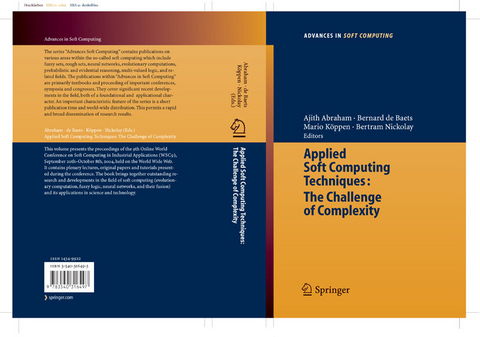
Applied Soft Computing Technologies: The Challenge of Complexity (eBook)
XXXIII, 837 Seiten
Springer-Verlag
9783540316626 (ISBN)

This volume presents the proceedings of the 9th Online World Conference on Soft Computing in Industrial Applications, held on the World Wide Web in 2004. It includes lectures, original papers and tutorials presented during the conference. The book brings together outstanding research and developments in soft computing, including evolutionary computation, fuzzy logic, neural networks, and their fusion, and its applications in science and technology.
WSC9 – Honorary Chair’s Message 6
WFSC Chairperson’s Message 7
WSC9 Chair’s Welcome Message 8
WSC9 – Organization 10
WSC9 Technical Sponsors 14
Contents 16
List of Contributors 24
Part I Plenary Presentations 36
Applying Fuzzy Sets to the SemanticWeb: The Problem of Retranslation 37
1. Computing with Words and the SemanticWeb 37
2. The Retranslation Process 38
3. Determining the Validity of a Retranslation 39
4. Measuring the Closeness of Fuzzy Subsets 41
5. Measuring the Fuzziness and Specificity 42
6. Providing Retranslations that Give Particular Perceptions 44
7. Multicriteria Evaluation 49
8. Conclusion 51
9. References 52
Granular Computing: An Overview 53
1. From Information Granules to Granular Computing 53
2. Formalisms of Granular Computing 55
2.1. Interval analysis 55
2.2. Fuzzy sets 56
2.3. Rough sets 59
3. The Development of Information Granules 61
4. Quantifying Granularity: Generality Versus Specificity 62
5. Communication between Systems of Information Granules 63
6. Granular Computing and Computational Intelligence 65
7. Conclusions 67
References 67
Part II Classification and Clustering 70
Parallel Neuro Classifier for Weld Defect Classification 71
1 Introduction 71
2 Neural Networks 73
2.1 Selection of Classifier 73
2.2 Classifier Performance Evaluation Methods 74
3 LVQ Implementation on PARAM 10000 74
3.1 Single Architecture Single Processor 74
3.2 Single Architecture Multiple Processor 76
5 Neural Networks Modeling for Weld Classification 78
5.1 Input and Output Parameters 78
5.2 Neural Network Architecture and Training 79
6 Results and Discussion 80
6.1 Results from Single Architecture Single Processor Simulator 80
6.2 Single Architecture Multiple Processor 84
7 Summary 85
Acknowledgments 86
References 86
Appendix: Brief Introduction to PARAM 10000 88
An Innovative Approach to Genetic Programming–based Clustering 89
1 Introduction 89
2 Data Clustering 90
3 Our Genetic Programming System for Data Clustering 91
4 Evaluation Indices and Database 94
5 Experimental Findings 95
6 Conclusions and Future Work 97
References 98
An Adaptive Fuzzy Min-Max Conflict-Resolving Classifier 99
1 Introduction 100
2 The Ordering Algorithm, Fuzzy ARTMAP, and Dynamic Decay Adjustment Algorithm 101
2.2 Fuzzy ARTMAP (FAM) 102
2.3 Dynamic Decay Adjustment (DDA) Algorithm 103
3 The Ordered FAMDDA 104
4 Benchmark Datasets: Experiments and Results 105
5 The Circulating Water (CW) System 107
6 Summary 109
Acknowledgements 109
A Method to Enhance the ‘Possibilistic C-Means with Repulsion’ Algorithm based on Cluster Validity Index 111
1 Introduction 111
3. Possibilistic Fuzzy Clustering with Repulsion 114
4. Tests Examples 115
5. Conclusions 119
References 120
Part III Optimization 123
Design Centering and Tolerancing with Utilization of Evolutionary Techniques 125
1 Introduction 125
2 Design Centering and Tolerancing Methods 126
3 New Method Description 126
4 Computational Examples 128
5 Conclusions 131
References 132
Curve Fitting with NURBS using Simulated Annealing 133
1 Introduction 133
2 Literature Survey 134
3 NURBS 135
4 Simulated Annealing 136
5 The Proposed Method 139
6 Experimental Results 143
7 Conclusions 144
Acknowledgement 145
References 145
Multiobjective Adaptive Representation Evolutionary Algorithm (MAREA) - a new evolutionary algorithm for multiobjective optimization 147
1 Introduction 147
2 AREA Technique 148
2.1 Solution representation 148
2.2 Mutation 148
2.3 Transmutation 148
2.4 O.spring acceptance 149
3 MAREA Algorithm 149
3.1 Stage I – Convergence to the Pareto front 149
3.2 Stage II – Dispersion on the Pareto front. 150
4 Test Functions 150
5 Performance Metrics 151
5.1 Convergence metric 151
6 Numerical Experiments 152
7 Conclusions and Further Work 152
References 155
Adapting Multi-Objective Meta-Heuristics for Graph Partitioning 157
1 Introduction 157
2 The Graph Partitioning Problem 158
3 Adapting Local Search MOMHs for GPP 159
3.1 Sera.ni’s Multi-Objective Simulated Annealing (SMOSA) 159
3.2 Ulungu’s Multi-Objective Simulated Annealing (UMOSA) 160
3.3 Czyzak’s Pareto Simulated Annealing (PSA) 161
3.4 Hansen’s Multi-Objective Tabu Search (MOTS) 162
4 Experimental Results 162
4.1 Parameter Setting 163
4.2 Metrics used to evaluate the quality of the solutions 163
4.3 Analysis of the results 164
5 Conclusions 165
Acknowledges 165
References 166
Part IV Diagnosis and Fault Tolerance 168
Genetic Algorithms for Artificial Neural Net-based Condition Monitoring System Design for Rotating Mechanical Systems 169
Introduction 170
Using Genetic Algorithms and ANNs 171
Artificial Neural Networks 173
Problem Description and Methods 174
Feature Extraction 175
Implementation 177
Results and Discussion 180
Conclusion and Future Work 181
Acknowledgments 182
References 182
The Applications of Soft Computing in Embedded Medical Advisory Systems for Pervasive Health Monitoring 185
1 Introduction 185
2 Building the Medical Knowledge Base 186
2.1 Temporal Fuzzy Variables 187
2.2 Weighted Medical Rules 188
3 Embedded Medical Advisory Systems 189
3.1 Accompanied Knowledge Base 190
3.2 Inference Machine 190
3.3 Shell 191
4 Prototyping System 192
5 Conclusion 193
Acknowledgments 193
References 194
Application of Fuzzy Inference Techniques to FMEA 195
1. Introduction 195
2. Failure Risk Evaluation, Ranking, and Prioritization Issues in FMEA 196
3. Fuzzy Production Rules and Weighted Fuzzy Production Rules 197
4. A Generic Modeling Approach to the Fuzzy RPN Function 198
4.1 Fuzzy Membership Functions 198
4.2 Fuzzy Rule Base 199
4.3 Properties of the Proposed Fuzzy RPN Model 200
4.3.1 Monotone output 200
4.3.2 Output resolution (Sensitivity of output to the changes of input) 200
5. A Case Study on the Test Handler Process 200
5.1 Experiment I Failure Risk Evaluation, Ranking, and Prioritization — 201
5.2 Experiment II Study of the monotone property — 202
5.3 Experiment III Study of the output resolution property — 203
6. Conclusion 204
7. References 204
Bayesian Networks Approach for a Fault Detection and Isolation Case Study 207
1 Introduction 207
2 Bayesian Networks Approach for FDI 208
3 Benchmark Specifications 209
4 Performance Indices 210
5 The FDI System 211
5.1 Train and Test Synthetic Data 211
5.2 FDI on Synthetic Data 212
5.3 FDI on Real Data 213
6 Conclusions 216
Acknowledgments 216
References 216
Part V Tracking and Surveillance 219
Path Planning Optimization for Mobile Robots Based on Bacteria Colony Approach 221
1 Introduction 221
2 Bacteria Colony 222
3 Trajectory Planning of Mobile Robots 225
4 Simulation Results 226
4.1 Case study 1: Environment with 4 obstacles 226
4.2 Case study 2: Environment with 12 obstacles 228
5 Conclusion and future works 231
References 231
An Empirical Investigation of Optimum Tracking with Evolution Strategies 233
1 Introduction 233
2 Related Work 234
3 Methodology 235
4 Results 236
4.1 Linear dynamics and linear dependence on population size 237
4.2 Linear dynamics and squared dependence on population size 239
4.3 Random dynamics 240
5 Conclusion 240
References 241
Implementing a Warning System for Stromboli Volcano 243
1 Introduction 243
2 System The Stromboli Volcanic Areas and the THEODORO 245
2.1 The THEODORO Measuring System 245
3 Data Analysis 246
3.1 Estimating DMVSD 249
3.1 Estimating MPEASD 249
4 Implementing a Warning System for THEODOROS 250
5 Conclusions 252
References 252
Part VI Scheduling and Layout 254
A Genetic Algorithm with a Quasi-local Search for the Job Shop Problem with Recirculation 255
1 Introduction 255
2 Classical Job Shop and Job Shop with Recirculation 256
2.1 Disjunctive Graph 256
2.2 Complexity and Types of Solutions 257
2.3 Neighbourhood Schemes 257
3 Proposed Methodology 258
3.1 Solution Representation 259
3.2 Solutions Decoding 259
3.3 Genetic Correction 261
3.4 Genetic Operators 261
3.5 The Genetic Algorithm 263
4 Computational Experiments 263
5 Conclusions 266
References 266
A Multiobjective Metaheuristic for Spatial-based Redistricting 269
1 Introduction 269
2 The Multiobjective Metaheuristic 270
2.1 General Redistricting Problem Definition 270
2.2 Seed Solution Initiator 271
2.3 Neighbouring Move and Generated Subset Combination 272
2.4 Multiobjective Decision Rules and Measurement 273
3 Experiment 274
3.1 Analysis of the Coverage of Approximation of Non- Dominated set 277
3.1.1 Analysis of the Distance Measurement for Dominancy Comparison 277
3.1.2 The -value 278
3.1.3 The -parameter 279
3.2 Analysis of the Number of Objectives Defined 279
4 Conclusion 279
5 References 281
Appendix: Algorithm for the proposed multiobjective metaheuristic 282
Solving Facility Layout Problems with a Set of Geometric Hard-constraints using Tabu Search 285
1 Introduction 285
2 Problem Scope 286
2.1 Objective Function 287
3 Solution Approach 288
3.1 Improvement on the Initial Solution 289
3.2 Tabu List Configuration 290
3.3 Neighborhood Structures 290
3.4 Strategy of Prohibition and of Liberation 290
4 Results 291
5 Conclusion 292
Acknowledgments 295
References 295
Part VII Complexity Management 298
Empathy: A Computational Framework for Emotion Generation 299
1 Introduction 299
2 The Empathy Model 300
3 Emotions and A.ective Phenomena 302
3.1 Emotion Blends and Mixed Emotions 303
3.2 Emotion Intensity 304
4 Emotional Behaviors 304
4.1 Behavior Selection 305
5 Cindy 307
5.1 Implementation details 308
6 Conclusions and Future Work 310
References 310
Intelligent Forecast with Dimension Reduction 313
1 Introduction 313
2 Time-series Prediction 314
3 Inductive Learning 315
3.1 Multi Layer Perceptron (MLP) 316
3.2 Support Vector Regression (SVR) 316
4 Model Selection 317
4.1 Simulated Annealing 317
5 Dimension Reduction 318
5.1 Analysis (PCA) Linear Dimension Reduction with Principal Component 318
5.2 Component Analysis (KPCA) Non-linear Dimension Reduction with Kernel Principal 319
6 Meta-Heuristic 320
7 Time-Series Prediction Framework 320
8 Experiments 321
9 Conclusions 324
References 325
Stochastic Algorithm Computational Complexity Comparison on Test Functions 327
1 Introduction 327
2 Brief on Test Case Stochastic Algorithms 328
2.1 Evolutionary Strategy ES-(1+1) 328
2.2 Evolution Strategy Self-Adaptation ES-(1+5)-sSA 329
2.3 Di.erential Evolution (DE/rand/1/bin) 331
2.4 Particle Swarm Optimization (PSO) 332
3 Stochastic Algorithm Computational Complexity Comparison: Test Set-Up 333
3.1 Test Functions 334
3.2 Results 335
4 A New Hybrid Algorithm: PSO-DE 335
5 Conclusions 336
References 336
Nonlinear Identification Method of a Yo-yo System Using Fuzzy Model and Fast Particle Swarm Optimisation 337
1. Introduction 337
2. Takagi-Sugeno Fuzzy System 338
3. PSO for Optimization of TS Fuzzy System 340
3.1. Fast Particle Swarm Optimisation 342
4. Yo-yo Motion Process 343
5. Analysis Results of Identification 345
6. Conclusion and Future Works 347
References 347
Part VIII Manufacturing and Production 350
Hybrid Type-1-2 Fuzzy Systems for Surface Roughness Control 351
1 Introduction 351
2 Method 353
2.1 Fuzzy Knowledge Discovery 353
2.2 Type Reducer and Iterative Evolutionary Learning 355
2.2 Performance Analysis 356
2.2.1 Membership function and rules 356
3 Results 358
3.1 Comparison of type-1 and hybrid Fuzzy Logic systems 358
4 Conclusions 359
5 References 360
Comparison of ANN and MARS in Prediction of Property of Steel Strips 363
1. Introduction 363
2. Method 365
2.1 Data 365
2.2 Predictive Models 366
2.2.1 ANN Model Development 367
2.2.2 MARS Model Development 369
3. Results and Discussion 370
4. Conclusion 374
Acknowledgements 375
References 375
Designing Steps and Simulation Results of a Pulse Classification System for the Electro Chemical Discharge Machining (ECDM) Process – An Artificial Neural Network Approach 377
1 Introduction 377
2 Pulse Types in the ECDM Process 378
3 Experimental Setup 379
4 Designing of the Classification System 379
4.1 Neural Network Architecture 380
4.2 Feature Extraction 380
4.3 The Preparation of a Training Data Set and a Test Data Set 381
4.4 Number of Layers and Number of Neurons in Each Layer 381
5 Definition of Classification Accuracy 382
6 Simulated Results 382
7 Classification Accuracy 384
8 Process Control System 384
9 Conclusions 385
References 385
Part IX Signal Processing 388
Hybrid Image Segmentation based on Fuzzy Clustering Algorithm for Satellite Imagery Searching and Retrieval 389
1 Introduction 389
2 Image Segmentation and Feature Extraction Techniques 390
2.1 Color Feature Extraction 390
2.2 Texture Feature Extraction 393
2.3 Fuzzy C-means Clustering 396
2.4 Region Merging and Labeling 397
2.4 Region Feature Extraction 399
3 Experimentation 400
4 Results and Discussion 402
5 Summary 404
Acknowledgments 404
References 404
Boosting the Performance of the Fuzzy Min-Max Neural Network in Pattern Classification Tasks 407
1. Introduction 407
2. Fuzzy Min-Max Neural Network and AdaBoost 408
2.1 Fuzzy Min-Max Neural Network 408
2.2 AdaBoost 411
2.2.1 Bootstrapping 413
3 Case Studies 414
3.1 Wisconsin Breast Cancer Data 414
3.2 Pima Indians Diabetes Data 416
3.3 Myocardial Infraction (MI) Data 418
4 Conclusions 420
References 421
A Genetic Algorithm for Solving BSS-ICA 423
1 Introduction 423
2 Basis Genetic Algorithms 424
3 Mutation Operator based on neighborhood philosophy 424
4 ICA and Convex Optimization under Discrepancy Constraints 425
5 A New Statistical Independence Criterion: the Search for a Suitable Fitness Function 426
6 Guided Genetic Algorithm 429
7 Simulations 430
8 Conclusions 432
References 432
Part X Computer Security 434
RDWT Domain Watermarking based on Independent Component Analysis Extraction 435
1 Introduction 435
2 RWDT 436
3 Adaptive Watermark Embedding 438
4 Intelligent Watermark Extraction Based on ICA 440
5 Experimental Results 441
6. Conclusions 446
Reference 447
Towards Very Fast Modular Exponentiations Using Ant Colony 449
1 Introduction 449
2 Addition Chain Minimisation 450
2.1 Addition Chain-Based Methods 451
2.2 Addition Chain Minimisation Problem 452
3 Ant Systems and Algorithms 452
4 Addition Chain Minimisation Using Ant System 454
4.1 The Ant System Shared Memory 454
4.2 The Ant Local Memory 454
4.3 Addition Chain Characteristics 455
4.4 Pheromone Trail and State Transition Function 456
5 Performance Comparison 457
6 Conclusion 458
References 458
Taming the Curse of Dimensionality in Kernels and Novelty Detection 459
1 Introduction 459
2 Recent Work 460
3 Analytical Investigation 461
3.1 The Curse of Dimensionality, Kernels, and Class Imbalance 461
3.2 Kernel Behavior in High Dimensional Input Space 463
3.3 The Impact of Dimensionality on the One-Class SVM 466
4 A Framework to Overcome High Dimensionality 467
5 Discussion and Conclusion 470
References 470
Part XI Bioinformatics 474
A Genetic Algorithm with Self–sizing Genomes for Data Clustering in Dermatological Semeiotics 475
1 Introduction 475
2 Data Clustering 476
2.2 Homogeneity and Separability 477
3 A Self–sizing Genome Genetic Algorithm 478
3.1 Genetic Algorithms and Data Clustering 478
3.2 SGGA for Data Clustering 478
4 Data Set and Pathology Addressing Index 480
4.1 The Considered Data Set 480
4.2 Pathology Addressing Index 480
5 Experimental Results of SGGA 481
5.1 SGGA Performance as a Data Clustering Tool 481
5.2 Comparison of Found Syndromes with Known Pathologies 482
6 Conclusions and Future Works 484
References 484
MultiNNProm: A Multi-Classifier System for Finding Genes 485
1 Introduction 485
2 Biological Background 486
3 Why use Multiple Classifiers? 487
3.2 The LAP and LOP Methods for Combining Classifiers 488
3.2.1 The LAP Method 489
3.2.2 The LOP Method 489
3.2.3 The LOP2 Method 489
4 Description of the MultiNNProm System 490
4.1 Overview of the System 490
4.2 The Probability Function 491
4.3 Result Aggregation 492
5 Experimental Results 493
5.1. Performance Evaluation of the Individual Classifiers 493
5.2 Performance Evaluation of the Combined System 494
6 Conclusion 496
References 496
An Overview of Soft Computing Techniques Used in the Drug Discovery Process 499
1 Introduction 499
2 Drug Discovery 501
2.1 The Drug Discovery Process 501
2.1.1 Target Identification 501
2.1.2 Target Validation 502
2.1.3 Lead Identification 503
2.1.4 Lead Optimisation 504
2.2 Limitations of Classical Techniques 505
3 Soft Computing Techniques in Drug Discovery 506
3.1 SC in Target Identification 506
3.2 SC in Target Validation 507
3.3 SC in Lead Identification 507
3.4 SC in Lead Optimisation 508
4 Discussion 510
5 Conclusions 511
Acknowledgments 511
References 511
Part XII Text Processing 516
Ontology-Based Automatic Classification of Web Pages 517
1. Introduction 517
2. Related works and Background information 518
2.1 Document Classification 518
2.2 Ontology 519
3. Document Classification using Ontology 519
3.1 Ontology Structure 519
3.2 Building Domain Ontology for Document Classification 520
3.3 Document Classification Using Ontology 521
4. Experimental Procedures 524
5. Conclusion and Future Research 526
References 527
Performance Analysis of Naïve Bayes Classification, Support Vector Machines and Neural Networks for Spam Categorization 529
1 Introduction 529
2 Related Works 530
3 Corpus 531
4 Feature Representation 531
5 Classification Methods 532
5.1 Neural Networks (NN) 532
5.2 Support Vector Machines 533
5.3 Naïve Bayes 533
6 Results 534
6.1 Comparison of NB, NN and SVM 536
7 Conclusions & Future Work
References 538
Sentence Extraction Using Asymmetric Word Similarity and Topic Similarity 539
1 Introduction 539
2 Mass Assignments Theory and Fuzzy Sets 540
2.1 Semantic Unification 541
3 Computation of Similarity 542
3.1 Word similarity 542
3.2 Topic Similarity 545
4 Sentence Extraction 545
5 Experimental Results 545
5.1 DUC Collection 546
6 Conclusions 548
References 548
Part XIII Algorithm Design 550
Designing Neural Networks Using Gene Expression Programming 551
Introduction 551
Genes with Multiple Domains for Designing NNs 552
Special Genetic Operators 554
Domain-specific Transposition 555
Intragenic Two-point Recombination 556
Direct Mutation of Weights and Thresholds 560
Solving Problems with NNs Designed by GEP 562
Neural Network for the Exclusive-or Problem 562
Neural Network for the 6-Multiplexer 565
Conclusions 568
References 568
Particle Swarm Optimisation from lbest to gbest 571
1 Introduction 571
2 Particle Swarm Optimization Algorithm 572
3 gbest Model vs. lbest Model 573
4 Algorithm Description from lbest to gbest 573
5 Benchmark Test Functions 574
6 Experiment Setting 575
7 Results and Discussions 575
8 Conclusion 578
Acknowledgments 578
References 578
Multiobjective 0/1 Knapsack Problem usingAdaptive e -Dominance 581
1 Introduction 581
2 Multiobjective 0/1 Knapsack Problem 582
3 e-Dominance 583
4 e-MOKA Technique 583
5 Adaptive e-MOKA 584
6 Experimental Results 585
6.1 C-Metric 585
6.2 Numerical Comparisons 586
7 Conclusions 588
References 589
Part XIV Control 592
Closed Loop Control for Common Rail Diesel Engines based on Rate of Heat Release 593
1 Introduction 593
2 Combustion Process in Diesel Engines: Rate of Heat Release 595
3 E.ective ROHR Forecasting Model Requirements 596
4 Soft Computing Techniques Based Model Forecasting ROHR 597
4.1 . Transform 597
4.2 Clustering 599
4.3 Set-up of the “Grey-Box” Model 600
5 Test Case 601
6 Conclusions 602
References 602
A MIMO Fuzzy Logic Autotuning PID Controller: Method and Application 603
1 Introduction 603
2 FUZZY PID CONTROLLER (FPID) SISO CASE 604
2.1 FPID SISO Structure 605
2.2 Simulation and Experimental Results for the FPID-SISO 607
3 FUZZY PID CONTROLLER: MIMO CASE 610
3.1 A. FPID MIMO Structure 610
3.2 Results for the FPID- MIMO – Double Tanks Case 612
4 Conclusion 613
References 614
Performance of a Four Phase Switched Reluctance Motor Speed Control Based On an Adaptive Fuzzy System: Experimental Tests, Analysis and Conclusions 615
1 Introduction 615
1.1 Motor Type 616
1.2 Power Circuit Topology 616
1.3 Learning Controller 617
2 Neuro-fuzzy Design 618
2.1 Neuro-Fuzzy Parameters 619
2.1.1 Universe of Discourse 620
2.1.2 Membership Functions 621
2.1.3 Distribution of Membership Functions 621
2.1.4 Setting the Learning Rate 621
2.1.5 Number of Membership Functions 621
3 Verification Tests 624
3.1 Weights Distribution 624
3.2 Learning Rate 624
4 Experimental Results 626
4.1 Control Surface 628
4.2 PID Controller 629
5 Conclusions 631
References 632
Part XV Hybrid Intelligent Systems using Fuzzy Logic, Neural Networks and Genetic Algorithms 635
Modular Neural Networks and Fuzzy Sugeno Integral for Face and Fingerprint Recognition 637
1 Introduction 637
2 Modular Neural Networks 638
2.1 Multiple Neural Networks 639
2.2 Main Architectures with Multiple Networks 640
2.3 “Modular” Neural Networks 640
2.4 Advantages of Modular Neural Networks 641
2.5 Elements of Modular Neural Networks 641
2.6 Main Task Decomposition into Subtasks 642
2.7 Communication Between Modules 642
2.8 Response Integration 642
3 Methods of Response Integration 643
3.1 Fuzzy Integral and Fuzzy Measures 644
4 Proposed Architecture and Results 645
4.2 Proposed Architecture 646
4.2 Description of the Integration Module 647
4.3 Summary of Results 648
5 Conclusions 651
Acknowlegments 651
References 651
Evolutionary Modeling Using A Wiener Model 653
1 Introduction 653
2 System Description 655
3 Evolutionary Optimization Technique 657
4 Training Signal Generation 659
5 Experimental Results 659
6 Conclusions 662
7 Acknowledgment 665
8 References 665
Evolutionary Computing for Topology Optimization of Fuzzy Systems in Intelligent Control 667
1 Introduction 667
2 Genetic Algorithms for Optimization 668
2.1 Genetic Algorithm for Optimization 669
3. Evolution of Fuzzy Systems 670
4 Type-2 Fuzzy Logic 672
5 Application to Intelligent Control 674
5.1 Anesthesia Control Using Fuzzy Logic 675
5.2 Characteristics of the Fuzzy Controller 676
5.3 Genetic Algorithm Specification 676
5.4 Representation of the Chromosome 677
6 Simulation Results 677
7 Conclusions 680
Acknowledgments 680
References 680
Part XVI Recent Developments in Support Vector and Kernel Machines 683
Analyzing Magni.cation Factors and Principal Spread Directions in Manifold Learning 685
1 Introduction 685
2 Dimensionality Reduction 687
3 SVD-based Magni.cation Factors and Principal Spread Directions 688
3.1 Magnification Factors 689
3.2 Principal Spread Directions 691
3.3 The Proposed Approach 691
4 Experiments 692
5 Conclusions 697
Acknowledgements 697
References 697
Bag Classification Using Support Vector Machines 699
1 Introduction 700
2 Classification Approach 700
3 Image Processing 702
4 Experimental Results 703
4.1 Methodology 703
4.2 Kernel Optimization Experiment for Bag Classification 703
4.3 Optimal Feature Selection 704
5 Analysis of the Results 706
6 Conclusions 707
Acknowledgments 707
References 707
The Error Bar Estimation for the Soft Classi.cation with Gaussian Process Models 709
1 Introduction 709
2 Support Vector Machine Method for Classi.cation 710
3 From Hard Classi.cation to Soft Classi.cation 712
4 Computation Method for the Error Bar 713
5 Conclusion 715
References 715
Research of Mapped Least Squares SVM Optimal Configuration 719
1 Introduction 719
2 Mapped LS-SVM and Model Selection 720
2.1 Least Squares (LS) SVM 720
2.2 Model Selection 721
2.3 Mapped LS-SVM 722
3 Physical Property of Mapped LS-SVM 724
3.1 Image Intensity Surface Function 724
3.2 Filters of Mapped LS-SVM 724
3.3 Physical Interpretation 725
4 Optimal Configuration of Mapped LS-SVM 727
5 Conclusions 728
References 728
Classifying Unlabeled Data with SVMs 729
1 Introduction 729
2 Quadric Program Problem of Classifying Unlabeled Data 730
2.1 Partial Related Works 730
2.2 Primal Problem 730
2.3 Dual Problem 731
3 Semi-supervised Learning 733
4 Conclusions 735
Acknowledgments 735
Reference 736
Part XVII Robotics 738
Car Auxiliary Control System Using Type-II Fuzzy Logic and Neural Networks 739
1 Introduction 739
2 Fuzzy Controller 740
2.1 Define fuzzy sets 740
2.2 Processes 741
2.3 Type–II Fuzzy Logic 742
3 Neural Networks 743
4 Simulations and Results 744
4.1 Type-I fuzzy logic system 744
4.2 Type-II fuzzy logic system 745
4.3 Results 747
5 Conclusions 750
6 References 750
Evolving Neural Controllers for Collective Robotic Inspection 751
1 Introduction 751
2 Evolutionary Methodology 753
2.1 Encoding of Arti.cial Neural Networks 753
2.2 Initialization 753
2.3 Genetic Operations 754
3 Case Study: Collective Robotic Inspection 755
3.1 Application Background 755
3.2 Experiment Setup and Simulation 755
3.3 Hand-coded Controller 757
4 Results and Discussions 757
4.1 Single Robot Single Object (SRSO) Scenario 758
4.2 Single Robot Multiple Objects (SRMO) Scenario 759
4.3 Multiple Robots Multiple Objects (MRMO) Scenario 760
5 Conclusion and Future Work 762
Acknowledgments 763
References 763
A Self-Contained Traversability Sensor for Safe Mobile Robot Guidance in Unknown Terrain 765
1 Introduction 765
2 Intelligence Hierarchy for Sensor Devices 767
3 Cognitive Sensor Technology 768
3.1 Cognitive Sensor Design Process 769
3.2 Motivation and Aims 770
4 Traversability Sensor Design 771
4.1 Intelligent Software for Terrain Assessment 773
4.1.1 Terrain Image Processing 774
4.1.2 Fuzzy Logic Reasoning 774
5 Experimental Validation 776
6 Discussion 778
7 Conclusions 780
Acknowledgments 781
References 781
Fuzzy Dispatching of Automated Guided Vehicles 783
1 Introduction 783
2 AGV Dispatching 784
3 Fuzzy Dispatching of AGV 785
4 Simulation Analysis 786
5 Results 788
6 Conclusion 792
References 793
Part XVIII Soft Computing and Hybrid Intelligent Systems in Product Design and Development 796
Application of Evolutionary Algorithms to the Design of Barrier Screws for Single Screw Extruders 797
1.1 Introduction 797
1.2 Process Modeling 799
1.3 Design Approach 800
1.3.1 Multi-Objective Optimization Algorithm 800
1.3.2 Methodology for Screw Design 802
1.4 Optimization Example 803
1.5 Conclusions 806
Acknowledgments 807
References 808
Soft Computing in Engineering Design: A Fuzzy Neural Network for Virtual Product Design 809
1. Introduction 809
2. Soft Computing Framework for Engineering Design 810
3. Fuzzy Neural Network Model 811
3.1 The FNN Architecture 812
3.2 Parameter Learning Algorithms 813
3.2.1 The Supervised Learning 813
3.2.2 Self-Organized Learning 814
4. System Implementation 815
5. Case Study 816
6. Conclusions 817
References 817
Internet Server Controller Based Intelligent Maintenance System for Products 819
1. Introduction 819
2. Intelligent Maintenance Systems 820
3. Internet-based Server Controller 822
3.1. Structure of the Embedded Network Model 822
3.2. Software Agent for Embedded Network Model 823
4. Watchdog Agent 825
5. Tele-Service Engineering System for Information Appliance and Testbed 826
5.1. Structure of the Remote Engineering System Testbed 826
5.2. Main Interfaces of the Remote Engineering System Testbed 827
5.3. The Development Toolkit 827
6. Conclusions 827
Acknowledgement and Disclaimer 828
References 828
A Novel Genetic Fuzzy/Knowledge Petri Net Model and Its Applications 829
1. Introduction 829
2. Knowledge-Based Petri Net Models 830
2.1 Knowledge Petri Net 830
2.2 Fuzzy Knowledge Petri net 831
2.3 FKPN-based Expert System 832
2.3.1 Knowledge Representation 832
2.3.2 Reasoning 833
3. Genetic Knowledge Petri Net Models 834
3.1 Genetic Models for KPN and FKPN 834
3.2 Evolutionary Design for Petri Nets 834
3.3 Genetic Rule-Finding and -Tuning for FKPN 835
4. Applications in Engineering Design 836
5. Conclusions 837
References 837
Individual Product Customization Based On Multi-agent Technology* 839
1 Introduction 839
2 Customization Principles of Individual Product 841
2.1 Module of Individual Product Customization 841
2.2 Content Matching of Individual Product Customization 841
2.3 Interesting Value Counting of Individual Products 843
3 The Customization System of Individual Product 843
4. Case Study: Individual Motorcycle Customization 844
4.1 Individual Motorcycle Customization Characteristics 844
4.2 Requirement Quantity Determination of Individual Motorcycle Customization 845
4.3 A Process of Individual Motorcycle Customization Based on Multi-agent Technology 845
4.4 An Individual Motorcycle Customization Calculation 846
5 Conclusions 848
References 848
An Intelligent Design Method of Product Scheme Innovation* 849
1 Introduction 849
2 Intelligent Design Principle of Product Scheme Innovation 852
2.1 Intelligent Design Model of Product Scheme Innovation 852
2.2 Function Cell Classes of a Product 853
2.3 Structure Cell Classes of a Product 853
2.4 Knowledge Acquiring, Expression and Reasoning of Product Scheme Intelligent Design 854
2.5 Intelligent Design of Motorcycle Innovation 855
3 Conclusions 858
References 858
Communication Method for Chaotic Encryption in Remote Monitoring Systems for Product e-Manufacturing and e-Maintenance 859
1. Introduction 859
2. Nonlinear Test Based on the VWK Method 861
2.1 The Theory 861
2.2 The Effect of Sampling Interval 862
2.3 Application 863
3. The Cryptanalysis 864
4. Nonlinear Test Study Based on the Surrogate Data 865
5. Conclusion 866
Acknowledgement and Disclaimer 867
References 867
Subject Index 869
Index of Contributors 873
Applying Fuzzy Sets to the SemanticWeb: The Problem of Retranslation (p. 3)
Ronald R. Yager
Machine Intelligence Institute, Iona College
New Rochelle, NY 10801
Abstract: We discuss the role of Zadeh's paradigmof computing with words on the semantic web We describe thethree important steps in using computing with words. We focuson the retranslation step, selecting a term from our prescribedvocabulary to express information represented using fuzzy sets. A number of criteria of concern in this retranslation processare introduced. Some of these criteria can be seen to correspondto a desire to accurately reflect the given information. Othercriteria may correspond to a desire, on the part provider ofthe information, to give a particular perception or "spin."We discuss some methods for combining these criteria to evaluatepotential retranslations.
Keywords: Computing with Words, Fuzzy Sets, Linguistic Approximation
1. Computing with Words and the Semantic Web
The Semantic Web is invisioned as an extension of the currentweb in which information is given well-defined meaning and semantics,better enabling computers and people to work in cooperation. Among its goals is a humanlike automated manipulation of theknowledge contained on the web. While computers are good atprocessing information, they have no understanding of the meaningand semantics of the content which greatly hinders human likemanipulation. The fulfillment of the vision of the SemanticWeb requires tools that enable the computational representationof knowledge that emulates human deep understanding. Hence enablingintelligent information processing. Fuzzy subset theory andthe related paradigm of computing with words [1-3] providetools of this nature and hence will help to enable the automatedmanipulation of human knowledge.
| Erscheint lt. Verlag | 11.8.2006 |
|---|---|
| Reihe/Serie | Advances in Intelligent and Soft Computing | Advances in Intelligent and Soft Computing |
| Zusatzinfo | XXXIII, 840 p. 324 illus. |
| Verlagsort | Berlin |
| Sprache | englisch |
| Themenwelt | Mathematik / Informatik ► Informatik |
| Mathematik / Informatik ► Mathematik | |
| Technik | |
| Schlagworte | algorithm • algorithms • Bioinformatics • classification • Complexity • Computational Intelligence • Data Mining • Evolution • evolutionary computation • Genetic Algorithm • Genetic algorithms • Kernel • Layout • neural network • Optimization • robot • Robotics • Signal • Soft Computing |
| ISBN-13 | 9783540316626 / 9783540316626 |
| Informationen gemäß Produktsicherheitsverordnung (GPSR) | |
| Haben Sie eine Frage zum Produkt? |
 PDF (Wasserzeichen)
DRM: Digitales Wasserzeichen
Dieses eBook enthält ein digitales Wasserzeichen und ist damit für Sie personalisiert. Bei einer missbräuchlichen Weitergabe des eBooks an Dritte ist eine Rückverfolgung an die Quelle möglich.
Dateiformat: PDF (Portable Document Format)
Mit einem festen Seitenlayout eignet sich die PDF besonders für Fachbücher mit Spalten, Tabellen und Abbildungen. Eine PDF kann auf fast allen Geräten angezeigt werden, ist aber für kleine Displays (Smartphone, eReader) nur eingeschränkt geeignet.
Systemvoraussetzungen:
PC/Mac: Mit einem PC oder Mac können Sie dieses eBook lesen. Sie benötigen dafür einen PDF-Viewer - z.B. den Adobe Reader oder Adobe Digital Editions.
eReader: Dieses eBook kann mit (fast) allen eBook-Readern gelesen werden. Mit dem amazon-Kindle ist es aber nicht kompatibel.
Smartphone/Tablet: Egal ob Apple oder Android, dieses eBook können Sie lesen. Sie benötigen dafür einen PDF-Viewer - z.B. die kostenlose Adobe Digital Editions-App.
Buying eBooks from abroad
For tax law reasons we can sell eBooks just within Germany and Switzerland. Regrettably we cannot fulfill eBook-orders from other countries.
aus dem Bereich