


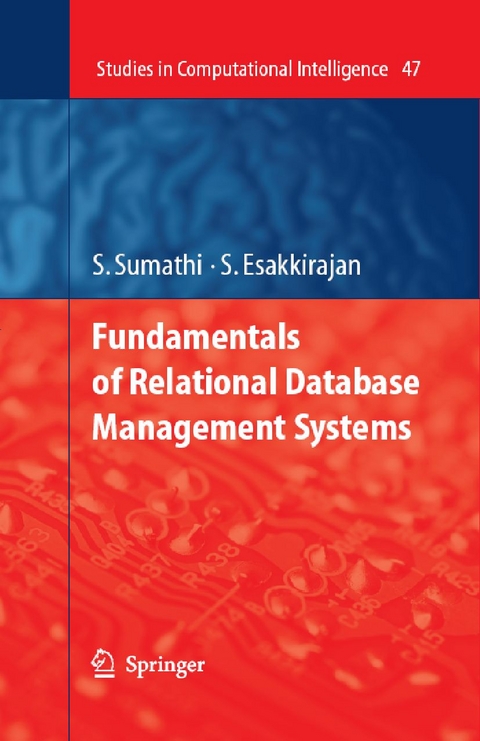
Fundamentals of Relational Database Management Systems (eBook)
803 Seiten
Springer-Verlag
9783540483991 (ISBN)
Information is a valuable resource to an organization. Computer software provides an efficient means of processing information, and database systems are becoming increasingly common means by which it is possible to store and retrieve information in an effective manner.
This book provides comprehensive coverage of fundamentals of database management system. This book is for those who wish a better understanding of relational data modeling, its purpose, its nature, and the standards used in creating relational data model.
Preface 6
About the Book 7
Salient Features 8
Organization of the Book 8
About the Authors 10
S. Sumathi, 10
S. Esakkirajan 11
Acknowledgment 11
Contents 12
Abbreviations 24
List of Symbols 27
1 Overview of Database Management System 28
1.1 Introduction 28
1.2 Data and Information 29
1.3 Database 29
1.4 Database Management System 30
1.4.1 Structure of DBMS 30
1.5 Objectives of DBMS 31
1.5.1 Data Availability 31
1.5.2 Data Integrity 31
1.5.3 Data Security 31
1.5.4 Data Independence 32
1.6 Evolution of Database Management Systems 32
1.7 Classi.cation of Database Management System 33
1.8 File-Based System 34
1.9 Drawbacks of File-Based System 35
1.9.1 Duplication of Data 35
1.9.2 Data Dependence 35
1.9.3 Incompatible File Formats 35
1.9.4 Separation and Isolation of Data 36
1.10 DBMS Approach 36
1.11 Advantages of DBMS 37
1.11.1 Centralized Data Management 37
1.11.2 Data Independence 37
1.11.3 Data Inconsistency 37
1.12 Ansi/Spark Data Model (American National Standard Institute/ Standards Planning and Requirements Committee) 38
1.12.1 Need for Abstraction 38
1.12.2 Data Independence 39
1.13 Data Models 40
1.13.1 Early Data Models 41
1.14 Components and Interfaces of Database Management System 41
1.14.1 Hardware 41
1.14.2 Software 42
1.14.3 Data 43
1.14.4 Procedure 43
1.14.5 People Interacting with Database 43
1.14.6 Data Dictionary 47
1.14.7 Functional Components of Database System Structure 48
1.15 Database Architecture 49
1.15.1 Two-Tier Architecture 49
1.15.2 Three-tier Architecture 51
1.15.3 Multitier Architecture 51
1.16 Situations where DBMS is not Necessary 53
1.17 DBMS Vendors and their Products 53
Review Questions 54
2 Entity–Relationship Model 58
2.1 Introduction 58
2.2 The Building Blocks of an Entity–Relationship Diagram 59
2.2.1 Entity 59
2.2.2 Entity Type 59
2.2.3 Relationship 59
2.2.4 Attributes 59
2.2.5 ER Diagram 60
2.3 Classification of Entity Sets 61
2.3.1 Strong Entity 61
2.3.2 Weak Entity 61
2.4 Attribute Classification 62
2.4.1 Symbols Used in ER Diagram 62
2.5 Relationship Degree 66
2.5.1 Unary Relationship 66
2.5.2 Binary Relationship 67
2.5.3 Ternary Relationship 67
2.5.4 Quaternary Relationships 67
2.6 Relationship Classi.cation 68
2.6.1 One-to-Many Relationship Type 68
2.6.2 One-to-One Relationship Type 68
2.6.3 Many-to-Many Relationship Type 68
2.6.4 Many-to-One Relationship Type 69
2.7 Reducing ER Diagram to Tables 69
2.7.1 Mapping Algorithm 69
2.7.2 Mapping Regular Entities 70
2.7.3 Converting Composite Attribute in an ER Diagram to Tables 71
2.7.4 Mapping Multivalued Attributes in ER Diagram to Tables 72
2.7.5 Converting Weak Entities in ER Diagram to Tables 72
2.7.6 Converting Binary Relationship to Table 73
2.7.7 Mapping Associative Entity to Tables 74
2.7.8 Converting Unary Relationship to Tables 76
2.7.9 Converting Ternary Relationship to Tables 77
2.8 Enhanced Entity–Relationship Model (EER Model) 78
2.8.1 Supertype or Superclass 78
2.8.2 Subtype or Subclass 79
2.9 Generalization and Specialization 79
2.10 ISA Relationship and Attribute Inheritance 80
2.11 Multiple Inheritance 80
2.12 Constraints on Specialization and Generalization 81
2.12.1 Overlap Constraint 81
2.12.2 Disjoint Constraint 82
2.12.3 Total Specialization 82
2.12.4 Partial Specialization 83
2.13 Aggregation and Composition 83
2.14 Entity Clusters 84
2.15 Connection Traps 85
2.15.1 Fan Trap 86
2.15.2 Chasm Trap 86
2.16 Advantages of ER Modeling 87
Summary 87
Review Questions 88
3 Relational Model 92
3.1 Introduction 92
3.2 CODD’S Rules 92
3.3 Relational Data Model 94
3.3.1 Structural Part 94
3.3.2 Integrity Part 94
3.3.3 Manipulative Part 95
3.3.4 Table and Relation 96
3.4 Concept of Key 96
3.4.1 Superkey 96
3.4.2 Candidate Key 97
3.4.3 Foreign Key 97
3.5 Relational Integrity 97
3.5.1 Entity Integrity 97
3.5.2 Null Integrity 98
3.5.3 Domain Integrity Constraint 98
3.5.4 Referential Integrity 98
3.6 Relational Algebra 99
3.6.1 Role of Relational Algebra in DBMS 99
3.7 Relational Algebra Operations 99
3.7.1 Unary and Binary Operations 99
3.7.2 Rename operation (p) 103
3.7.3 Union Operation 104
3.7.4 Intersection Operation 105
3.7.5 Difference Operation 106
3.7.6 Division Operation 107
3.7.7 Cartesian Product Operation 109
3.7.8 Join Operations 110
3.8 Advantages of Relational Algebra 116
3.9 Limitations of Relational Algebra 116
3.10 Relational Calculus 117
3.10.1 Tuple Relational Calculus 117
3.10.2 Set Operators in Relational Calculus 119
3.11 Domain Relational Calculus (DRC) 124
3.11.1 Queries in Domain Relational Calculus: 125
STUDENT ID Name Address CLASS CID CNAME location TAKES ID CID GRADE 125
3.11.2 Queries and Domain Relational Calculus Expressions 125
Domain Relational Calculus Expression 126
Domain Relational Calculus Expression 126
Domain Relational Calculus Expression 126
Domain Relational Calculus Expression 126
Domain Relational Calculus Expression 126
Query Set 2: 127
Domain Relational Calculus Expression 127
Domain Relational Calculus Expression 127
Domain Relational Calculus Expression 127
Domain Relational Calculus Expression 128
Domain Relational Calculus Expression 128
Domain Relational Calculus Expression 128
Domain Relational Calculus Expression 129
Domain Relational Calculus Expression 129
Domain Relational Calculus Expression 129
Domain Relational Calculus Expression 129
3.12 QBE 129
Summary 134
Review Questions 135
4 Structured Query Language 138
4.1 Introduction 138
4.2 History of SQL Standard 139
4.2.1 Benefits of Standardized Relational Language 140
4.3 Commands in SQL 140
4.4 Datatypes in SQL 141
4.5 Data Definition Language (DDL) 144
4.6 Selection Operation 148
4.7 Projection Operation 149
4.8 Aggregate Functions 151
4.8.1 COUNT Function 151
4.8.2 MAX, MIN, and AVG Aggregate Function 154
4.9 Data Manipulation Language 162
4.9.1 Adding a New Row to the Table 163
4.9.2 Updating the Data in the Table 164
4.9.3 Deleting Row from the Table 165
4.10 Table Modi.cation Commands 165
4.10.1 Adding a Column to the Table 166
4.10.2 Modifying the Column of the Table 168
4.10.3 Deleting the Column of the Table 169
4.11 Table Truncation 170
4.12 Imposition of Constraints 173
4.12.1 NOT NULL Constraint 174
4.12.2 UNIQUE Constraint 176
4.12.3 Primary Key Constraint 178
4.12.4 CHECK Constraint 181
4.12.5 Referential Integrity Constraint 182
4.12.6 ON DELETE CASCADE 186
4.12.7 ON DELETE SET NULL 188
4.13 Join Operation 190
4.13.1 Equijoin 192
4.14 Set Operations 193
4.14.1 UNION Operation 193
4.14.2 INTERSECTION Operation 195
4.14.3 MINUS Operation 196
4.15 View 196
4.15.1 Nonupdatable View 199
4.15.2 Views from Multiple Tables 203
4.15.3 View From View 206
4.15.4 VIEW with CHECK Constraint 213
4.15.5 Views with Read-only Option 214
4.15.6 Materialized Views 218
4.16 Subquery 219
4.16.1 Correlated Subquery 221
4.17 Embedded SQL 228
Summary 231
Review Questions 232
5 PL/SQL 240
5.1 Introduction 240
5.2 Shortcomings in SQL 240
5.3 Structure of PL/SQL 241
5.4 PL/SQL Language Elements 242
5.5 Data Types 249
5.6 Operators Precedence 250
5.7 Control Structure 251
5.8 Steps to Create a PL/SQL Program 253
5.9 Iterative Control 255
5.10 Cursors 258
5.10.1 Implicit Cursors 259
5.10.2 Explicit Cursor 261
5.11 Steps to Create a Cursor 262
5.11.1 Declare the Cursor 262
5.11.2 Open the Cursor 263
5.11.3 Passing Parameters to Cursor 264
5.11.4 Fetch Data from the Cursor 264
5.11.5 Close the Cursor 264
5.12 Procedure 270
5.13 Function 274
5.14 Packages 279
5.15 Exceptions Handling 282
5.16 Database Triggers 291
5.17 Types of Triggers 294
Summary 304
Review Questions 305
6 Database Design 310
6.1 Introduction 310
Feasibility Study 310
Requirement Collection and Analysis 311
Prototyping and Design 311
Implementation 311
6.2 Objectives of Database Design 312
Efficiency 312
Integrity 312
Privacy 312
Security 312
Implementation 312
Flexibility 313
6.3 Database Design Tools 313
6.3.1 Need for Database Design Tool 313
6.3.2 Desired Features of Database Design Tools 313
6.3.3 Advantages of Database Design Tools 314
6.3.4 Disadvantages of Database Design Tools 314
6.3.5 Commercial Database Design Tools 314
6.4 Redundancy and Data Anomaly 315
6.4.1 Problems of Redundancy 315
6.4.2 Insertion, Deletion, and Updation Anomaly 315
6.5 Functional Dependency 316
(1) Notation of Functional Dependency 317
(2) Compound Determinants 317
(3) Full Functional Dependency 317
(4) Partial Functional Dependency 317
(5) Transitive Dependency 318
6.6 Functional Dependency Inference Rules ( Armstrong’s Axioms) 319
(1) Reflexivity 319
(2) Augmentation 319
(3) Transitivity 320
(4) Pseudotransitivity 320
(5) Union 320
(6) Decomposition 320
6.7 Closure of Set of Functional Dependencies 321
6.7.1 Closure of a Set of Attributes 321
6.7.2 Minimal Cover 322
6.8 Normalization 323
6.8.1 Purpose of Normalization 323
6.9 Steps in Normalization 323
First Normal Form (1NF) 324
Second Normal Form (2NF) 325
Third Normal Form (3NF) 325
Boyce–Codd Normal Form (BCNF) 325
Fifth Normal Form (5NF) 325
Domain/Key Normal Form (DK/NF) 325
6.10 Unnormal Form to First Normal Form 325
6.11 First Normal Form to Second Normal Form 327
6.12 Second Normal Form to Third Normal Form 328
6.13 Boyce–Codd Normal Form (BCNF) 331
6.14 Fourth and Fifth Normal Forms 334
6.14.1 Fourth Normal Form 334
6.14.2 Fifth Normal Form 338
6.15 Denormalization 338
6.15.1 Basic Types of Denormalization 338
6.15.2 Table Denormalization Algorithm 339
Summary 340
Review Questions 340
7 Transaction Processing and Query Optimization 346
7.1 Transaction Processing 346
7.1.1 Introduction 346
7.1.2 Key Notations in Transaction Management 347
7.1.3 Concept of Transaction Management 347
7.1.4 Lock-Based Concurrency Control 353
7.2 Query Optimization 359
7.2.1 Query Processing 360
7.2.2 Need for Query Optimization 360
7.2.3 Basic Steps in Query Optimization 361
7.2.4 Query Optimizer Architecture 362
7.2.5 Basic Algorithms for Executing Query Operations 368
7.2.6 Query Evaluation Plans 371
7.2.7 Optimization by Genetic Algorithms 373
Summary 376
Review Questions 376
8 Database Security and Recovery 380
8.1 Database Security 380
8.1.1 Introduction 380
8.1.2 Need for Database Security 381
8.1.3 General Considerations 381
8.1.4 Database Security System 383
8.1.5 Database Security Goals and Threats 383
8.1.6 Classification of Database Security 384
8.2 Database Recovery 395
8.2.1 Different Types of Database Failures 395
8.2.2 Recovery Facilities 395
8.2.3 Main Recovery Techniques 397
8.2.4 Crash Recovery 397
8.2.5 ARIES Algorithm 398
Summary 403
Review Questions 404
9 Physical Database Design 408
9.1 Introduction 408
9.2 Goals of Physical Database Design 409
9.2.1 Physical Design Steps 409
9.2.2 Implementation of Physical Model 410
9.3 File Organization 411
9.3.1 Factors to be Considered in File Organization 411
9.3.2 File Organization Classification 411
9.4 Heap File Organization 412
9.4.1 Uses of Heap File Organization 412
9.4.2 Drawback of Heap File Organization 412
9.4.3 Example of Heap File Organization 413
9.5 Sequential File Organization 413
9.5.1 Sequential Processing of File 414
9.5.2 Draw Back 414
9.6 Hash File Organization 414
9.6.1 Hashing Function 414
9.6.2 Bucket 415
9.6.3 Choice of Bucket 416
9.6.4 Extendible Hashing 418
9.7 Index File Organization 419
9.7.1 Advantage of Indexing 419
9.7.2 Classi.cation of Index 419
9.7.3 Search Key 420
9.8 Tree-Structured Indexes 421
9.8.1 ISAM 421
9.8.2 B-Tree 421
9.8.3 Building a B+ Tree 421
9.8.4 Bitmap Index 423
9.9 Data Storage Devices 424
9.9.1 Factors to be Considered in Selecting Data Storage Devices 424
9.9.2 Magnetic Technology 424
9.9.3 Fixed Magnetic Disk 425
9.9.4 Removable Magnetic Disk 425
9.9.5 Floppy Disk 425
9.9.6 Magnetic Tape 425
9.10 Redundant Array of Inexpensive Disk 425
9.10.1 RAID Level 0+ 1 426
9.10.2 RAID Level 0 427
Advantages of RAID Level 0 427
Drawbacks of RAID Level 0 427
Recommended Applications of RAID Level 0 427
9.10.3 RAID Level 1 428
Advantages of RAID Level 1 428
Disadvantages of RAID Level 1 428
Recommended Applications of RAID Level 1 428
9.10.4 RAID Level 2 428
Advantages of RAID Level 2 429
Disadvantages of RAID Level 2 429
9.10.5 RAID Level 3 429
Advantages of RAID Level 3 430
Disadvantages of RAID Level 3 430
Recommended Applications 430
9.10.6 RAID Level 4 430
Advantages of RAID Level 4 430
Disadvantages of RAID Level 4 431
9.10.7 RAID Level 5 431
Advantages of RAID Level 5 431
Disadvantages of RAID Level 5 431
Recommended Applications 432
9.10.8 RAID Level 6 432
Advantages of RAID Level 6 432
Drawbacks of RAID Level 6 432
Recommended Applications 433
9.10.9 RAID Level 10 433
Advantages of RAID Level 10 433
Drawbacks of RAID Level 10 433
Recommended Application 433
9.11 Software-Based RAID 433
9.12 Hardware-Based RAID 434
9.12.1 RAID Controller 434
9.12.2 Types of Hardware RAID 435
9.13 Optical Technology 436
9.13.1 Advantages of Optical Disks 436
9.13.2 Disadvantages of Optical Disks 436
Summary 437
Review Questions 437
10 Data Mining and Data Warehousing 442
10.1 Data Mining 442
10.1.1 Introduction 442
10.1.2 Architecture of Data Mining Systems 443
10.1.3 Data Mining Functionalities 444
10.1.4 Classi.cation of Data Mining Systems 444
10.1.5 Major Issues in Data Mining 445
10.1.6 Performance Issues 446
10.1.7 Data Preprocessing 447
10.1.8 Data Mining Task 450
10.1.9 Data Mining Query Language 452
10.1.10 Architecture Issues in Data Mining System 453
10.1.11 Mining Association Rules in Large Databases 454
10.1.12 Mining Multilevel Association From Transaction Databases 457
10.1.13 Rule Constraints 460
10.1.14 Classi.cation and Prediction 461
10.1.15 Comparison of Classification Methods 463
10.1.16 Prediction 468
10.1.17 Cluster Analysis 469
10.1.18 Mining Complex Types of Data 476
10.1.19 Applications and Trends in Data Mining 480
10.1.20 How to Choose a Data Mining System 483
10.1.21 Theoretical Foundations of Data Mining 485
10.2 Data Warehousing 488
10.2.1 Goals of Data Warehousing 488
10.2.2 Characteristics of Data in Data Warehouse 489
10.2.3 Data Warehouse Architectures 489
10.2.4 Data Warehouse Design 492
10.2.5 Classi.cation of Data Warehouse Design 494
10.2.6 The User Interface 498
Summary 499
Review Questions 500
11 Objected-Oriented and Object Relational DBMS 504
11.1 Objected oriented DBMS 504
11.1.1 Introduction 504
11.1.2 Object-Oriented Programming Languages (OOPLs) 506
11.1.3 Availability of OO Technology and Applications 508
11.1.4 Overview of OODBMS Technology 509
11.1.5 Applications of an OODBMS 514
11.1.6 Evaluation Criteria 518
11.1.7 Evaluation Targets 546
11.1.8 Object Relational DBMS 552
11.1.9 Object-Relational Model 553
11.1.10 Aggregation and Composition in UML 556
11.1.11 Object-Relational Database Design 557
11.1.12 Comparison of OODBMS and ORDBMS 564
Summary 565
Review Questions 567
12 Distributed and Parallel Database Management Systems 586
12.1 Distributed Database 586
12.1.1 Features of Distributed vs. Centralized Databases 588
12.2 Distributed DBMS Architecture 589
12.2.1 DBMS Standardization 589
12.2.2 Architectural Models for Distributed DBMS 590
12.2.3 Types of Distributed DBMS Architecture 591
12.3 Distributed Database Design 592
12.3.1 Framework for Distributed Database Design 593
12.3.2 Objectives of the Design of Data Distribution 594
12.3.3 Top-Down and Bottom-Up Approaches to the Design of Data Distribution 595
12.3.4 Design of Database Fragmentation 595
12.4 Semantic Data Control 599
12.4.1 View Management 599
12.4.2 Views in Centralized DBMSs 600
12.4.3 Update Through Views 600
12.4.4 Views in Distributed DBMS 601
12.4.5 Data Security 601
12.4.6 Centralized Authorization Control 602
12.4.7 Distributed Authorization Control 602
12.4.8 Semantic Integrity Control 603
12.4.9 Distributed Semantic Integrity Control 604
12.5 Distributed Concurrency Control 605
12.5.1 Serializability Theory 605
12.5.2 Taxonomy of Concurrency Control Mechanism 605
12.5.3 Locking-Based Concurrency Control 607
12.5.4 Timestamp-Based Concurrency Control Algorithms 609
12.5.5 Optimistic Concurrency Control Algorithms 610
12.5.6 Deadlock Management 610
12.6 Distributed DBMS Reliability 613
12.6.1 Reliability Concepts and Measures 613
12.6.2 Failures in Distributed DBMS 615
12.6.3 Basic Fault Tolerance Approaches and Techniques 617
12.6.4 Distributed Reliability Protocols 617
12.7 Parallel Database 619
12.7.1 Database Server and Distributed Databases 620
12.7.2 Main Components of Parallel Processing 622
12.7.3 Functional Aspects 624
12.7.4 Various Parallel System Architectures 626
12.7.5 Parallel DBMS Techniques 629
Summary 633
Review Questions 633
13 Recent Challenges in DBMS 638
13.1 Genome Databases 639
13.1.1 Introduction 639
13.1.2 Basic Idea of Genome 639
13.1.3 Building Block of DNA 639
13.1.4 Genetic Code 641
13.1.5 GDS (Genome Directory System) Project 641
13.1.6 Conclusion 646
13.2 Mobile Database 646
13.2.1 Concept of Mobile Database 646
13.2.2 General Block Diagram of Mobile Database Center 647
13.2.3 Mobile Database Architecture 647
13.2.4 Modes of Operations of Mobile Database 649
13.2.5 Mobile Database Management 649
13.2.6 Mobile Transaction Processing 650
13.2.7 Distributed Database for Mobile 651
13.3 Spatial Database 653
13.3.1 Spatial Data Types 654
13.3.2 Spatial Database Modeling 655
13.3.3 Discrete Geometric Spaces 655
13.3.4 Querying 656
13.4 Multimedia Database Management System 659
13.4.1 Introduction 659
13.4.2 Multimedia Data 659
13.4.3 Multimedia Data Model 660
13.4.4 Architecture of Multimedia System 662
13.4.5 Multimedia Database Management System Development 663
13.4.6 Issues in Multimedia DBMS 663
13.5 XML 664
13.5.1 Introduction 664
13.5.2 Origin of XML 664
13.5.3 Goals of XML 665
13.5.4 XML Family 665
13.5.5 XML and HTML 665
13.5.6 XML Document 666
13.5.7 Document Type De.nitions (DTD) 667
13.5.10 XML and Datbase Applications 670
14 Projects in DBMS 672
14.1 List of Projects 672
14.2 Overview of the Projects 672
14.2.1 Front-End: Microsoft Visual Basic 672
14.2.2 Back-End: Oracle 9i 673
14.2.3 Interface: ODBC 673
14.3 First Project: Bus Transport Management System 674
14.3.1 Description 674
14.3.2 Features of the Project 674
14.3.3 Source Code Code Sample for Integrating Main Window to Subwindows 676
14.4 Second Project: Course Administration System 683
14.4.1 Description 683
14.4.2 Source Code Code Sample for Manipulating Login Details 683
14.5 Third Project: Election Voting System 693
14.5.1 Description 693
14.5.2 Source Code Code Sample for Manipulating Candidates Details 693
14.6 Fourth Project: Hospital Management System 700
14.6.1 Description 700
14.6.2 Source Code Sample Code for Manipulating Blood Donor’s Details 701
14.7 Fifth Project: Library Management System 707
14.7.1 Description 707
14.7.2 Source Code Code Sample for Manipulating Login Details 707
14.8 Sixth Project: Railway Management System 717
14.8.1 Description 717
14.8.2 Source Code Code Sample for Viewing Train Details 717
14.9 Some Hints to Do Successful Projects in DBMS 723
A Dictionary of DBMS Terms 726
B Overview of Commands in SQL 748
C Pioneers in DBMS 754
C.1 About Dr. Edgar F. Codd 755
C.2 Ronald Fagin 763
C.2.1 Abstract of Ronald Fagin’s Article 764
D Popular Commercial DBMS 766
D.1 System R 766
D.1.1 Introduction to System R 766
D.1.2 Keywords Used Database 766
D.1.3 Architecture and System Structure 767
D.1.4 Relational Data Interface Query Facilities in RDI 769
D.1.5 Data Manipulation Facilities in SEQUEL 770
D.1.6 Data De.nition Facilities 772
D.1.7 Data Control Facilities 773
D.2 Relational Data System 776
D.3 DB2 779
D.3.1 Introduction to DB2 779
D.3.2 De.nition of DB2 Data Structures 780
D.3.3 DB2 Stored Procedure 780
D.3.4 DB2 Processing Environment 782
D.3.5 DB2 Commands 784
D.3.6 Data Sharing in DB2 786
D.3.7 Conclusion 787
D.4 Informix 787
D.4.1 Introduction to Informix 787
D.4.2 Informix SQL and ANSI SQL 788
D.4.3 Software Dependencies 789
D.4.4 New Features in Version 7.3 790
D.4.5 Conclusion 793
Bibliography 794
1 Overview of Database Management System (P. 1)
Learning Objectives. This chapter provides an overview of database management system which includes concepts related to data, database, and database management system. After completing this chapter the reader should be familiar with the following concepts:
– Data, information, database, database management system
– Need and evolution of DBMS
– File management vs. database management system
– ANSI/SPARK data model
– Database architecture: two-, three-, and multitier architecture
1.1 Introduction
Science, business, education, economy, law, culture, all areas of human development "work" with the constant aid of data. Databases play a crucial role within science research: the body of scientific and technical data and information in the public domain is massive and factual data are fundamental to the progress of science.
But the progress of science is not the only process affected by the way people use databases. Stock exchange data are absolutely necessary to any analyst, access to comprehensive databases of large scale is an everyday activity of a teacher, an educator, an academic or a lawyer.
There are databases collecting all sorts of different data: nuclear structure and radioactive decay data for isotopes (the Evaluated Nuclear Structure Data File) and genes sequences (the Human Genome Database), prisoners’ DNA data ("DNA o.ender database"), names of people accused for drug o.enses, telephone numbers, legal materials and many others.
In this chapter, the basic idea about database management system, its evolution, its advantage over conventional file system, database system structure is discussed.
1.2 Data and Information
Data are raw facts that constitute building block of information. Data are the heart of the DBMS. It is to be noted that all the data will not convey useful information. Useful information is obtained from processed data. In other words, data has to be interpreted in order to obtain information. Good, timely, relevant information is the key to decision making. Good decision making is the key to organizational survival.
Data are a representation of facts, concepts, or instructions in a formalized manner suitable for communication, interpretation, or processing by humans or automatic means. The data in DBMS can be broadly classified into two types, one is the collection of information needed by the organization and the other is "metadata" which is the information about the database. The term "metadata" will be discussed in detail later in this chapter.
Data are the most stable part of an organization’s information system. A company needs to save information about employees, departments, and salaries. These pieces of information are called data. Permanent storage of data are referred to as persistent data. Generally, we perform operations on data or data items to supply some information about an entity. For example library keeps a list of members, books, due dates, and fines.
1.3 Database
A database is a well-organized collection of data that are related in a meaningful way, which can be accessed in different logical orders. Database systems are systems in which the interpretation and storage of information are of primary importance.
| Erscheint lt. Verlag | 1.1.2007 |
|---|---|
| Sprache | englisch |
| Themenwelt | Mathematik / Informatik ► Informatik ► Datenbanken |
| Technik | |
| ISBN-13 | 9783540483991 / 9783540483991 |
| Informationen gemäß Produktsicherheitsverordnung (GPSR) | |
| Haben Sie eine Frage zum Produkt? |
 PDF (Wasserzeichen)
Größe: 54,1 MB
DRM: Digitales Wasserzeichen
Dieses eBook enthält ein digitales Wasserzeichen und ist damit für Sie personalisiert. Bei einer missbräuchlichen Weitergabe des eBooks an Dritte ist eine Rückverfolgung an die Quelle möglich.
Dateiformat: PDF (Portable Document Format)
Mit einem festen Seitenlayout eignet sich die PDF besonders für Fachbücher mit Spalten, Tabellen und Abbildungen. Eine PDF kann auf fast allen Geräten angezeigt werden, ist aber für kleine Displays (Smartphone, eReader) nur eingeschränkt geeignet.
Systemvoraussetzungen:
PC/Mac: Mit einem PC oder Mac können Sie dieses eBook lesen. Sie benötigen dafür einen PDF-Viewer - z.B. den Adobe Reader oder Adobe Digital Editions.
eReader: Dieses eBook kann mit (fast) allen eBook-Readern gelesen werden. Mit dem amazon-Kindle ist es aber nicht kompatibel.
Smartphone/Tablet: Egal ob Apple oder Android, dieses eBook können Sie lesen. Sie benötigen dafür einen PDF-Viewer - z.B. die kostenlose Adobe Digital Editions-App.
Zusätzliches Feature: Online Lesen
Dieses eBook können Sie zusätzlich zum Download auch online im Webbrowser lesen.
Buying eBooks from abroad
For tax law reasons we can sell eBooks just within Germany and Switzerland. Regrettably we cannot fulfill eBook-orders from other countries.
aus dem Bereich


