


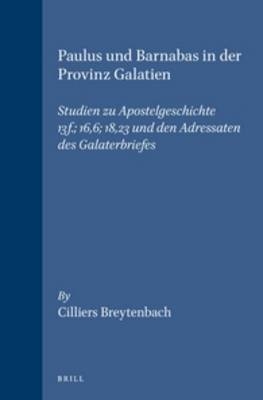
Paulus und Barnabas in der Provinz Galatien
Studien zu Apostelgeschichte 13f.: 16,6: 18,23 und den Adressaten des Galaterbriefes
Seiten
1996
Brill (Verlag)
978-90-04-10693-2 (ISBN)
Brill (Verlag)
978-90-04-10693-2 (ISBN)
This study of the local colour in the texts of Acts 13 and 14 and on the problem of the addressees of the letter to the Galatians introduces the newest findings in historical research of the province of Galatia in antiquity and shows how they may be fruitfully used in the interpretation of Acts and Galatians.
This study poses and answers two questions: 1. What is the basis in the tradition for the Acts 13 and 14 narrative about Paul's and Barnabas' mission on Cyprus and in southern Galatia? 2. Who are the addressees of the letter to the Galatians?
Using the extant inscriptions and literary sources that relate to the provinces of Cyprus and Galatia in the early Roman Empire, the above questions are addressed to Acts and Galatians, and answered as follows: 1 Acts 13-14 contains so much local colour as to rule out the thesis that the so-called first missionary journey is fictional. 2. Paul's letter to the Galatians is addressed to the churches in southern Galatia - Antioch, Iconium, Lystra and Derbe. The hypothesis of a north-Galatian setting is shown to be improbable in the light of the geographical, archaeological and epigraphic evidence.
This study poses and answers two questions: 1. What is the basis in the tradition for the Acts 13 and 14 narrative about Paul's and Barnabas' mission on Cyprus and in southern Galatia? 2. Who are the addressees of the letter to the Galatians?
Using the extant inscriptions and literary sources that relate to the provinces of Cyprus and Galatia in the early Roman Empire, the above questions are addressed to Acts and Galatians, and answered as follows: 1 Acts 13-14 contains so much local colour as to rule out the thesis that the so-called first missionary journey is fictional. 2. Paul's letter to the Galatians is addressed to the churches in southern Galatia - Antioch, Iconium, Lystra and Derbe. The hypothesis of a north-Galatian setting is shown to be improbable in the light of the geographical, archaeological and epigraphic evidence.
Cilliers Breytenbach, Dr. theol.habil. (1986), Ludwig-Maximilians-Universität München, is Professor of New Testament at the Institute for Early Christianity and Antiquity at the Humboldt-Universität, Berlin. He has published several studies on the Gospel of Mark and on the tradition history of early Christian soteriology, including Versöhnung (WMANT 60, 1989).
| Erscheint lt. Verlag | 1.11.1996 |
|---|---|
| Reihe/Serie | Arbeiten zur Geschichte des antiken Judentums und des Urchristentums ; 38 |
| Verlagsort | Leiden |
| Sprache | deutsch |
| Maße | 155 x 235 mm |
| Gewicht | 498 g |
| Einbandart | Leinen |
| Themenwelt | Geschichte ► Teilgebiete der Geschichte ► Religionsgeschichte |
| Religion / Theologie ► Christentum ► Kirchengeschichte | |
| Geisteswissenschaften ► Religion / Theologie ► Judentum | |
| Technik ► Architektur | |
| ISBN-10 | 90-04-10693-6 / 9004106936 |
| ISBN-13 | 978-90-04-10693-2 / 9789004106932 |
| Zustand | Neuware |
| Informationen gemäß Produktsicherheitsverordnung (GPSR) | |
| Haben Sie eine Frage zum Produkt? |
Mehr entdecken
aus dem Bereich


aus dem Bereich
von der Antike bis zur Gegenwart
Buch | Softcover (2025)
C.H.Beck (Verlag)
CHF 16,80


