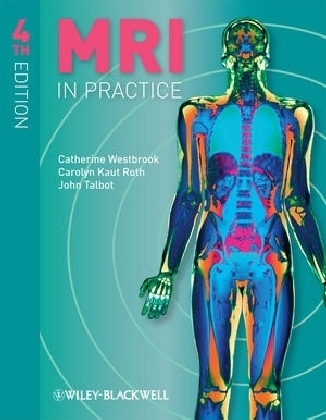
MRI in Practice
Wiley-Blackwell (an imprint of John Wiley & Sons Ltd) (Verlag)
978-1-4443-3743-3 (ISBN)
- Titel ist leider vergriffen;
keine Neuauflage - Artikel merken
The book explains in clear terms the theory that underpins magnetic resonance so that the capabilities and operation of MRI systems can be fully appreciated and maximised. This fourth edition captures recent advances, and coverage includes: parallel imaging techniques and new sequences such as balanced gradient echo.
Building on the success of the first three editions, the fourth edition has been fully revised and updated. The book now comes with a companion website at www.wiley.com/go/mriinpractice which hosts animated versions of a selection of illustrations in the book that are used on the MRI in Practice Course. These animations and accompanying text are aimed at helping the reader s comprehension of some of the more difficult concepts. The website also hosts over 200 interactive self-assessment exercises to help the reader test their understanding.
MRI in Practice features:
Full color illustrations
Logical presentation of the theory and applications of MRI
A new page design
A companion website at www.wiley.com/go/mriinpractice featuring interactive multiple choice questions, short answer questions PLUS animations of more complex concepts from the book
For more information on the MRI in Practice Course and other learning resources by Westbrook and Talbot, please visit www.mrieducation.com
Catherine Westbrook MSc, FHEA, PgC (HE), DCRR, CTCert, is a Senior Lecturer and postgraduate pathway leader at The Faculty of Health & Social Care, Anglia Ruskin University, Cambridge, UK where she is responsible for the postgraduate course in MRI. Catherine is also an independent teaching consultant lecturing on the MRI in Practice Course and other renowned international courses and conferences. She is also the author of Handbook of MRI Technique and MRI at a Glance, both published by Wiley. Carolyn Kaut Roth RT (R) (MR) (CT) (M) (CV), FSMRT, is the CEO of Imaging Education Associates, Berwyn, Pennsylvania, USA, delivering a wide variety of learning resources in MRI and other imaging modalities. John Talbot MSc, FHEA, PgC (HE), DCRR, is Senior Lecturer at The Faculty of Health & Social Care, Anglia Ruskin University, Cambridge, UK, where he is responsible for delivery of undergraduate and postgraduate modules. John is also an independent teaching consultant lecturing on the MRI in Practice Course and developing the companion website animations.
Foreword ix
Preface to the Fourth Edition xi
Acknowledgments xiii
Chapter 1 Basic principles 1
Introduction 1
Atomic structure 1
Motion in the atom 2
MR active nuclei 2
The hydrogen nucleus 4
Alignment 4
Precession 8
The Larmor equation 9
Resonance 11
The MR signal 15
The free induction decay signal (FID) 16
Relaxation 16
T1 recovery 16
T2 decay 16
Pulse timing parameters 19
Chapter 2 Image weighting and contrast 21
Introduction 21
Image contrast 21
Contrast mechanisms 22
Relaxation in diff erent tissues 23
T1 contrast 25
T2 contrast 27
Proton density contrast 27
Weighting 29
T2â decay 31
Introduction to pulse sequences 34
Chapter 3 Encoding and image formation 59
Encoding 59
Introduction 59
Gradients 60
Slice selection 62
Frequency encoding 65
Phase encoding 69
Sampling 73
Data collection and image
formation 79
Introduction 79
K space description 80
K space fi lling 81
Fast Fourier transform (FFT) 86
Important facts about K space 90
K space traversal and gradients 96
Options that fill K space 98
Types of acquisition 101
Chapter 4 Parameters and trade-offs 103
Introduction 103
Signal to noise ratio (SNR) 104
Contrast to noise ratio (CNR) 123
Spatial resolution 126
Scan time 131
Trade-offs 134
Decision making 134
Volume imaging 137
Chapter 5 Pulse sequences 140
Introduction 140
Spin echo pulse sequences 141
Conventional spin echo 141
Fast or turbo spin echo 143
Inversion recovery 151
Fast inversion recovery 157
STIR (short tau inversion recovery) 157
FLAIR (fluid attenuated inversion recovery) 159
IR prep sequences 163
Gradient echo pulse sequences 164
Conventional gradient echo 164
The steady state and echo formation 166
Coherent gradient echo 169
Incoherent gradient echo (spoiled) 172
Steady state free precession (SSFP) 175
Balanced gradient echo 179
Fast gradient echo 185
Single shot imaging techniques 186
Parallel imaging techniques 193
Chapter 6 Flow phenomena 198
Introduction 198
The mechanisms of flow 198
Flow phenomena 200
Time of flight phenomenon 200
Entry slice phenomenon 203
Intra-voxel dephasing 206
Flow phenomena compensation 207
Introduction 207
Even echo rephasing 207
Gradient moment rephasing (nulling) 207
Spatial pre-saturation 210
Chapter 7 Artefacts and their compensation 225
Introduction 225
Phase mismapping 225
Aliasing or wrap around 234
Chemical shift artefact 243
Out of phase artefact (chemical misregistration) 244
Truncation artefact 249
Magnetic susceptibility artefact 250
Cross-excitation and cross-talk 252
Zipper artefact 255
Shading artefact 256
Moire artefact 256
Magic angle 257
Chapter 8 Vascular and cardiac imaging 261
Introduction 261
Conventional MRI vascular imaging techniques 262
Magnetic resonance angiography (MRA) 269
Cardiac MRI 290
Cardiac gating 291
Peripheral gating 298
Pseudo-gating 300
Multiphase cardiac imaging 300
Cine 301
SPAMM 304
Chapter 9 Instrumentation and equipment 307
Introduction 307
Magnetism 309
Permanent magnets 312
Electromagnets 314
Superconducting electromagnets 317
Fringe fields 321
Shim coils 322
Gradient coils 323
Radio frequency (RF) 330
Patient transportation system 337
MR computer systems and the user interface 337
Chapter 10 MRI safety 341
Introduction 341
Government guidelines 342
Safety terminology 343
Hardware and magnetic field considerations 345
Radio frequency fields 346
Gradient magnetic fields 349
The main magnetic field 351
Projectiles 355
Siting considerations 357
MRI facility zones 358
Safety education 360
Protecting the general public from the fringe field 360
Implants and prostheses 361
Devices and monitors in MRI 367
Pacemakers 367
Patient conditions 368
Safety policy 369
Safety tips 370
Reference 371
Chapter 11 Contrast agents in MRI 372
Introduction 372
Mechanism of action of contrast agents 373
Molecular tumbling 373
Dipole dipole interactions 375
Magnetic susceptibility 376
Relaxivity 378
Gadolinium safety 380
Other contrast agents 383
Current applications of gadolinium contrast agents 385
Conclusion 393
Chapter 12 Functional imaging techniques 396
Introduction 396
Diff usion weighted imaging (DWI) 397
Perfusion imaging 400
Susceptibility weighting (SWI) 404
Functional imaging (fMRI) 404
Interventional MRI 405
MR spectroscopy (MRS) 407
Whole body imaging 410
MR microscopy (MRM) 411
Glossary 413
Index 427
| Verlagsort | Chicester |
|---|---|
| Sprache | englisch |
| Maße | 186 x 240 mm |
| Gewicht | 1070 g |
| Themenwelt | Medizinische Fachgebiete ► Radiologie / Bildgebende Verfahren ► Kernspintomographie (MRT) |
| Technik | |
| ISBN-10 | 1-4443-3743-2 / 1444337432 |
| ISBN-13 | 978-1-4443-3743-3 / 9781444337433 |
| Zustand | Neuware |
| Informationen gemäß Produktsicherheitsverordnung (GPSR) | |
| Haben Sie eine Frage zum Produkt? |
aus dem Bereich