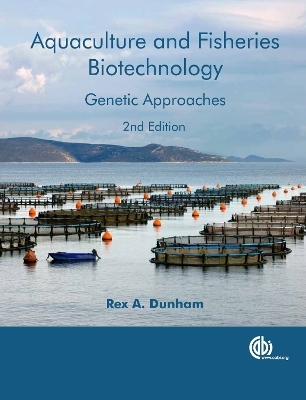
Aquaculture and Fisheries Biotechnology
CABI Publishing (Verlag)
978-1-84593-651-8 (ISBN)
- Titel ist leider vergriffen;
keine Neuauflage - Artikel merken
The growth of worldwide aquaculture has been sustained and rapid, and the explosion of research in genetic biotechnology has made significant impact on aquaculture and fisheries, although potential for much greater progress exists. Aquaculture and Fisheries Biotechnology: Genetic Approaches covers topics essential to the study of fish genetics, including qualitative and quantitative traits, crossbreeding, inbreeding, genetic drift, hybridization, selection programs, polyploidy, genomics and cloning. This fully updated second edition also addresses environmental risk, food safety and government regulation of transgenic aquatic organisms, commercial applications of fish biotechnology and future issues in fish genetics.
Rex Dunham is a Professor and Aquaculture Geneticist in the School of Fisheries Aquaculture and Aquatic Sciences at Auburn University. He received a B.S. from the University of Illinois in 1978, a M.S. and a PhD in Fisheries and Allied Aquacultures from Auburn University in 1979 and 1981. He has been on the faculty at Auburn University for 37 years. He also briefly served as Program Leader for the Genetic Enhancement and Breeding Program, ICLARM, Philippines, and as the President of the International Association of Genetics in Aquaculture From 2009-2012. His research team was the first to first demonstrate that selection works for the genetic improvement of channel catfish, the first to release genetically improved fish (catfish) in the United States, made the first transgenic fish in the United States, conducted the first outdoor environmental risk assessment and the first outdoor evaluation of performance of any transgenic animal in the world, generated the first xenogenic catfish (channel catfish males capable of producing blue catfish sperm, a form of stem cell surrogacy), accomplished the first repressible transgenic sterilization in fish, the first targeted gene insertion in the non-coding region of a fish and the first double CRISPR knockin of 2 transgenes in the non-coding region of 2 chromosomes. His research led to two major changes in the genetic type of fish used in the US catfish industry, the last resulting in the transformation of the US channel catfish industry into a majority hybrid catfish industry.
1: History of Biotechnology, Genetics and Selective Breeding in Aquaculture and Fisheries 2: Phenotypic Variation and Environmental Effects 3: Basic Genetics, Qualitative Traits and Selection for Qualitative Traits 4: Strain Evaluation, Domestication and Strain Selection 5: Population Size, Inbreeding, Random Genetic Drift and Maintenance of Genetic Quality 6: Gynogenesis, Androgenesis, Cloned Populations and Nuclear Transplantation 7: Intraspecific Crossbreeding 8: Interspecific Hybridization 9: Selection and Correlated Responses to Selection 10: Polyploidy and Xenogenesis 11: Sex Reversal and Breeding 12: Biochemical and Molecular Markers 13: Population Genetics and Interactions of Hatchery and Wild Fish 14: Genomics, Gene Mapping, Quantitative Trait Locus Mapping and Marker-assisted Selection 15: Gene Expression 16: Gene-transfer Technology 17: Combining Genetic Enhancement Programmes 18: Genotype-Environment Interactions 19: Commercial Application of Fish Biotechnology 20: Environmental Risk of Aquatic Organisms from Genetic Biotechnology 21: Food Safety of Transgenic Aquatic Organisms 22: A Case Example: Safety of Consumption of Transgenic Salmon Potentially Containing Elevated Levels of Growth Hormone and Insulin-like Growth Factor 23: Government Regulation of Transgenic Fish and Biotechnology Products 24: Strategies for Genetic Conservation, Gene Banking and Maintaining Genetic Quality 25: Ethics 26: Constraints and Limitations of Genetic Biotechnology
| Erscheint lt. Verlag | 29.9.2011 |
|---|---|
| Verlagsort | Wallingford |
| Sprache | englisch |
| Maße | 172 x 244 mm |
| Gewicht | 1240 g |
| Themenwelt | Technik ► Umwelttechnik / Biotechnologie |
| Veterinärmedizin | |
| Weitere Fachgebiete ► Land- / Forstwirtschaft / Fischerei | |
| ISBN-10 | 1-84593-651-5 / 1845936515 |
| ISBN-13 | 978-1-84593-651-8 / 9781845936518 |
| Zustand | Neuware |
| Informationen gemäß Produktsicherheitsverordnung (GPSR) | |
| Haben Sie eine Frage zum Produkt? |
aus dem Bereich