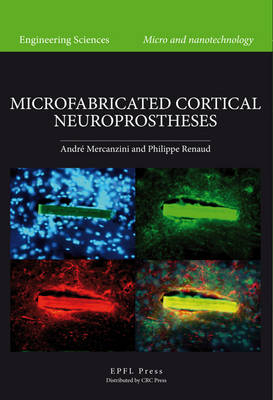
Microfabricated Cortical Neuroprostheses
Taylor & Francis Inc (Verlag)
978-1-4398-3754-2 (ISBN)
- Keine Verlagsinformationen verfügbar
- Artikel merken
This book addresses one of the main clinical complications with the use of electrodes, namely the reaction of the neurological tissue in the immediate vicinity of an implanted device. The authors describe new techniques for assessing this phenomenon, as well as new microfabrication techniques to impede the inflammatory response of the brain. Inflammation can adversely effect these devices, limiting their lifetime and reducing their effectiveness. The measurement protocols and improved fabrication protocols described within these pages will become standard tools in the future of neuroprostheses.
The author holds two U.S. patents on microassembly and is also a Review Editor for Frontiers in Neuroengineering.
André Mercanzini has experience in both academic and industrial research environments, having developed MEMS (Microelectromechanical Systems) for a wide range of applications. He has held internships at the Institute for Biomedical Engineering (University of Toronto), the Artificial Intelligence Laboratory (Massachusetts Institute of Technology), the Zyvex Corporation, and at Bosch Research in Palo Alto, California where he developed silicon processes for the Stanford Nanofabrication Facility. He holds two issued US patents on microassembly and has two patents pending on neurostimulation devices. André received his Ph.D. in bioengineering from the Ecole Polytechnique Fédérale de Lausanne (EPFL) in 2009 Philippe Renaud is Professor at the Microsystem Laboratory (LMIS4) at the EPFL and scientific director of the EPFL Center of MicroNanoTechnology (CMI). His main research area is related to micronano technologies in biomedical applications (BioMEMS) with emphasis on cell-chips, nanofluidics and bioelectronics. After receiving his Ph.D. degree from the University of Lausanne (1988), he was a postdoctoral fellow at University of California, Berkeley, and then at the IBM Zürich Research Laboratory in Switzerland, before joining the Swiss Center for Electronics and Microtechnology (CSEM) at Neuchâtel, Switzerland in 1992. He has been at the EPFL since 1994. Dr. Renaud is active in several scientific committees (scientific journals, international conferences, scientific advisory boards of companies) and is deeply involved in several high-tech start-up companies.
Introduction
Scope
Problem Statement: The Tissue Reaction to Implanted Neuroprostheses
The Initial Response
The Sustained Response
Effect of Tissue Reaction on Recording and Stimulation
Tissue Reaction Reduction Methods
Literature Review
Thin-Film Microelectrode Technology
Electrical Impedance Spectroscopy
Controlled Release Polymers
Technology Position With Respect to State of the Art
Research Objectives
Limitations
Structure
References
Microfabrication Techniques for Neuroprostheses
Introduction
Microelectrode Arrays
Microfabrication Techniques
Device Packaging
Electrical Characterization
Microfluidic Channels
Device Results
Conclusion
Neural Recording and Stimulation
Introduction
The Neurophysiological Basis of Recording
Detection of Biopotentials
Scaling of Electrodes and Noise
The Neurophysiological Basis of Stimulation
Applications of Neural Recording
The Somatosensory Cortex
Chronic Hippocampus Recordings
Chronic Auditory Cortex Recordings
Applications of Neural Stimulation
Cochlear and Modiolus Stimulation
Retinal Stimulation
Conclusion
References
in vivo Electrical Impedance Spectroscopy
Introduction
Materials and Methods
Implantable Microelectrode Array Fabrication
Electrode-Tissue Interface Modelling
Peak Resistance Frequency Method Simulation
Animal Implantation Procedure
in vivo Electrical Impedance Spectroscopy
Histology
Results
in vivo Electrical Impedance Spectroscopy
Histology
Discussion
Conclusion
References
Controlled Release Drug Coatings
Introduction
Materials and Methods
Microelectrode Array Fabrication
Nanoparticle-PEO Coating Synthesis
Implantation
in vivo Impedance Measurements
Histology
Results
Nanoparticle-PEO Coating Synthesis
in vivo Impedance Comparison
Qualitative Histological Comparison
Discussion
Conclusion
References
Conclusion
Summary of Main Results
Significance of Contribution to Knowledge
Future Perspectives
References
| Erscheint lt. Verlag | 14.1.2011 |
|---|---|
| Verlagsort | Washington |
| Sprache | englisch |
| Maße | 152 x 229 mm |
| Gewicht | 567 g |
| Themenwelt | Medizin / Pharmazie ► Physiotherapie / Ergotherapie ► Orthopädie |
| Naturwissenschaften ► Biologie ► Humanbiologie | |
| Naturwissenschaften ► Biologie ► Zoologie | |
| Technik ► Medizintechnik | |
| ISBN-10 | 1-4398-3754-6 / 1439837546 |
| ISBN-13 | 978-1-4398-3754-2 / 9781439837542 |
| Zustand | Neuware |
| Informationen gemäß Produktsicherheitsverordnung (GPSR) | |
| Haben Sie eine Frage zum Produkt? |
aus dem Bereich