


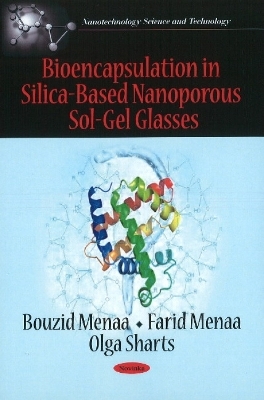
Bioencapsulation in Silica-Based Nanoporous Sol-Gel Glasses
Seiten
2010
Nova Science Publishers Inc (Verlag)
978-1-60876-989-6 (ISBN)
Nova Science Publishers Inc (Verlag)
978-1-60876-989-6 (ISBN)
Reports the results on the influence of different parameters (such as surface hydration, hydrophobicity, solute effects, thermal stability, porosity, macromolecular crowding) on the protein conformation based on the design and the characterisation of nanoporous silica-based materials containing different functional groups.
In this book, the authors report the recent results on the influence of different parameters (such as surface hydration, hydrophobicity, solute effects, thermal stability, porosity, macromolecular crowding) on the protein conformation based on the design and the characterisation of nanoporous silica-based materials containing different functional groups (e.g., hydrophobic alkyl, phosphate and fluorinated groups). The enhancement of the protein folding owing the physical properties and microstructure of the host matrix induced by the nature of the functional groups and the siloxane network play a major role on the protein biological activity and therefore to the development efficient bionanodevices such as biocatalysts, sensors, drug delivery systems or implanted devices. This book enlightens the bioapplications of silica-based glasses prepared from functionalised organosilane precursors used to mimic and to understand the different factors that influencing the protein folding process.
In this book, the authors report the recent results on the influence of different parameters (such as surface hydration, hydrophobicity, solute effects, thermal stability, porosity, macromolecular crowding) on the protein conformation based on the design and the characterisation of nanoporous silica-based materials containing different functional groups (e.g., hydrophobic alkyl, phosphate and fluorinated groups). The enhancement of the protein folding owing the physical properties and microstructure of the host matrix induced by the nature of the functional groups and the siloxane network play a major role on the protein biological activity and therefore to the development efficient bionanodevices such as biocatalysts, sensors, drug delivery systems or implanted devices. This book enlightens the bioapplications of silica-based glasses prepared from functionalised organosilane precursors used to mimic and to understand the different factors that influencing the protein folding process.
Introduction; Sol-Gel Bioencapsulation Process in Silica-Based Materials: Method, Materials & Bioapplications, Characterization Techniques; Parameters Affecting the Protein Folding in Nanoporous Silica-Based Sol-Gel Glasses; Enhancing the Protein Folding by Introducing & Associating Hydrophobic & Steric Effects in Modified Silica-Based Porous Glasses; Developed Techniques for a Better Understanding of Protein Folding in Nanoporous Sol-Gel Glasses; Conclusion; Index.
| Erscheint lt. Verlag | 1.7.2010 |
|---|---|
| Zusatzinfo | Illustrations |
| Verlagsort | New York |
| Sprache | englisch |
| Maße | 230 x 155 mm |
| Gewicht | 150 g |
| Themenwelt | Studium ► 1. Studienabschnitt (Vorklinik) ► Physiologie |
| Technik | |
| ISBN-10 | 1-60876-989-5 / 1608769895 |
| ISBN-13 | 978-1-60876-989-6 / 9781608769896 |
| Zustand | Neuware |
| Informationen gemäß Produktsicherheitsverordnung (GPSR) | |
| Haben Sie eine Frage zum Produkt? |
Mehr entdecken
aus dem Bereich


aus dem Bereich


