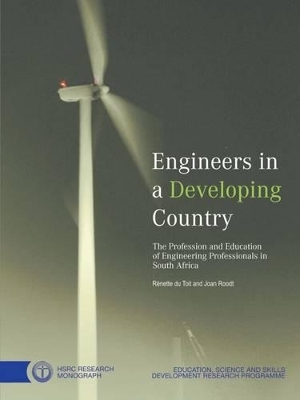
Engineers in a Developing Country
HSRC Press (Verlag)
978-0-7969-2262-5 (ISBN)
Economic growth in South Africa depends on engineering capacity to provide state-of-the-art, safe infrastructure for service delivery. At the same time the new democracy needs to address transformation. This monograph explores current capacity to address these challenges. The study provides a demographic analysis of employment trends across the public and private sectors of the economy, and investigates the demand for engineers, technologists and technicians in the workforce. A comprehensive analysis of the educational context for engineering professionals focuses on enrolment, graduation and throughout trends in all engineering disciplines at universities and universities of technology, and reveals that although there have been positive innovations in education and training strategies in recent years, many issues, especially at secondary school level, remain a challenge. Women in engineering is a particular focus of this study, which devotes a chapter to examining the factors that influence their choice of career, the barriers they experience in the labour market and strategies for encouraging women into the profession. This comprehensive monograph offers valuable quantitative and qualitative information about engineering capacity across all engineering disciplines in South Africa. It is therefore an important reference for all engineering academics as well as decision-makers in both the private and public sectors, and will be useful to aspiring and current engineering students, whatever their field. This study forms part of a broader project on professions and professional education within the HSRC Research Programme on Education, Science and Skills Development (ESSD). The research focus of ESSD is wide, spanning three major social domains: the education system, the national system of innovation, and the world of work. The programme is distinctive in that it is able to conduct research at the interface of these domains, to produce comprehensive, integrated and holistic analyses of the pathways of learners through schooling, further and higher education into the labour market and the national system of innovation.
Dr Renette du Toit holds a DLitt et Phil (Psychology) from the University of Johannesburg. She has extensive research experience in human resources and skills development in the labour market. Dr du Toit is also a member of the International Technology, Education and Development (INTED) 2008-2009 Scientific Advisory Board. Joan Roodt is a chief researcher in the Education, Science and Skills Development research programme at the HSRC and is a member of the International Technology, Education and Development (INTED) 2008-2009 Scientific Advisory Board.
The South African engineering labour market and professional milieu: introduction; the labour market context; current employment, and employment trends; the professional milieu; workforce demand; conclusion. The educational context for engineering professionals: Drivers of change in engineering education; secondary school education; reasons for studying engineering; higher education: the supply of engineering professionals; engineering programmes, and the accreditation process; challenges for institutions offering engineering programmes; student access and mobility or articulation; further education and training colleges; learnerships. Women in engineering: strategies to enhance women's participation; factors influencing women in choosing engineering; labour market barriers; graduation trends; employment trends; conclusion.
| Verlagsort | Cape Town |
|---|---|
| Sprache | englisch |
| Gewicht | 351 g |
| Themenwelt | Sozialwissenschaften ► Pädagogik ► Berufspädagogik |
| Technik | |
| Wirtschaft ► Volkswirtschaftslehre ► Makroökonomie | |
| ISBN-10 | 0-7969-2262-4 / 0796922624 |
| ISBN-13 | 978-0-7969-2262-5 / 9780796922625 |
| Zustand | Neuware |
| Informationen gemäß Produktsicherheitsverordnung (GPSR) | |
| Haben Sie eine Frage zum Produkt? |
aus dem Bereich