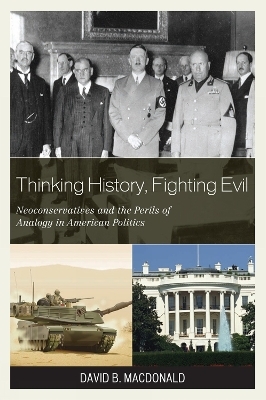
Thinking History, Fighting Evil
Lexington Books (Verlag)
978-0-7391-2502-1 (ISBN)
- Titel ist leider vergriffen;
keine Neuauflage - Artikel merken
David B. MacDonald is a well-known scholar in the fields of international relations, genocide studies, and American politics. He taught at the Graduate School of Management Paris and was a senior lecturer in political studies at the University of Otago, New Zealand, before taking up his current appointment in the Political Science Department at the University of Guelph. He is the author of Identity Politics in the Age of Genocide: The Holocaust and Historical Representation and Balkan holocausts? Serbian and Croatian Propaganda and the War in Yugoslavia. He is also co-editor of and contributor to The Ethics of Foreign Policy.
Chapter 1 Introduction Part 2 Part 1. Analogies in U.S. Foreign Policy Chapter 3 Chapter 1. Thinking History: Analogies and Schemas in International Politics Chapter 4 Chapter 2. Fighting Evil: The Hebrew Shema and the Munich Analogy Chapter 5 Chapter 3. World War II Analogies in American Politics Part 6 Part 2. Neoconservatives and Historical Analogies Chapter 7 Chapter 4. Neoconservatives and the American Weimar Chapter 8 Chapter 5. Islam, the Holocaust, and the New Cold War Chapter 9 Chapter 6. Swastikas in the Sand?: Neoconservatives and the War in Iraq Part 10 Part 3. Anti-Americanism and the War on Terror Chapter 11 Chapter 7. Righteous Victims: The Pathologies of Anti-Americanism Chapter 12 Chapter 8. Near Enemies: The European Collaborators Chapter 13 Conclusions
| Erscheint lt. Verlag | 16.5.2009 |
|---|---|
| Sprache | englisch |
| Maße | 160 x 239 mm |
| Gewicht | 483 g |
| Themenwelt | Sonstiges ► Geschenkbücher |
| Sozialwissenschaften ► Politik / Verwaltung ► Politische Theorie | |
| ISBN-10 | 0-7391-2502-8 / 0739125028 |
| ISBN-13 | 978-0-7391-2502-1 / 9780739125021 |
| Zustand | Neuware |
| Informationen gemäß Produktsicherheitsverordnung (GPSR) | |
| Haben Sie eine Frage zum Produkt? |
aus dem Bereich