


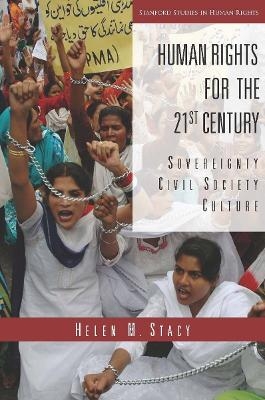
Human Rights for the 21st Century
Sovereignty, Civil Society, Culture
Seiten
2009
|
New edition
Stanford University Press (Verlag)
978-0-8047-6095-9 (ISBN)
Stanford University Press (Verlag)
978-0-8047-6095-9 (ISBN)
Considers the legal, moral and pragmatic issues at stake when international standards of human rights are trumped by culture and politics, and proposes new approaches to fill the gaps in current human rights theories and practice, namely relational sovereignty, reciprocal adjudication, and regional human rights courts.
A new moral, ethical, and legal framework is needed for international human rights law. Never in human history has there been such an elaborate international system for human rights, yet from massive disasters, such as the Darfur genocide, to everyday tragedies, such as female genital mutilation, human rights abuses continue at an alarming rate. As the world population increases and global trade brings new wealth as well as new problems, international law can and should respond better to those who live in fear of violence, neglect, or harm.
Modern critiques global human rights fall into three categories: sovereignty, culture, and civil society. These are not new problems, but have long been debated as part of the legal philosophical tradition. Taking lessons from tradition and recasting them in contemporary light, Helen Stacy proposes new approaches to fill the gaps in current approaches: relational sovereignty, reciprocal adjudication, and regional human rights. She forcefully argues that law and courts must play a vital role in forging a better human rights vision in the future.
A new moral, ethical, and legal framework is needed for international human rights law. Never in human history has there been such an elaborate international system for human rights, yet from massive disasters, such as the Darfur genocide, to everyday tragedies, such as female genital mutilation, human rights abuses continue at an alarming rate. As the world population increases and global trade brings new wealth as well as new problems, international law can and should respond better to those who live in fear of violence, neglect, or harm.
Modern critiques global human rights fall into three categories: sovereignty, culture, and civil society. These are not new problems, but have long been debated as part of the legal philosophical tradition. Taking lessons from tradition and recasting them in contemporary light, Helen Stacy proposes new approaches to fill the gaps in current approaches: relational sovereignty, reciprocal adjudication, and regional human rights. She forcefully argues that law and courts must play a vital role in forging a better human rights vision in the future.
Helen M. Stacy is a Senior Fellow at the Center on Democracy, Development, and the Rule of Law at the Freeman Spogli Institute for International Studies, Stanford University, and a Senior Lecturer at the Stanford Law School.
| Erscheint lt. Verlag | 5.2.2009 |
|---|---|
| Reihe/Serie | Stanford Studies in Human Rights |
| Verlagsort | Palo Alto |
| Sprache | englisch |
| Maße | 152 x 229 mm |
| Gewicht | 386 g |
| Themenwelt | Recht / Steuern ► EU / Internationales Recht |
| Recht / Steuern ► Öffentliches Recht ► Völkerrecht | |
| Sozialwissenschaften ► Politik / Verwaltung | |
| ISBN-10 | 0-8047-6095-0 / 0804760950 |
| ISBN-13 | 978-0-8047-6095-9 / 9780804760959 |
| Zustand | Neuware |
| Informationen gemäß Produktsicherheitsverordnung (GPSR) | |
| Haben Sie eine Frage zum Produkt? |
Mehr entdecken
aus dem Bereich



aus dem Bereich
Die Rechtsprechung des Gerichtshofs der Europäischen Union, deutscher …
Buch | Softcover (2025)
Nomos (Verlag)
CHF 53,50


