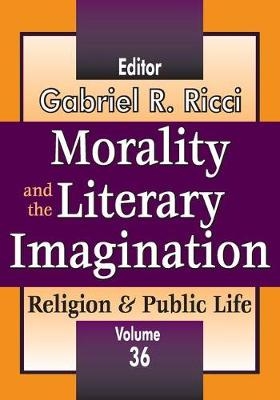
Morality and the Literary Imagination
Routledge (Verlag)
9781412808392 (ISBN)
The collected works in this new volume of the Transaction series Religion and Public Life heeds Petrarch's advice that literature not only orients us to life's developmental stages, it can provide us with a more complete understanding of the human character while artfully advancing morals. To this end, Michelle Darnell's opening chapter entitled "A New Age of Reason" explains how existentialism is an argument for how literature can take on philosophical form, not as formal argument, but as persuasive narrative. Over the objections of even those who study Sartre, Darnell uses Sartre's The Age of Reason as a model and shows how his literary output was a legitimate philosophical inquiry.
In addition to the Darnell piece, the volume boasts a series of outstanding and innovative works by scholars in the field. Taken together as a whole, these authors not only illustrate the moral consequences of an original choice, but oblige the reader to explore the ramifications of such a choice in one's own life.
Gabriel R. Ricci is professor of humanities and the chair of the Department of History at Elizabethtown College. He is the author of Time Consciousness: The Philosophical Uses of History and the editor of Transaction's much-admired Religion and Public Life series.
1: A New Age of Reason; 2: The Great Yearning: Spiritual Mysticism and Aesthetic Morality—Vedanta, the Perennial Philosophy, Schopenhauer, and Iris Murdoch; 3: The Not So Black and White World of Brothers: Morality and Filial Piety in the Works of Lu Xun and Lao She; 4: On the Fundamentalist Imagination: Toward the Poetics of Truth in Modernism; 5: The Form of Emptiness: Aesthetic Ambivalence and Moral Obligation in Charles Johnson’s Middle Passage; 6: George Orwell on the Moral Obligations of Intellectuals; 7: “Politics has Become Too Serious a Matter to be Left to the Politicians”: T.S. Eliot and George Orwell; 8: Wyndham Lewis: A Portrait of the Artist as Ideologue; 9: The Moral Value of Gothic Sublimity; 10: Aldous Huxley: Anglo-American Skeptic-Become-Mystic in Search of the Moral Ground—The Fictional Path; 11: Earthen, Brazen, and Golden: A Moral Taxonomy of Literature
| Erscheint lt. Verlag | 15.2.2009 |
|---|---|
| Reihe/Serie | Religion and Public Life |
| Verlagsort | New York |
| Sprache | englisch |
| Maße | 178 x 254 mm |
| Gewicht | 408 g |
| Themenwelt | Geisteswissenschaften ► Philosophie ► Ethik |
| Geisteswissenschaften ► Sprach- / Literaturwissenschaft ► Anglistik / Amerikanistik | |
| Geisteswissenschaften ► Sprach- / Literaturwissenschaft ► Literaturwissenschaft | |
| Sozialwissenschaften | |
| ISBN-13 | 9781412808392 / 9781412808392 |
| Zustand | Neuware |
| Informationen gemäß Produktsicherheitsverordnung (GPSR) | |
| Haben Sie eine Frage zum Produkt? |
aus dem Bereich