


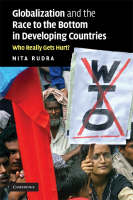
Globalization and the Race to the Bottom in Developing Countries
Who Really Gets Hurt?
Seiten
2008
Cambridge University Press (Verlag)
9780521715034 (ISBN)
Cambridge University Press (Verlag)
9780521715034 (ISBN)
According to conventional wisdom, globalisation's 'race to the bottom' undercuts welfare protections in developing countries, with the biggest losers being the poor. This study argues for a more complex conceptualisation, noting that it is the middle classes, the real beneficiaries of these welfare systems, who are most affected.
The advance of economic globalization has led many academics, policy-makers, and activists to warn that it leads to a 'race to the bottom'. In a world increasingly free of restrictions on trade and capital flows, developing nations that cut public services are risking detrimental effects to the populace. Conventional wisdom suggests that it is the poorer members of these societies who stand to lose the most from these pressures on welfare protections, but this new study argues for a more complex conceptualization of the subject. Nita Rudra demonstrates how and why domestic institutions in developing nations have historically ignored the social needs of the poor; globalization neither takes away nor advances what never existed in the first place. It has been the lower- and upper-middle classes who have benefited the most from welfare systems and, consequently, it is they who are most vulnerable to globalization's race to the bottom.
The advance of economic globalization has led many academics, policy-makers, and activists to warn that it leads to a 'race to the bottom'. In a world increasingly free of restrictions on trade and capital flows, developing nations that cut public services are risking detrimental effects to the populace. Conventional wisdom suggests that it is the poorer members of these societies who stand to lose the most from these pressures on welfare protections, but this new study argues for a more complex conceptualization of the subject. Nita Rudra demonstrates how and why domestic institutions in developing nations have historically ignored the social needs of the poor; globalization neither takes away nor advances what never existed in the first place. It has been the lower- and upper-middle classes who have benefited the most from welfare systems and, consequently, it is they who are most vulnerable to globalization's race to the bottom.
Nita Rudra is an Assistant Professor of International Affairs in the Graduate School of Public and International Affairs at the University of Pittsburgh.
Preface; 1. Introduction; 2. The race to the bottom in developing countries; 3. Who really gets hurt?; 4. LDC welfare states: convergence? What are the implications?; 5. Globalization and the protective welfare state: case study of India; 6. Globalization and the productive welfare state: case study of South Korea; 7. Globalization and the dual welfare state: case study of Brazil; 8. Conclusions; Appendices.
| Erscheint lt. Verlag | 25.9.2008 |
|---|---|
| Zusatzinfo | Worked examples or Exercises |
| Verlagsort | Cambridge |
| Sprache | englisch |
| Maße | 152 x 228 mm |
| Gewicht | 510 g |
| Themenwelt | Sozialwissenschaften ► Politik / Verwaltung |
| Sozialwissenschaften ► Soziologie | |
| Wirtschaft ► Volkswirtschaftslehre ► Wirtschaftspolitik | |
| ISBN-13 | 9780521715034 / 9780521715034 |
| Zustand | Neuware |
| Informationen gemäß Produktsicherheitsverordnung (GPSR) | |
| Haben Sie eine Frage zum Produkt? |
Mehr entdecken
aus dem Bereich



aus dem Bereich
Wohlstand, Wachstum, Wettbewerb
Buch | Softcover (2025)
Kohlhammer (Verlag)
CHF 68,90
mit Marx, Menger und Marshall durch die Grundlagen der Ökonomie
Buch | Hardcover (2025)
De Gruyter Oldenbourg (Verlag)
CHF 62,90
Wurzeln und Perspektiven
Buch | Softcover (2025)
Kohlhammer (Verlag)
CHF 44,75


