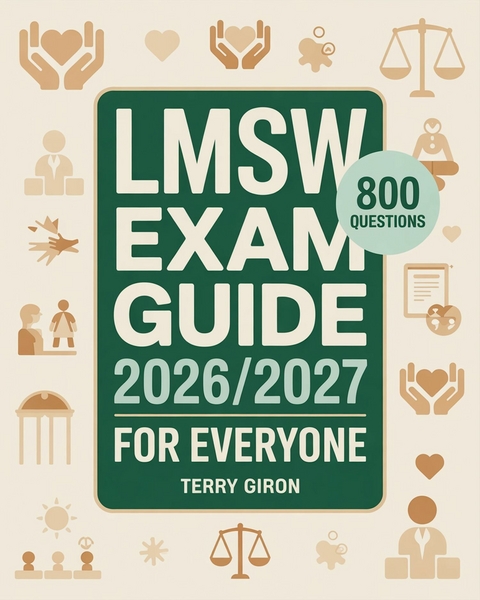
LMSW Exam Guide 2026/2027 for Everyone (eBook)
194 Seiten
Publishdrive (Verlag)
978-0-00-113243-6 (ISBN)
The LMSW Exam Guide 2026/2027 for Everyone is a structured learning resource designed to support candidates preparing for the Licensed Master Social Worker (LMSW) licensure examination. This guide presents core social work knowledge and exam-relevant content in a clear, organized format suitable for learners at all stages of preparation.
The guide focuses on helping readers understand and apply concepts commonly assessed on the LMSW exam, including human behavior and development, social work practice, assessment and intervention strategies, ethics and professional standards, cultural competence, policy and advocacy, and legal responsibilities. Explanations emphasize comprehension, ethical reasoning, and practical application within social work settings.
Designed for Everyone-including social work students, recent graduates, and professionals seeking licensure-this guide serves as a comprehensive review and structured reference to help learners organize their study, reinforce foundational knowledge, and approach the LMSW exam with clarity and confidence.
Disclaimer: This exam guide is an independent educational resource created for general exam preparation purposes. It is not affiliated with, endorsed by, or sponsored by ASWB or any state licensing board. All terminology and references are used solely for educational purposes.
Chapter 2 — Human Development, Diversity & Behavior in the Environment (Exam Topic Area)
Life-span development, cultural competence, and social/sociocultural influences
- Describe how Bronfenbrenner’s bioecological model explains the differing developmental outcomes of two siblings raised in the same household but attending different schools and social circles.
- Analyze how attachment theory (Bowlby/Ainsworth) and contemporary neurobiology together account for chronic interpersonal difficulties in an adult who experienced disorganized attachment in early childhood.
- Explain how Erikson’s stage of identity vs. role confusion might present differently for a first-generation immigrant adolescent negotiating parental cultural expectations and peer assimilation pressures.
- Using Piagetian and Vygotskian frameworks, compare how cognitive development in middle childhood is shaped by individual constructivist processes versus sociocultural scaffolding.
- Evaluate the limitations of stage theories (e.g., Freud, Erikson, Piaget) when applied to neurodivergent development across the life span.
- Describe mechanisms by which adverse childhood experiences (ACEs) produce intergenerational effects on development via both social learning and epigenetic pathways.
- Outline an evidence-based conceptualization of resilience in older adults facing cumulative losses, incorporating life-course perspective and socioemotional selectivity theory.
- Explain how intersectionality (e.g., race, gender, disability, socioeconomic status) modifies risk trajectories for adolescent substance use, citing relevant developmental pathways.
- Analyze cultural models of parenting (e.g., authoritativeness vs. authoritarianism vs. relational models) and their differential associations with academic and socioemotional outcomes in collectivist versus individualist contexts.
- Discuss how puberty’s endocrinological changes interact with peer dynamics to influence risk-taking behaviors in adolescents, using dual systems and social identity frameworks.
- Explain the role of parental reflective functioning and mentalization in buffering the effects of parental depression on infant attachment and later emotional regulation.
- Describe how the life-course principle of linked lives explains health disparities observed among second-generation immigrants in midlife.
- Compare and contrast cultural humility, cultural competence, and cultural safety as professional frameworks, including strengths and practical limitations.
- Using family systems theory, analyze how an adolescent’s externalizing behavior can function to maintain family homeostasis in a family with parental conflict.
- Explain how social determinants of health (income, education, housing, food security) translate into neurodevelopmental differences observable in early childhood.
- Describe processes of acculturation (assimilation, integration, separation, marginalization) and predict psychological outcomes for adults forced to migrate due to climate disaster.
- Analyze the implications of the life-span idea of plasticity for interventions targeting cognitive decline in early stages of dementia.
- Explain how cohort, period, and age effects could be disentangled when researching depressive symptoms trajectories from adolescence into late adulthood.
- Describe developmental cascades and provide an example showing how early language delay can lead to adolescent school failure and antisocial behavior.
- Explain how stereotypes and stereotype threat can produce measurable cognitive and performance decrements among older adults in cross-cultural assessment contexts.
- Analyze how policy-level socioeconomic changes (e.g., reduction of welfare benefits) can alter family functioning and child developmental outcomes through mesosystem effects.
- Describe how cultural models of aging influence older adults’ health behaviors and help-seeking patterns in two contrasting societies.
- Explain how moral development theories (Kohlberg, Gilligan) might be reinterpreted through cultural relativism and feminist critiques.
- Analyze how community violence exposure during early adolescence alters stress physiology and social information processing, increasing later aggression risk.
- Explain the developmental implications of early bilingualism on executive function and identity formation, distinguishing simultaneous from sequential bilingual acquisition.
- Using Erikson and contemporary identity theory, explain late-life identity renegotiation following retirement and spousal loss.
- Describe the role of peer contagion and social reinforcement in the escalation of self-harm behaviors among adolescents within online communities.
- Explain how cultural narratives about masculinity shape help-seeking and emotional expression across the male life span.
- Compare Bronfenbrenner’s mesosystem and macrosystem influences in shaping educational attainment trajectories among children from marginalized communities.
- Analyze mechanisms by which stigmatization of disability produces secondary health disparities across adulthood.
- Explain how attachment patterns formed in infancy may be activated and reshaped during pregnancy and early parenting in adulthood.
- Describe how gender socialization across development contributes to differential prevalence of internalizing disorders among adolescent girls versus boys.
- Analyze how cumulative inequality theory explains widening health gaps between low- and high-SES individuals from midlife onward.
- Explain the interplay between temperament and parenting style in predicting externalizing trajectories from toddlerhood through school age.
- Describe the effects of mass media and social media on adolescent identity development, locus of control, and normative belief formation.
- Explain the concept of cultural bereavement and its potential developmental impacts on refugees’ children born in exile.
- Analyze how developmental psychopathology’s equifinality and multifinality principles complicate clinical prognosis after early trauma.
- Describe how caregiving roles across generations (sandwich generation) influence mental health trajectories using role strain and role enhancement models.
- Explain how structural racism operates at institutional and community levels to shape prenatal and perinatal outcomes for minority mothers.
- Analyze the role of early motor development and embodied cognition in later language and socioemotional outcomes.
- Describe how family narratives and autobiographical memory socialization affect identity coherence in adolescence.
- Explain how neurodevelopmental disorder diagnoses in childhood influence self-concept and educational placement across developmental transitions.
- Analyze cultural variations in expressions of grief and their implications for assessment and intervention in multicultural clinical practice.
- Describe mechanisms through which grandparent involvement buffers developmental risk in single-parent households.
- Explain the developmental consequences of incarceration of a parent during a child’s sensitive period, incorporating attachment and ecological perspectives.
- Analyze the role of neighborhood collective efficacy in moderating adolescent delinquency despite economic disadvantage.
- Describe how menopause’s biopsychosocial changes can impact identity, intimate relationships, and occupational functioning.
- Explain how early childhood programs (e.g., high-quality daycare, Head Start) produce both immediate and long-term developmental effects, and why effects may fade or persist.
- Analyze how cultural models of mental illness affect symptom reporting, treatment engagement, and recovery trajectories among adults from different ethnoracial backgrounds.
- Describe how sexual orientation identity formation during adolescence may interact with family rejection to predict long-term mental health outcomes.
- Explain the ways in which childhood chronic illness alters typical developmental tasks and peer relationships into adolescence.
- Analyze how the digital divide across socioeconomic strata influences cognitive and academic development during middle childhood.
- Describe the developmental pathways linking adolescent exposure to parental substance use and later adult attachment insecurity and relationship dysfunction.
- Explain how early caregiving deprivation impacts the HPA axis and how therapeutic interventions can target those dysregulations.
- Analyze how differing cultural child-rearing goals (autonomy vs. interdependence) influence the clinical interpretation of adolescent behaviors in therapy.
- Describe the role of sleep architecture changes across the lifespan and their downstream effects on cognition and mood.
- Explain how rites of passage or cultural initiation rituals function in identity consolidation and social role assignment during adolescence.
- Analyze how peer rejection in elementary school translates into social-cognitive biases that perpetuate victimization across development.
- Describe how microaggressions accumulate to undermine academic achievement and psychological wellbeing among minority college students.
- Explain the developmental implications of gender-affirming interventions in transgender youth, focusing on psychosocial and identity outcomes.
- Analyze how parental incarceration intersects with community resources to shape delinquency risk over...
| Erscheint lt. Verlag | 2.1.2026 |
|---|---|
| Sprache | englisch |
| Themenwelt | Sozialwissenschaften ► Pädagogik ► Sozialpädagogik |
| ISBN-10 | 0-00-113243-1 / 0001132431 |
| ISBN-13 | 978-0-00-113243-6 / 9780001132436 |
| Informationen gemäß Produktsicherheitsverordnung (GPSR) | |
| Haben Sie eine Frage zum Produkt? |
 EPUB (Adobe DRM)
Größe: 898 KB
Kopierschutz: Adobe-DRM
Adobe-DRM ist ein Kopierschutz, der das eBook vor Mißbrauch schützen soll. Dabei wird das eBook bereits beim Download auf Ihre persönliche Adobe-ID autorisiert. Lesen können Sie das eBook dann nur auf den Geräten, welche ebenfalls auf Ihre Adobe-ID registriert sind.
Details zum Adobe-DRM
Dateiformat: EPUB (Electronic Publication)
EPUB ist ein offener Standard für eBooks und eignet sich besonders zur Darstellung von Belletristik und Sachbüchern. Der Fließtext wird dynamisch an die Display- und Schriftgröße angepasst. Auch für mobile Lesegeräte ist EPUB daher gut geeignet.
Systemvoraussetzungen:
PC/Mac: Mit einem PC oder Mac können Sie dieses eBook lesen. Sie benötigen eine
eReader: Dieses eBook kann mit (fast) allen eBook-Readern gelesen werden. Mit dem amazon-Kindle ist es aber nicht kompatibel.
Smartphone/Tablet: Egal ob Apple oder Android, dieses eBook können Sie lesen. Sie benötigen eine
Geräteliste und zusätzliche Hinweise
Buying eBooks from abroad
For tax law reasons we can sell eBooks just within Germany and Switzerland. Regrettably we cannot fulfill eBook-orders from other countries.
aus dem Bereich