


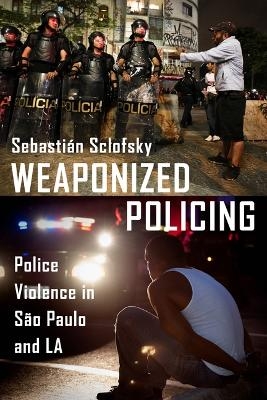
Weaponized Policing
Police Violence in São Paulo and LA
Seiten
2026
New York University Press (Verlag)
978-1-4798-0746-8 (ISBN)
New York University Press (Verlag)
978-1-4798-0746-8 (ISBN)
- Noch nicht erschienen (ca. September 2026)
- Versandkostenfrei
- Auch auf Rechnung
- Artikel merken
How police reproduce social, spatial, and racial inequalities in two global cities
From Donald Trump to Brazil's Jair Bolsonaro, political leaders endorsing "law and order" – specifically through aggressive policing strategies – have supported the formation of carceral states in self-proclaimed democracies. In Weaponized Policing, Sebastián Sclofsky provides a comparative lens on this dynamic, taking a look at police-civilian violence in the United States and Brazil, and its impact on people's understanding of race, space, and citizenship.
The book argues that the socio-economic transformations of the last half-century, marked by the rise of neoliberal capitalism, have produced extreme levels of inequality, and created new forms of vulnerability that are managed and reproduced by police. The pacifying processes conducted by the police in their production and reproduction of social order produce the categories of black, poor, and periphery, transforming these subjects into the ultimate "other" against whom police intervention and violence is deemed necessary and justified for the sake of the city's well-being.
Drawing on hundreds of interviews with politicians, police officers, community activists, and low-income residents of São Paulo's periphery and neighborhoods in South L.A., Sclofsky follows the stories of individuals who live, and are policed, on the "peripheries." He argues that, in both countries, aggressive policing creates authoritarian enclaves within faulty democracies. As a result, residents of color are criminalized, individual rights are systematically violated, and a sense of second-class citizenship is developed—even when people live in a country where political rights are supposedly guaranteed, and free and fair elections do take place.
From Donald Trump to Brazil's Jair Bolsonaro, political leaders endorsing "law and order" – specifically through aggressive policing strategies – have supported the formation of carceral states in self-proclaimed democracies. In Weaponized Policing, Sebastián Sclofsky provides a comparative lens on this dynamic, taking a look at police-civilian violence in the United States and Brazil, and its impact on people's understanding of race, space, and citizenship.
The book argues that the socio-economic transformations of the last half-century, marked by the rise of neoliberal capitalism, have produced extreme levels of inequality, and created new forms of vulnerability that are managed and reproduced by police. The pacifying processes conducted by the police in their production and reproduction of social order produce the categories of black, poor, and periphery, transforming these subjects into the ultimate "other" against whom police intervention and violence is deemed necessary and justified for the sake of the city's well-being.
Drawing on hundreds of interviews with politicians, police officers, community activists, and low-income residents of São Paulo's periphery and neighborhoods in South L.A., Sclofsky follows the stories of individuals who live, and are policed, on the "peripheries." He argues that, in both countries, aggressive policing creates authoritarian enclaves within faulty democracies. As a result, residents of color are criminalized, individual rights are systematically violated, and a sense of second-class citizenship is developed—even when people live in a country where political rights are supposedly guaranteed, and free and fair elections do take place.
Sebastián Sclofsky is Associate Professor of Criminal Justice at California State University, Stanislaus. He received his Ph.D. in Political Science from University of Florida in 2008.
| Erscheint lt. Verlag | 1.9.2026 |
|---|---|
| Zusatzinfo | 5 b/w images and 2 tables |
| Verlagsort | New York |
| Sprache | englisch |
| Maße | 152 x 229 mm |
| Themenwelt | Recht / Steuern ► Strafrecht ► Kriminologie |
| Sozialwissenschaften ► Politik / Verwaltung | |
| ISBN-10 | 1-4798-0746-X / 147980746X |
| ISBN-13 | 978-1-4798-0746-8 / 9781479807468 |
| Zustand | Neuware |
| Informationen gemäß Produktsicherheitsverordnung (GPSR) | |
| Haben Sie eine Frage zum Produkt? |
Mehr entdecken
aus dem Bereich



aus dem Bereich
Mein Leben zwischen Kokain und Waffen
Buch | Softcover (2025)
Piper (Verlag)
CHF 24,90
zwei Essays
Buch | Softcover (2025)
Reclam, Philipp (Verlag)
CHF 9,80


