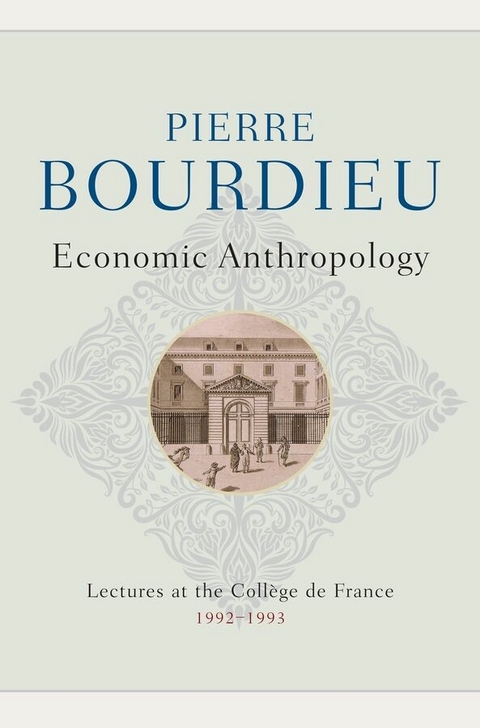
Economic Anthropology (eBook)
294 Seiten
Polity (Verlag)
978-1-5095-3478-4 (ISBN)
Has the revolution that led from the economy of the gift, characteristic of most precapitalist societies, to the economy of modern societies been accomplished in all spheres of life, as tacitly assumed by those who claim to apply the model of the profit-optimizing agent to every practice - to art, to education and even to marriage, seen as an exchange of economic services of production and reproduction? And is it totally accomplished even at the heart of the sphere most directly concerned with economic activity - the world of business?
These and many other questions are absent from the dominant economic theories, which fail to take account of the economic and social conditions under which economic agents and their universe arise. In his lectures at the Collège de France in 1987-89, Pierre Bourdieu laid bare the assumptions of the imaginary anthropology that underlies economics in its dominant form and put forward an alternative view. He replaced the notion of a pure and perfect market with the notion of an economic field structured by the unequal distribution of different forms of capital and by relations of force and symbolic struggle. He replaced homo economicus - that sovereign individual with no qualities or qualifications other than a capacity for rational calculation - with an agent endowed with enduring dispositions, fashioned by social background and experience, both individual and collective. And thus, without having to appeal to a perfectly lucid calculating mind or to the logic of bounded rationality, he was able to account for the alignment of subjective expectations and objective opportunities that confers on the great majority of economic behaviour its 'reasonable' character.
Bourdieu's trenchant critique of dominant economic thought and his development of an alternative way of understanding economic activity, rooted in his notion of field and his theory of practice, will be of great interest to students and scholars in anthropology, sociology, economics and throughout the social sciences and humanities.
Pierre Bourdieu (1930-2002) was one of the most influential sociologists and anthropologists of the late twentieth century. He was Professor of Sociology at the Collège de France and Director of Studies at the École des Hautes Etudes en Sciences Sociales. His many works include Outline of a Theory of Practice, Distinction: A Social Critique of the Judgement of Taste, The Rules of Art, The Logic of Practice and Pascalian Meditations.
Has the revolution that led from the economy of the gift, characteristic of most precapitalist societies, to the economy of modern societies been accomplished in all spheres of life, as tacitly assumed by those who claim to apply the model of the profit-optimizing agent to every practice to art, to education and even to marriage, seen as an exchange of economic services of production and reproduction? And is it totally accomplished even at the heart of the sphere most directly concerned with economic activity the world of business?These and many other questions are absent from the dominant economic theories, which fail to take account of the economic and social conditions under which economic agents and their universe arise. In his lectures at the Coll ge de France in 1987-89, Pierre Bourdieu laid bare the assumptions of the imaginary anthropology that underlies economics in its dominant form and put forward an alternative view. He replaced the notion of a pure and perfect market with the notion of an economic field structured by the unequal distribution of different forms of capital and by relations of force and symbolic struggle. He replaced homo economicus that sovereign individual with no qualities or qualifications other than a capacity for rational calculation with an agent endowed with enduring dispositions, fashioned by social background and experience, both individual and collective. And thus, without having to appeal to a perfectly lucid calculating mind or to the logic of bounded rationality, he was able to account for the alignment of subjective expectations and objective opportunities that confers on the great majority of economic behaviour its 'reasonable' character.Bourdieu's trenchant critique of dominant economic thought and his development of an alternative way of understanding economic activity, rooted in his notion of field and his theory of practice, will be of great interest to students and scholars in anthropology, sociology, economics and throughout the social sciences and humanities.
Lecture of 1 April 1993
Preamble: rethinking the problems of economics – The theory of rational action – The dehistoricization of economic universes and behaviour – The case of the gift – The phenomenological approach to the gift (Derrida) – The anthropological analysis of the gift – Reintegrating lived experience, creating a theory of practice – The destruction of time in science – The scholastic point of view
Preamble: rethinking the problems of economics
This year I am proposing to deal with a rather daunting topic, and I feel some trepidation as I come to offer it up to you. I shall immediately define some limits to my ambition. I am obviously not going to launch into a criticism of economics, which would be the aggressive and pretentious sort of attack that is based on nothing more than ignorance. It would be senseless – although such attacks are very commonly mounted by sociologists. What I would like to do, is to refer to the discussions that are current among economists themselves in order to establish some clear foundations for economic behaviour, since economics is in fact an extremely advanced, complex and diversified science, and the aggressivity that sociologists show towards it is explained partly by this real or apparent advance: most of the accusations that we could aim at economics in general – like the majority of those we could aim at sociology in general – have no sense, insofar as some economist has already addressed them to other economists or to himself. If you are familiar with the discourse of economics, then, you will find that it contains all the most fundamental reflections that can be made about economics. (I am referring to sociology at the same time by proxy, and it is common enough for sociologists to be irritated to hear what non-sociologists have to say about sociology. Philosophers in particular willingly conflate issues and make sweeping accusations that have no sense – it is admittedly less false if they say ‘sociology’ when they are thinking of some particular sociologist, but even in such a case, they frequently target a scapegoat rather than the reality of a scientific practice.) So I have to warn you not to expect this from me: that is not at all what I intend to do. I am going to attempt to tackle economics on its own terms, and take the problems that it poses as it poses them, while attempting to pose them in a more rigorous and perhaps more systematic way. If I have a contribution to make to a reflection that is inherent in the discipline of economics, it is perhaps a reintegration of economic behaviour within the universe of all human behaviour; I would like to try to show that this economic behaviour, which we treat as a datum, a given object, is in fact a historical construction.
Another difficulty in the discussion with a discipline as complex and diversified as economics is that, like all contemporary disciplines, it is composed as a field: it forms a space of objective relations between producers who hold different positions in the social space that comprises the discipline, and who adopt stances differentiated according to their different situations in the space of positions. In other words, when you have even a smattering of the culture of a discipline, you measure the fact that confronting a discipline in isolation has no sense; a discipline, rather like the Hydra of Lerna, is a kind of monster with a hundred heads: when you think you have cut off one head, ninety-nine others sprout up and tell you that your attack is both vain and rather stupid. Often, if you can handle the culture – and I shall do my best within the limits of my knowledge – you can place economics in dialogue with itself and – as I shall try to do – use economics and its various discoveries, born of conflict and won through conflict, to try to elucidate, perhaps more systematically than before, the problems of the foundations and the temporal structure of economic action. There you have what is more or less the intention [of my course of lectures]; I wanted to immediately dispel any ambiguities that the title I have announced might arouse or encourage.
The theory of rational action
If this reflection on the foundations of economic behaviour seems important to me, it is because it has today returned to the centre of debates in the social sciences as a whole. Strangely, the notorious homo economicus, who had become an object of derision, as much for the economists themselves as for non-economists, has returned, for reasons that need to be analysed in sociological terms, to the centre of the intellectual stage, under the aegis of what is now called ‘rational action theory’. This has been developing for some years now around the University of Chicago, where it brings together at once economists, philosophers of economics (Jon Elster, for instance1), and cognitive psychology theorists, among others. A whole complex of disciplines has been refashioned around an anthropological concept or a philosophy of man which aims to base human actions on rational intentions. This rational action theory, however diversified (it does also take on very specific forms, insofar as some rational action theorists, such as Elster, see themselves as Marxists and claim to reinterpret Marxism according to the logic of this philosophy of action), accepts a certain number of fundamental postulates on human activity that seem to me to warrant discussion. In fact these people are responding to the question of the anthropological foundations of economic action that I have offered as the theme for these lectures, with a theory that we might characterize as intellectualist in the sense that it places conscious intentions and rational calculations at the source of action. It aims to account for all human behaviour, and notably economic behaviour in the narrow sense of the term (such as acts of investment, saving and credit). For example, Gary Becker, a recent and rather surprising Nobel Prize winner,2 has spent quite some time on his ambition to use this model to explain behaviour such as marriage:3 he charges boldly ahead in blissful ignorance of any anthropological studies or theories of kinship, etc., and has come up with a theory of marriage in terms of expenses, profit and loss. He was the first to forge the ambition to apply a mode of economic thinking based on the anthropological theory that I have just spelt out to all branches of human behaviour. Through these types of model, economics is presented as the general science of human practice, and it threatens all the other sciences because it invades among others the terrains of sociology, anthropology and history in the wider sense, etc. This challenge is not the real reason for me to choose this topic, because my first studies in the domain of ethnology, anthropology and sociology had already dealt with sociological problems of economics, such as credit and savings.4 But while it is not the reason why I decided to approach this subject, the existence of such a powerful, indeed dominant current does I believe underline the relevance and importance of reflecting on these problems. I shall not explicitly comment on this rational action theory, which I have already discussed on several occasions.5 To put it simply, let us say that I would defend a very different anthropology, based on the idea that, to explain behaviour perceived as rational there is no need to formulate the hypothesis that it is motivated by reason or by a consciously rational intention. This is in general terms the basis of the analysis that I shall deliver.
The dehistoricization of economic universes and behaviour
This rational action theory draws substantially on the practice of economists – here I think we can lump them all together – who are characterized without exception by a kind of in-depth dehistoricization of economic agents and universes. This will be the burden of what I wish to argue: it seems to me that, in order to account for human behaviour in real terms, including the behaviour closest to a rationalist model, that is, the economic behaviour of the most advanced societies, we need to rehistoricize anthropological theory and take on board two dimensions ignored by economic theory. We need on the one hand to reintroduce the genesis of economic dispositions which have nothing natural about them: a simple glance at comparative anthropology will reveal that the economic behaviour which we find most obvious, such as savings or credit, is a historical invention that is almost impenetrable for a society that has not taken shape within this universe. And on the other hand we need to rediscover the genesis of the economic universes themselves, whether of credit or the market: economic institutions are all historical inventions; there is nothing universal about them and they are not the products of pure reason. We must therefore reintroduce a history of the process according to which the universes that we call ‘economic’ have become established and more precisely the history of the process of autonomization of the economic universe which is never completely separate from other universes, for instance that of the family, but which is particularly separate in our societies where the process of separation has nonetheless taken place very slowly over a long period of time.
The source of the error – at least what I see as such – committed by the proponents of theories of rational action is that by dehistoricizing economic...
| Erscheint lt. Verlag | 23.12.2025 |
|---|---|
| Übersetzer | Peter Collier |
| Sprache | englisch |
| Themenwelt | Sozialwissenschaften ► Soziologie ► Allgemeines / Lexika |
| Schlagworte | autonomy of the economic universe • Bounded Rationality • Bourdieu's analysis of the economy • did Bourdieu have a theory of the economy? • Economic anthropology • economic field • Field • Habitus • Homo economicus • how did Bourdieu understand the economy? • illusion of lucidity in economics • Limited Rationality • Market • Pierre Bourdieu • Pierre Bourdieu at the College de France • Pierre Bourdieu's analysis of the market • Pierre Bourdieu's anthropology • Pierre Bourdieu's lecture series • rational action theory • rationality of the economic field • Sociology • symbolic struggle • universality • what's wrong with economic theory? • what was Bourdieu's critique of economic theory? |
| ISBN-10 | 1-5095-3478-4 / 1509534784 |
| ISBN-13 | 978-1-5095-3478-4 / 9781509534784 |
| Informationen gemäß Produktsicherheitsverordnung (GPSR) | |
| Haben Sie eine Frage zum Produkt? |
 EPUB (Adobe DRM)
Kopierschutz: Adobe-DRM
Adobe-DRM ist ein Kopierschutz, der das eBook vor Mißbrauch schützen soll. Dabei wird das eBook bereits beim Download auf Ihre persönliche Adobe-ID autorisiert. Lesen können Sie das eBook dann nur auf den Geräten, welche ebenfalls auf Ihre Adobe-ID registriert sind.
Details zum Adobe-DRM
Dateiformat: EPUB (Electronic Publication)
EPUB ist ein offener Standard für eBooks und eignet sich besonders zur Darstellung von Belletristik und Sachbüchern. Der Fließtext wird dynamisch an die Display- und Schriftgröße angepasst. Auch für mobile Lesegeräte ist EPUB daher gut geeignet.
Systemvoraussetzungen:
PC/Mac: Mit einem PC oder Mac können Sie dieses eBook lesen. Sie benötigen eine
eReader: Dieses eBook kann mit (fast) allen eBook-Readern gelesen werden. Mit dem amazon-Kindle ist es aber nicht kompatibel.
Smartphone/Tablet: Egal ob Apple oder Android, dieses eBook können Sie lesen. Sie benötigen eine
Geräteliste und zusätzliche Hinweise
Buying eBooks from abroad
For tax law reasons we can sell eBooks just within Germany and Switzerland. Regrettably we cannot fulfill eBook-orders from other countries.
aus dem Bereich