


The Self-Aware Learner (eBook)
113 Seiten
JNR Publishing (Verlag)
978-0-00-112701-2 (ISBN)
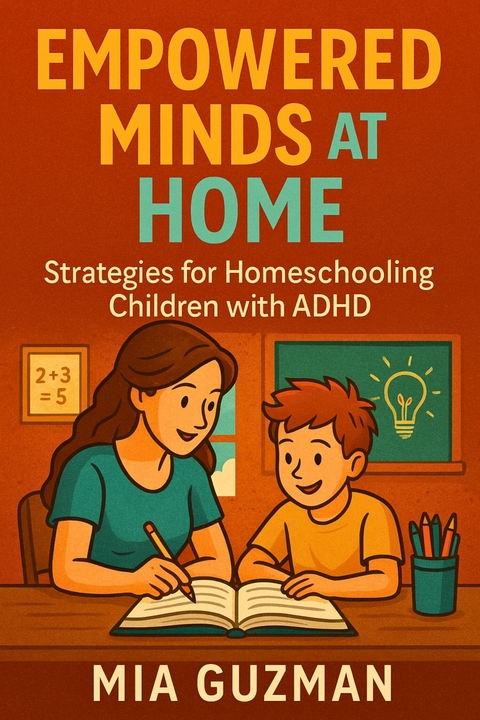
Empowered Minds at Home
Harnessing ADHD Strengths Through Homeschooling
Turn the unique brilliance of ADHD into your child's greatest academic advantage with strategies designed for real-world success.
✔️ Ignite engagement with hands-on labs, field trips, and maker projects
✔️ Use storytelling, role-play, and interactive history to make facts stick
✔️ Blend technology safely for digital art, coding, and virtual labs
✔️ Build strong emotional tools-mindful breaks, chill zones, and positive reinforcement
✔️ Track progress with SMART goals, vision boards, and weekly check-ins
Empower your child-order now and unlock their full potential!
What You'll Discover
Chapter 1: Homeschooling and ADHD - A Perfect Fit?
Chapter 2: Understanding ADHD from a Teaching Perspective
Chapter 3: Setting Goals and Objectives
Chapter 4: Core Academics - Reading, Writing, and Language Arts
Chapter 5: Mathematics Mastery
Chapter 6: Science, Technology, and Nature Studies
Chapter 7: Social Studies, History, and World Cultures
Chapter 8: Arts, Crafts, and Creative Exploration
Chapter 9: Physical Education and Movement Breaks
TAGS: ADHD, Homeschooling, Visual Learning, Kinesthetic Learning, Growth Mindset, Project-Based Learning, Executive Skills, Emotional Regulation, Community Co-op, Tech Integration
1
Chapter 1: Homeschooling and ADHD – A Perfect Fit?
The Rise of Homeschooling
Homeschooling, once a fringe concept often associated with families on far-flung homesteads or small religious enclaves, has blossomed in recent decades into a dynamic, thriving movement that appeals to a wide array of people, cultures, and philosophies. While it’s probably safe to say that lessons once took place in the barn with chickens pecking at your feet—yes, that image might be exaggerated, but you get the idea—the modern-day homeschool environment can look like just about anything: from a cozy kitchen table covered in worksheets and crayons, to a digitally connected “living room classroom” with laptops streaming math tutorials, to a backyard where kids collect leaves for a biology project.
Homeschooling is rapidly increasing due to:
- Dissatisfaction with traditional schooling, including large classes, standardized testing, and inflexible curricula.
- The appeal of tailored education, particularly for students with specific learning profiles or advanced abilities.
- Technological advancements providing vast resources and online support, simplifying homeschooling logistics and education.
When you factor in the extraordinary options now available—co-ops, hybrid models, distance learning academies—homeschooling suddenly doesn’t seem so “fringe” anymore. Instead, it can be as diverse and flexible as the families who embrace it.
In the context of ADHD, this rise of homeschooling is particularly timely. Many parents of children with ADHD find that the traditional classroom environment, rigid in its daily structure and designed for the “average” student, places their child at a disadvantage. Long stretches of sitting, limited movement, and uniform lesson plans can clash with a child who has heightened energy levels, difficulty sustaining focus on uninteresting tasks, or a mind that thrives on spontaneity and self-directed creativity. Enter homeschooling—an approach that can be molded, sculpted, and fine-tuned to fit the exact needs of the child.
Why Homeschooling Appeals to ADHD Families
Picture this scenario: your child has ADHD, so they crave movement, they need the freedom to fidget, and they benefit from frequent “brain breaks.” In a typical classroom, they might be told repeatedly to “sit still,” “stop tapping your pencil,” or “pay attention,” turning learning into a constant struggle. At home, you can calibrate the environment so that movement is integrated into the learning process. You can allow them to bounce on an exercise ball while they read, or walk laps around the living room as they recite vocabulary words out loud.
Homeschooling is essentially a blank canvas on which you can paint a customized learning plan. It’s as if you’re a tailor, sewing a suit that must fit your child’s unique dimensions—both physically and cognitively. Sure, it may take a few tries to get those sleeves just right (we’ve all been there with that “oops, too tight” moment), but once you do, it can result in a snug, comfortable, and confidence-boosting fit. This level of flexibility is the principal reason so many families with ADHD children find homeschooling not only viable, but transformative.
Homeschooling offers several advantages for children with ADHD:
- Personalized Learning: Curricula and teaching methods can be tailored to the child’s individual learning style (visual, auditory, or kinesthetic). Subjects where the child excels can be accelerated, while more time can be spent on areas needing reinforcement, eliminating the pressure of keeping pace with a class.
- Flexibility and Adaptability: The schedule is not fixed, allowing for learning during times of day when the child is most focused. Breaks for physical activity, yoga, or chores can be incorporated to help manage energy levels and improve concentration.
- Increased Creativity and Spontaneity: The learning environment can be more flexible, allowing for spontaneous learning opportunities and creative approaches.
Ultimately, homeschooling for ADHD can be a breath of fresh air for those who’ve battled the constraints of a traditional classroom. Many families report that their children’s self-esteem improves, their interest in learning deepens, and the tension between parent and child over “homework” dissipates when the child feels more understood and supported.
Myths and Realities
Despite the growing acceptance of homeschooling, a number of myths still linger. Let’s tackle a few favorites—hopefully with just enough humor to underscore their absurdity, while still addressing them thoroughly.
Myth #1: “Homeschooled Kids Are All Recluses with Zero Social Skills.” Reality? The homeschooling landscape today is bursting with co-ops, clubs, sports teams, theatrical productions, volunteer opportunities, community classes, and more. ADHD learners, in particular, benefit from the flexibility to practice social skills in smaller or more controlled group settings first, if that’s what they need. Socialization happens in myriad ways—often in ways that are actually more dynamic and age-diverse than a standard classroom environment.
Myth #2: “Homeschooling Can’t Possibly Match the Academic Rigor of Traditional Schools.” Reality? Many homeschooling families discover the opposite—that they can far exceed the limitations of a one-size-fits-all curriculum. You’re free to experiment with advanced topics, deep-dive into tangents that spark your child’s passion, or pause to reinforce fundamental skills without the tick-tock pressure of a rigid class period. For children with ADHD, that’s gold. They can master the basics thoroughly while also exploring advanced or niche interests that keep them motivated.
Myth #3: “Parents Who Homeschool Must Be Superhuman or Have Teaching Degrees.” Reality? While some homeschoolers are former teachers, plenty are not. The parent’s role in homeschooling is more like a project manager and facilitator. You don’t have to have all the answers or memorize the entire periodic table (seriously, who can do that?). You can outsource math tutoring, bring in specialists for music lessons, or join a local cooperative where you rotate teaching responsibilities with other families. It’s about resourcefulness and a willingness to learn alongside your child.
Myth #4: “An ADHD Child Will Fail Without the Structure of Traditional Classrooms.” Reality? Yes, children with ADHD often benefit from some level of structure. But “structure” can be created at home just as effectively—perhaps even more so, because you can adapt it to your child’s natural rhythms and incorporate tools like visuals, timers, or frequent breaks. The difference is that the structure at home can be flexible and personalized, rather than uniform and unchanging. If anything, homeschooling can provide the scaffolding needed for ADHD learners to shine.
Legal Considerations
Just as you wouldn’t hop into a car and speed off without a valid driver’s license (well, hopefully you wouldn’t), you can’t embark on your homeschooling journey without some awareness of the legal nuts and bolts. The specifics vary widely by region—some states or provinces require strict reporting and portfolio evaluations, while others have very minimal requirements. If your local laws say you need to notify the superintendent of your intent to homeschool, make sure to do so. If your area mandates standardized testing or certain curriculum components, you’ll need to be aware of those obligations.
Don’t let that deter you. In most places, finding reliable information is fairly straightforward. You can start by checking with your local department of education or a homeschooling advocacy organization. You might be pleasantly surprised to learn that even in regions with more stringent requirements, there’s often quite a bit of flexibility in how you fulfill them. And because you’re likely already documenting your child’s progress (e.g., daily journaling, lesson plans, project portfolios, or reading logs), meeting legal requirements might simply be a matter of organization.
For ADHD families, it can also be helpful to research what services your child is eligible for through the public school system, even if you homeschool. Some districts allow homeschoolers to access special education services, speech therapy, or counseling. Ultimately, the legal framework can be a puzzle to figure out, but it’s not as intimidating once you break it down into smaller, simpler pieces. Gathering the right paperwork and documentation is a manageable task—especially when the payoff is an educational approach that fits your child like a glove.
Exercises (Optional but Recommended)
Exercise: “Define Your Homeschooling Why” Close your eyes (unless you’re reading this, of course—then keep them open just enough to skim) and think about why homeschooling appeals to you. Write down a short manifesto or mission statement that captures your primary motivation. Is it the flexibility? The chance to tap into your child’s creativity? The relief from standardized tests? Identifying your “why” becomes your...
| Erscheint lt. Verlag | 18.12.2025 |
|---|---|
| Sprache | englisch |
| Themenwelt | Sozialwissenschaften ► Pädagogik |
| ISBN-10 | 0-00-112701-2 / 0001127012 |
| ISBN-13 | 978-0-00-112701-2 / 9780001127012 |
| Informationen gemäß Produktsicherheitsverordnung (GPSR) | |
| Haben Sie eine Frage zum Produkt? |
 EPUB (Adobe DRM)
Größe: 2,1 MB
Kopierschutz: Adobe-DRM
Adobe-DRM ist ein Kopierschutz, der das eBook vor Mißbrauch schützen soll. Dabei wird das eBook bereits beim Download auf Ihre persönliche Adobe-ID autorisiert. Lesen können Sie das eBook dann nur auf den Geräten, welche ebenfalls auf Ihre Adobe-ID registriert sind.
Details zum Adobe-DRM
Dateiformat: EPUB (Electronic Publication)
EPUB ist ein offener Standard für eBooks und eignet sich besonders zur Darstellung von Belletristik und Sachbüchern. Der Fließtext wird dynamisch an die Display- und Schriftgröße angepasst. Auch für mobile Lesegeräte ist EPUB daher gut geeignet.
Systemvoraussetzungen:
PC/Mac: Mit einem PC oder Mac können Sie dieses eBook lesen. Sie benötigen eine
eReader: Dieses eBook kann mit (fast) allen eBook-Readern gelesen werden. Mit dem amazon-Kindle ist es aber nicht kompatibel.
Smartphone/Tablet: Egal ob Apple oder Android, dieses eBook können Sie lesen. Sie benötigen eine
Geräteliste und zusätzliche Hinweise
Buying eBooks from abroad
For tax law reasons we can sell eBooks just within Germany and Switzerland. Regrettably we cannot fulfill eBook-orders from other countries.
aus dem Bereich


