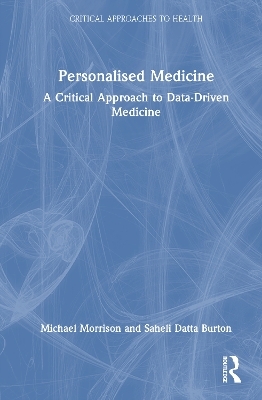
Personalised Medicine
Routledge (Verlag)
978-1-032-24631-4 (ISBN)
- Noch nicht erschienen (ca. Juni 2026)
- Versandkostenfrei
- Auch auf Rechnung
- Artikel merken
Bringing together perspectives from science and technology studies, medical sociology, law and bioethics, the book traces personalised medicine from its historical roots in disease classification and genomics to its data-driven present of digital infrastructures, algorithmic prediction, and precision therapeutics. Across seven chapters, it explores how measurement, classification, and datafication shape medical knowledge; how infrastructures and platforms distribute benefits and risks; how publics are imagined as patients, consumers, and citizens; and how privacy, access, and equity are negotiated in global health systems. The book concludes by outlining possible futures grounded in solidarity, patient-centered care, and democratic innovation—offering practical ways to shift personalised medicine from a privilege for the few to a shared public good.
Written for scholars and practitioners in science and technology studies, sociology of medicine, health policy, and bioethics, as well as for clinicians and policymakers, this book will engage readers seeking to understand—and reshape—the social futures of data-intensive healthcare. It will also be useful for policy makers debating the implementation of different personalised medicine projects in local or national healthcare systems.
Michael Morrison is a Senior Researcher at the Centre for Health, Law and Emerging Technologies, University of Oxford. His work examines the social, ethical, and regulatory dimensions of biomedical innovation, focusing on regenerative medicine, personalised healthcare, and the governance of emerging biotechnologies. Saheli Datta Burton is a Lecturer in Science Policy at the Department of Science and Technology Studies (UCL-STS), University College London. Her work interrogates the political-economic and governance dimensions of emerging technologies, with a focus on the geostrategic shaping of data-driven health and biomedicine. Elisa Lievevrouw (PhD, KU Leuven) is a postdoctoral researcher at the Media Culture & Policy Lab, KU Leuven. She studies the interplay between innovation and policymaking in digital health and life sciences. Elisabetta Biasin is an Associate Researcher at the KU Leuven Centre for IT & IP Law. She studies the ethical and legal aspects of healthcare technologies’, with a focus on medical device, AI, cybersecurity and data laws.
Series Editor Preface Foreword by Barbara Prainsack Chapter 1: Introduction: The Origins and Meaning of Personalised Medicine Chapter 2: The Perils and Promise of Data-Driven Medicine Chapter 3: Infrastructures and Infrastructur-ing Chapter 4: The Publics of Personalised Medicine Chapter 5: Personalisation in Treatment, Therapies, and Care Chapter 6: Health Data Governance in Personalised Medicine Chapter 7: The Possible Futures of Personalised Medicine References
| Erscheint lt. Verlag | 5.6.2026 |
|---|---|
| Reihe/Serie | Critical Approaches to Health |
| Verlagsort | London |
| Sprache | englisch |
| Maße | 156 x 234 mm |
| Gewicht | 453 g |
| Themenwelt | Geisteswissenschaften ► Psychologie ► Sozialpsychologie |
| Medizin / Pharmazie | |
| Naturwissenschaften ► Biologie ► Humanbiologie | |
| Sozialwissenschaften ► Ethnologie | |
| ISBN-10 | 1-032-24631-6 / 1032246316 |
| ISBN-13 | 978-1-032-24631-4 / 9781032246314 |
| Zustand | Neuware |
| Informationen gemäß Produktsicherheitsverordnung (GPSR) | |
| Haben Sie eine Frage zum Produkt? |
aus dem Bereich