


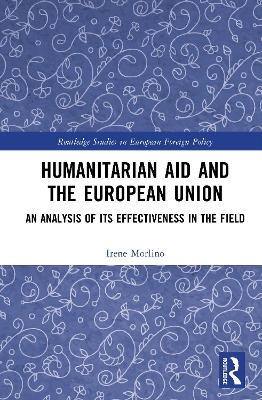
Humanitarian Aid and the European Union
An Analysis of its Effectiveness in the Field
Seiten
2026
Routledge (Verlag)
978-1-041-12764-2 (ISBN)
Routledge (Verlag)
978-1-041-12764-2 (ISBN)
- Noch nicht erschienen (ca. Juni 2026)
- Versandkostenfrei
- Auch auf Rechnung
- Artikel merken
This book critically examines the effectiveness of EU humanitarian aid delivery in the wake of multiple crises.
Focusing on four primary case studies – Myanmar, Lebanon, Mozambique, and Mali – which present distinct crisis types (complex, human-made, and natural), it reveals why the effectiveness of EU humanitarian aid programmes varies in relation to pre-established objectives. Drawing on extensive interviews and official documents from the UN, EU, and NGO officials, the book introduces an innovative, multidimensional theoretical framework conceptualising effectiveness beyond goal attainment, encompassing needs assessment, the seamlessness of the policy cycle, and the transition between humanitarian and development aid. The book argues that EU humanitarian aid effectiveness is primarily influenced by institutional, relational, and political factors rather than by the type of crisis or funding gap. In particular, the attitudes of national authorities toward donors and implementing agents are the most decisive factors, followed by the quality of coordination among donors and agents. The book ultimately suggests that adopting a holistic, ‘resilience-first’ approach that integrates humanitarian and long-term development goals, creating integrated funding instruments that enable comprehensive responses from the outset, and fostering collegiality, formal and informal relationships among staff can lead to greater overall effectiveness.
This book is of key interest to scholars, students and practitioners in EU foreign policy, humanitarian aid, development studies, and more broadly to International Relations, and policymakers.
Focusing on four primary case studies – Myanmar, Lebanon, Mozambique, and Mali – which present distinct crisis types (complex, human-made, and natural), it reveals why the effectiveness of EU humanitarian aid programmes varies in relation to pre-established objectives. Drawing on extensive interviews and official documents from the UN, EU, and NGO officials, the book introduces an innovative, multidimensional theoretical framework conceptualising effectiveness beyond goal attainment, encompassing needs assessment, the seamlessness of the policy cycle, and the transition between humanitarian and development aid. The book argues that EU humanitarian aid effectiveness is primarily influenced by institutional, relational, and political factors rather than by the type of crisis or funding gap. In particular, the attitudes of national authorities toward donors and implementing agents are the most decisive factors, followed by the quality of coordination among donors and agents. The book ultimately suggests that adopting a holistic, ‘resilience-first’ approach that integrates humanitarian and long-term development goals, creating integrated funding instruments that enable comprehensive responses from the outset, and fostering collegiality, formal and informal relationships among staff can lead to greater overall effectiveness.
This book is of key interest to scholars, students and practitioners in EU foreign policy, humanitarian aid, development studies, and more broadly to International Relations, and policymakers.
Irene Morlino is a Visiting Fellow in International Relations in the Department of International Relations at the London School of Economics (LSE), UK, and Visiting Professor in International Conflict Management at Escola Superior d'Administració i Direcció d'Empreses (ESADE), Spain.
1. Introduction 2. EU humanitarian aid: An overview 3. Defining effectiveness 4. Myanmar 5. Lebanon 6. Mozambique 7. Mali 8. Explaining why the effectiveness varied: A comparative analysis 9. How can EU humanitarian aid be made more effective?: Key findings and future directions
| Erscheint lt. Verlag | 17.6.2026 |
|---|---|
| Reihe/Serie | Routledge Studies in European Foreign Policy |
| Zusatzinfo | 20 Tables, black and white; 6 Line drawings, black and white; 6 Illustrations, black and white |
| Verlagsort | London |
| Sprache | englisch |
| Maße | 156 x 234 mm |
| Themenwelt | Sozialwissenschaften ► Politik / Verwaltung ► Europäische / Internationale Politik |
| Sozialwissenschaften ► Soziologie ► Spezielle Soziologien | |
| ISBN-10 | 1-041-12764-2 / 1041127642 |
| ISBN-13 | 978-1-041-12764-2 / 9781041127642 |
| Zustand | Neuware |
| Informationen gemäß Produktsicherheitsverordnung (GPSR) | |
| Haben Sie eine Frage zum Produkt? |
Mehr entdecken
aus dem Bereich


aus dem Bereich
Amerikas Strategie der Vorherrschaft und der Kampf um Eurasien
Buch | Softcover (2024)
NOMEN Verlag
CHF 27,95
kurze Geschichte einer langen Beziehung
Buch | Hardcover (2025)
Suhrkamp (Verlag)
CHF 36,40
erfolgreiche Interessenvertretung durch Prozesskompetenz im komplexen …
Buch | Hardcover (2023)
Wiley-VCH (Verlag)
CHF 58,75


