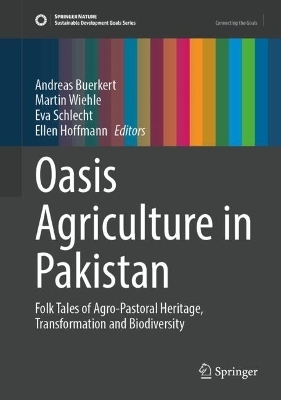
Oasis Agriculture in Pakistan
Springer International Publishing (Verlag)
978-3-032-17327-0 (ISBN)
- Noch nicht erschienen - erscheint am 28.06.2026
- Versandkostenfrei
- Auch auf Rechnung
- Artikel merken
This book emerged from decades of agro-ecological research in the Karakoram Mountains and the Cholistan Desert of Pakistan conducted in collaboration with local scientists, PhD scholars, and villagers in partly very remote oases that exhibit a historically unusually high diversity of agro-pastoral land use systems. Due to their resilience under isolated harsh environmental conditions, as outlined in Section 1 these oases exemplify many centuries-old sustainable systems of resource use that are currently undergoing rapid transformation. The volume depicts a mixed-methods approach that combines classical multi-location biodiversity research and molecular analyses with a collection of 169 Folk Tales. Taken together, the book draws attention to the sustainability lessons that are encoded in ancient social-ecological systems.
In an environment whose interacting environmental stresses of droughts, floods, harsh winters, hot summers, wanted and unwanted vistors, and fragile political conditions could hardly be controlled by small agropastoral communities, their members found ways to navigate constraints and uncertainties. Sustainable water use (SDG 6, Clean water) is key to the ancient, gravity irrigated terrace agriculture practiced in the mountain and lowland desert oases. Given millennia-old trading between East and West but also South and North across Asia and with Europe, the crops cultivated and the animal husbandry systems practised in these areas of Pakistan are extraordinarily diverse and adapted to varying resources (SDG 15, Life on land). This equally applies to fruit and cereal species but also to livestock, mainly yaks and goats, that thrive on the summer pastures surrounding the oases. Responsible consumption and production (SDG 12) are inherent to these systems and a prerequisite for their mere existence. Section 3 of the book takes scientific account of this rich biodiversity. In managing their oasis systems, local residents are highly dependent on each other. Collaboration is essential for survival and this has formed strong social commitments (SDG 11, Sustainable communities). Resource governance is encoded in cultural practices, and has been passed on in a large reservoir of Folk Tales. Section 2 of the book presents a unique collection of such tales reported by village elders. In original language videos readily available through QR codes and their careful English transcriptions, peasants narrate historical events, traditional practices of every-day life, mystical fairy-tales with symbolic meanings, and general lessons of moral as part of an ancient heritage of humanity. Given that the linkage between socio-cultural heritage and bio-physical diversity has been little explored in scientific research, this book provides a starting point for a deeper, interdisciplinary analysis of the ancient social-ecological systems of Pakistan's desert oases, which takes into account different knowledge systems. It documents a rapidly vanishing bio-cultural diversity preserved for many centuries and testifies of eye-level partnerships that allowed their documentation.
Prof. Dr. Andreas Bürkert is head of the Section of Organic Plant Production and Agroecosystems Research in the Tropics and Subtropics at the University of Kassel. His research focuses on carbon and plant nutrient cycling in agroecosystems to analyze management effects on system sustainability, the role of organic amendments and mineral fertilizers on plant nutrient availability and product quality, and on nutrient acquisition by plants in marginal and intensive environments. Over the past decades he has increasingly initiated, coordinated, and engaged in interdisciplinary and international research collaborations, analyzing interactions in complex social-ecological systems, drivers and effects of land use change at different scales, and urbanization-induced transformation processes both in metropolitan regions as well as in remote oasis systems.
Dr. Ellen Hoffmann is a member of the Section of Organic Plant Production and Agroecosystems Research in the Tropics and Subtropics at the University of Kassel. A biologist by training, she later engaged in the field of agricultural sciences, both as a researcher and a science manager. In her current position she coordinates collaborative research projects on rural-urban transformations and contributes to the interdisciplinary discussion on system approaches, land use changes, and social-ecological dynamics in the context of urbanization.
Prof. Dr. Eva Schlecht heads the joint Section Animal Husbandry in the Tropics and Subtropics at the University of Kassel and the University of Göttingen, Germany. Her research centers on livestock nutrition, livestock-mediated nutrient cycling, and livestock-based livelihoods across rural, peri-urban, and urban settings in sub-Saharan Africa, the Middle East, and Asia. For over thirty years, she has been engaged numerous interdisciplinary and international research projects exploring livestock environment interactions at farm, pasture, and landscape scales. Her work aims at optimizing these relationships to ensure adequate animal nutrition, resource efficiency, enhanced livelihoods, and reduced environmental externalities.
PD Dr. Martin Wiehle is a researcher and lecturer in the Section of Organic Plant Production and Agroecosystems Research in the Tropics and Subtropics at the University of Kassel, Germany. With a background in biology, particularly in landscape ecology and botany, his academic focus has shifted toward agroecology, plant population genetics, and sustainable land use systems. He is actively involved in supervising students at all levels, including Ph.D. candidates, and has conducted field research in semi-arid regions of Africa and Asia. Dr. Wiehle also serves as the Managing Director of the Centre for International Rural Development (Tropenzentrum), where he contributes to academic capacity development in good scientific practice at faculty and project level. He further coordinates international academic cooperation, manages global mobility programs, and supports research collaborations, particularly in the Middle East, West Africa, and Southern Africa.
1 The Ancient Social-Ecological Basis for Plant and Animal Diversity and Related Folk Tales in Desert Oases of Pakistan.- 2 The Narration and the System.- 3 Positioning Folk Tales from Oases of Pakistan in the Global Oral Heritage.- 4 The Karakoram Highlands.- 5 The Cholistan Desert.- 6 Morphological and Genetic Diversity of Sea Buckthorn (Hippophae rhamnoides L.) in the Karakoram Mountains of Northern Pakistan.- 7 Superfruit in the Niche Underutilized Sea Buckthorn in Gilgit-Baltistan, Pakistan.- 8 Morphology, Biochemistry, and Management of Russian Olive (Elaeagnus angustifolia L.) Accessions in Gilgit-Baltistan, Northern Pakistan.- 9 Pheno-Genetic Studies of Apple Varieties in Northern Pakistan: A Hidden Pool of Diversity.- 10 A Stony Track Towards Innovation in Remote Highland Regions: Agricultural Intensification in the Apricot Sector of Northern Pakistan.- 11 A Brief Introduction to Yak Husbandry in Gilgit-Baltistan, Pakistan.- 12 Phenotypic and Genetic Diversity of Domestic Yak (Bos grunniens) in High-Altitude Rangelands of Gilgit-Baltistan, Pakistan.- 13 Constraints and Prospects of Utilizing Mountain Pastures in Gilgit-Baltistan, Pakistan.- 14 Effects of Soil Characteristics and Date Palm Morphology Diversity on Nutritional Composition of Pakistani Dates.- 15 Socio-Economic Characterisation of Date Palm (Phoenix dactylifera L.) Growers and Date Value Chains in Pakistan.- 16 Prevalence of Gastrointestinal Helminths in Pastoral Sheep and Goat Flocks in the Cholistan Desert of Pakistan.- 17 Ethno-Botanical Remedies Used by Pastoralists for the Treatment of Livestock Diseases in Cholistan Desert, Pakistan.
| Erscheint lt. Verlag | 28.6.2026 |
|---|---|
| Reihe/Serie | Sustainable Development Goals Series |
| Zusatzinfo | Approx. 400 p. |
| Verlagsort | Cham |
| Sprache | englisch |
| Maße | 178 x 254 mm |
| Themenwelt | Naturwissenschaften ► Biologie ► Ökologie / Naturschutz |
| Naturwissenschaften ► Geowissenschaften | |
| Sozialwissenschaften ► Soziologie | |
| Schlagworte | Agricultural systems • Agroecology • Bio-cultural heritage • biodiversity • Karakoram • Narration • Pastoralism • social-ecological systems • Traditional Ecological Knowledge |
| ISBN-10 | 3-032-17327-2 / 3032173272 |
| ISBN-13 | 978-3-032-17327-0 / 9783032173270 |
| Zustand | Neuware |
| Informationen gemäß Produktsicherheitsverordnung (GPSR) | |
| Haben Sie eine Frage zum Produkt? |
aus dem Bereich