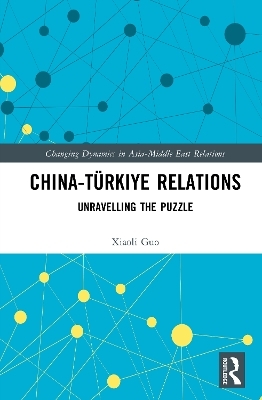
China-Türkiye Relations
Routledge (Verlag)
978-1-041-03675-3 (ISBN)
- Noch nicht erschienen (ca. April 2026)
- Versandkostenfrei
- Auch auf Rechnung
- Artikel merken
Using primary sources, including interviews with government officials and experts, alongside international relations theory, the author analyses the motives and actions of both nations to demonstrate how China and Turkey pursue their interests through overlapping yet misaligned connectivity initiatives that limit the depth of their partnership, and how structural constraints tied to issues such as the Uyghur question and NATO alignment form a constant backdrop. These constraints become salient when political or economic triggers intervene, so that what appears to be oscillation between convergence and divergence is better understood as compartmentalized engagement rather than a broader strategic realignment.
This volume will appeal to scholars and students in the fields of international relations, global security, and economic relations, as well as those specializing in China studies, alliance behaviours, middle power balancing, and Asian and Middle Eastern studies. It will also be a useful resource for researchers interested in the geopolitical dynamics of the region and the broader implications of these relations on global politics.
Xiaoli Guo is a Postdoctoral Researcher at the Institute of East Asian Studies (IN-EAST) at the University of Duisburg-Essen, Germany. She holds a PhD in International Relations and an MA in Asia-Pacific Studies from the Australian National University (ANU) and is also affiliated with ANU’s School of Politics and International Relations (SPIR). She has previously been a visiting scholar at the Shanghai Academy of Social Sciences (SASS). Her research focuses on China’s foreign policy and its evolving roles in global politics, with a particular emphasis on international economic cooperation.
PART ONE INTRODUCTION Chapter 1 Introduction Chapter 2 The Insufficiency of Structural Variables to Explain China-Turkey Relations PART TWO POLITICAL RELATIONS: THE UYGHUR ISSUE—DEEP-SEATED POLITICAL ANTIPATHIES Chapter 3 The Early Turkish Republic’s Strategic Interests and China’s Scepticism Chapter 4 Intersecting Strategic Interests: China’s Uyghur Issue Chapter 5 Converging Policy Paradigms and Kinship Politics PART THREE: ECONOMIC ENGAGEMENTS: EXPLORING A BILATERAL ECONOMIC HARMONY Chapter 6 The Evolution of China-Turkey Economic Relations Chapter 7 Reassessing Economic Interdependence Through FDIs and Financial Strategies PART FOUR MILLITARY RELATIONS: TESTING THE LIMITS OF STRATEGIC CONVERGENCE Chapter 8 Military Relations: a Well-Designed Strategic Cooperation? Chapter 9 From Bidding to Bargaining: The T-LORAMIDS Decision at the Negotiating Table PART FIVE Chapter 10: Conclusion—Rethinking China-Turkey Relations
| Erscheint lt. Verlag | 23.4.2026 |
|---|---|
| Reihe/Serie | Changing Dynamics in Asia-Middle East Relations |
| Zusatzinfo | 15 Tables, black and white; 15 Line drawings, black and white; 15 Illustrations, black and white |
| Verlagsort | London |
| Sprache | englisch |
| Maße | 156 x 234 mm |
| Themenwelt | Sozialwissenschaften ► Politik / Verwaltung ► Europäische / Internationale Politik |
| Sozialwissenschaften ► Soziologie ► Spezielle Soziologien | |
| ISBN-10 | 1-041-03675-2 / 1041036752 |
| ISBN-13 | 978-1-041-03675-3 / 9781041036753 |
| Zustand | Neuware |
| Informationen gemäß Produktsicherheitsverordnung (GPSR) | |
| Haben Sie eine Frage zum Produkt? |
aus dem Bereich