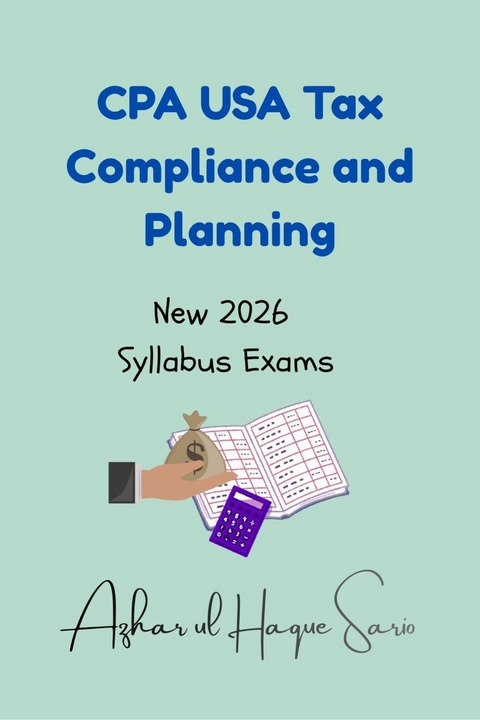
CPA USA Tax Compliance and Planning (eBook)
212 Seiten
Azhar Sario Hungary (Verlag)
978-3-384-77822-2 (ISBN)
Master the 2026 CPA Tax Compliance and Planning exam with a guide that turns complex statutes into clear, actionable strategies.
This book covers the new 2026 CPA syllabus. It explains the 'One Big Beautiful Bill Act' (OBBBA). You will learn about individual tax compliance. The text details equity compensation rules. We cover the Alternative Minimum Tax (AMT). You will understand 'phantom' income risks. The book explains the 'Kiddie Tax' limits. We discuss strategic timing for income. You will learn about HSAs and FSAs. The content covers C Corporation losses. We analyze S Corporation basis rules. You will master partnership tax laws. The book details property disposition rules. It explains international tax issues. This is a complete guide for the modern CPA.
This book provides a unique competitive edge. It focuses on strategic planning, not just compliance. Other books only list rules. This book uses human-centric case studies. You will learn from real-world scenarios. We explain the 2026 'tax cliff' clearly. You will understand the end of the Section 199A deduction. The book explains the drop in bonus depreciation. It teaches you to be a tax architect. You will learn to navigate complex statutes. The content is fresh and actionable. It helps you anticipate future tax liabilities. This approach prepares you for the actual exam. It also makes you a better advisor.
Inside You Will Discover:
Individual Tax Optimization: Navigate the 'Golden Handcuffs' of equity compensation. Learn the difference between Non-Qualified Stock Options (NQSOs) and Incentive Stock Options (ISOs). Master the 'shadow tax' known as the AMT. Understand how the OBBBA reshapes tax brackets and standard deductions.
Entity Compliance & Planning: Dive deep into the lifecycle of business entities. Understand the 'double taxation' traps of C Corporations. Learn the strict 'Control Club' rules for formation. Master the complex 'loss waterfall' for flow-through entities. We break down the At-Risk and Passive Activity loss limitations.
The 2026 Partnership Landscape: Explore the 'GPS of money' in international taxation. Learn sourcing rules for global operations. Master the complex basis adjustments of Subchapter K. Understand the '754 Election' lever. We explain how to handle liquidating distributions without triggering massive tax bills.
Property Transactions: Navigate the guardrails of asset disposition. Learn to spot 'Related Party' transaction traps. Understand the 'Wash Sale' rules for securities. Master the 'Netting Process' for capital gains. We explain the specific rules for installment sales and depreciation recapture.
Wealth Transfer & Trusts: Understand the new era of estate planning. Learn about the 'Simple' vs. 'Complex' trust structures. Master the Distributable Net Income (DNI) calculation. We explain how to use the annual gift exclusion effectively. You will learn strategies to freeze estate values before they grow.
This book transforms you from a historian recording the past into an architect designing the future. It provides the tools to navigate the 'tax cliff' of 2026 with confidence.
Copyright Disclaimer: Copyright © 2025 by Azhar ul Haque Sario. All rights reserved. This book is independently produced by the author. It is not affiliated with, endorsed by, or sponsored by the American Institute of Certified Public Accountants (AICPA) or any official CPA board. All references to 'CPA' or specific exam components are used under nominative fair use for educational and descriptive purposes only.
Area II – Entity Tax Compliance
C Corporation Taxation: Loss Utilization and Shareholder Transactions (2026 Guide)
The landscape of corporate taxation in the United States is a dynamic ecosystem where statutory rigor meets economic reality. As we navigate the 2026 tax year, the fundamental structure of the C Corporation remains unique: it is a distinct legal entity, separate from its owners, standing alone as a taxpayer. This separation creates both opportunities for tax planning and significant pitfalls known as "double taxation."
For the modern tax professional, understanding how a corporation manages its failures (losses) and how it interacts with its creators (shareholders) is not just about compliance—it is about strategic survival. The rules governing Net Operating Losses (NOLs) and property transactions are designed to strictly measure economic income, ensuring that tax benefits are neither artificially inflated nor trafficked between entities.
This guide explores the intricate mechanics of loss utilization and the complex tax friction that occurs when property moves between a corporation and its shareholders.
Part I: The Strategic Management of Losses
In the lifecycle of a business, profitability is the goal, but losses are often the reality. The Internal Revenue Code (IRC) allows corporations to smooth out their tax liabilities over time by utilizing these losses. However, because deductions reduce revenue for the Treasury, the government imposes strict "gatekeeping" rules to ensure these losses are legitimate and not abused.
1. Net Operating Losses (NOLs): The Engine of Tax Smoothing
A Net Operating Loss occurs when a corporation's allowable deductions exceed its gross income. In a year where a company loses money, it pays no tax. However, the value of that loss lies in its ability to offset future profits.
For tax years beginning in 2026, the rules established by the Tax Cuts and Jobs Act (TCJA) remain the governing standard. These rules fundamentally changed the liquidity of losses.
The 2026 NOL Framework
The calculation of a C Corporation's NOL is a specific statutory formula. It is not simply "accounting loss." Specific modifications must be made:
No NOL Deduction: You cannot create a current year NOL by deducting a past year's NOL.
No Capital Loss Carrybacks: Capital losses cannot be used to generate an operating loss.
The DRD Exception: Crucially, a corporation can take the full Dividends Received Deduction (DRD) even if it creates an NOL. This is a rare instance where the tax code allows a deduction to generate a negative income figure, acting as a powerful benefit for corporations holding stock in other companies.
Carryforward and Limitations
The treatment of NOLs in 2026 is characterized by longevity but limited intensity.
Indefinite Life: Unlike pre-2018 rules which had a 20-year expiration, NOLs generated in 2026 can be carried forward indefinitely. They never expire.
No Carryback: Generally, losses cannot be carried back to retrieve past taxes paid (with narrow exceptions for farming).
The 80% Taxable Income Cap: This is the most significant constraint. When a corporation carries an NOL forward to a profitable year (e.g., 2027), it cannot wipe out its tax bill entirely. It can only offset up to 80% of taxable income determined without regard to the NOL deduction.
Max NOL Deduction=0.80×Taxable Income (pre-NOL)
Analytical Example: Imagine "TechNova Corp" has a disastrous 2026, generating a ($500,000) NOL. In 2027, they recover and earn $200,000 in taxable income.
Without the 80% rule: They would use $200,000 of the loss, pay $0 tax, and carry forward $300,000.
With the 2026 rule: They can only deduct 80% of $200,000, which is $160,000. TechNova must pay tax on the remaining $40,000. The unused loss carryforward is $340,000. This ensures the government collects some revenue in every profitable year.
2. The Anti-Trafficking Wall: Section 382
Perhaps the most complex area of loss utilization is IRC Section 382. This section was born out of a need to stop "loss trafficking." Without Section 382, a profitable corporation could simply buy a defunct corporation that had massive accumulated losses, merge with it, and use those losses to wipe out its own profits.
Section 382 places a strict annual limit on how much pre-change loss can be used after a significant ownership change.
The Ownership Change Trigger
The limitation is dormant until an "ownership change" occurs. This is defined mathematically:
An ownership change occurs if the percentage of stock owned by 5% shareholders increases by more than 50 percentage points over the lowest percentage owned by those shareholders during a three-year testing period.
This is a cumulative test, not just a snapshot of a single transaction. A series of small stock sales over three years can trigger the limit.
Calculating the Limitation
Once triggered, the "Section 382 Limitation" acts as a ceiling on the NOL deduction. It is calculated using the value of the company before the new capital infusion.
Section 382 Annual Limit=FMV of Old Loss Corp×Long-Term Tax-Exempt Rate
FMV of Old Loss Corp: The equity value of the loss corporation immediately before the ownership change.
Long-Term Tax-Exempt Rate: A published federal rate (often quite low, hovering between 2% and 4% historically).
The Economic Consequence: If a company with $10 million in NOLs is sold for $1 million when the rate is 3%, the annual limit is only $30,000 (1M×3%). It would take over 300 years to use the losses. Effectively, the value of the NOLs is destroyed. This forces acquirers to value the target company based on its assets and business potential, not its tax attributes.
3. Capital Loss "Baskets"
C Corporations face a much harsher reality regarding capital losses compared to individuals. In the individual tax world, capital losses can offset $3,000 of ordinary wages. In the corporate world, strict "basketing" applies.
The Golden Rule: Corporate capital losses can only offset corporate capital gains. They can never offset ordinary operating income.
The Carryover Mechanics
If a C Corporation has a "Net Capital Loss" (excess of losses over gains) for the year, the deduction is denied for the current year. The corporation must then engage in a mandatory time-travel exercise:
Carryback 3 Years: The loss must first be carried back to the earliest of the previous three years to offset capital gains paid in those years, generating an immediate tax refund.
Carryforward 5 Years: If the loss remains, it moves forward for five years.
Expiration: If not used within the 5-year forward window, the loss evaporates permanently.
Crucial Nuance: When a capital loss is carried to another year, it loses its original character (short-term vs. long-term). It is treated as a Short-Term Capital Loss in the carryover year. This distinction matters because short-term losses are applied against gains in a specific order, potentially affecting the tax rate usage if tax rates were to vary (though C Corps generally face a flat rate).
Part II: Transactions Between Shareholder and Corporation
The relationship between a C Corporation and its shareholders is a continuous cycle of property exchanges. Shareholders put property in (contribution), and the corporation eventually sends property out (distribution). Because these are distinct legal entities, every movement of assets is a potential taxable event.
1. Corporate Formation and Contributions (Section 351)
When an entrepreneur starts a business, they often transfer assets (computers, buildings, patents) to the new corporation in exchange for stock. Under general tax principles, exchanging a truck for stock is a "sale"—you gave up a truck and got stock. However, taxing the formation of a business would discourage entrepreneurship.
IRC Section 351 provides a mandatory "safe harbor." It posits that if you merely change the form of your ownership (from direct ownership to owning stock), you haven't economically "cashed out," so you shouldn't be taxed yet.
The Three Requirements for Deferral
To qualify for tax-free treatment, three strict conditions must be met simultaneously:
Property: Cash or tangible/intangible assets must be transferred. (Services are not property. Stock received for services is immediate wage income).
Stock: The transferor must receive stock in exchange.
Control: Immediately after the exchange, the transferors (as a group) must own at least 80% of the voting power and 80% of all other shares.
The "Boot" Trap
If a shareholder receives anything other than stock—such as cash or a promissory note—this is called "Boot." Boot triggers gain recognition. The shareholder has partially "cashed...
| Erscheint lt. Verlag | 14.12.2025 |
|---|---|
| Reihe/Serie | CPA USA 2026 |
| Sprache | englisch |
| Themenwelt | Sachbuch/Ratgeber ► Beruf / Finanzen / Recht / Wirtschaft ► Bewerbung / Karriere |
| Sozialwissenschaften ► Pädagogik ► Bildungstheorie | |
| Schlagworte | Advanced Entity Taxation Strategies • Asset Disposition and Planning • CPA 2026 Tax Compliance and Planning • Federal Income Tax Study Guide • Individual Tax Optimization • OBBBA Tax Law Changes • Partnership and S Corp Compliance |
| ISBN-10 | 3-384-77822-7 / 3384778227 |
| ISBN-13 | 978-3-384-77822-2 / 9783384778222 |
| Informationen gemäß Produktsicherheitsverordnung (GPSR) | |
| Haben Sie eine Frage zum Produkt? |
 EPUB (Ohne DRM)
Digital Rights Management: ohne DRM
Dieses eBook enthält kein DRM oder Kopierschutz. Eine Weitergabe an Dritte ist jedoch rechtlich nicht zulässig, weil Sie beim Kauf nur die Rechte an der persönlichen Nutzung erwerben.
Dateiformat: EPUB (Electronic Publication)
EPUB ist ein offener Standard für eBooks und eignet sich besonders zur Darstellung von Belletristik und Sachbüchern. Der Fließtext wird dynamisch an die Display- und Schriftgröße angepasst. Auch für mobile Lesegeräte ist EPUB daher gut geeignet.
Systemvoraussetzungen:
PC/Mac: Mit einem PC oder Mac können Sie dieses eBook lesen. Sie benötigen dafür die kostenlose Software Adobe Digital Editions.
eReader: Dieses eBook kann mit (fast) allen eBook-Readern gelesen werden. Mit dem amazon-Kindle ist es aber nicht kompatibel.
Smartphone/Tablet: Egal ob Apple oder Android, dieses eBook können Sie lesen. Sie benötigen dafür eine kostenlose App.
Geräteliste und zusätzliche Hinweise
Buying eBooks from abroad
For tax law reasons we can sell eBooks just within Germany and Switzerland. Regrettably we cannot fulfill eBook-orders from other countries.
aus dem Bereich