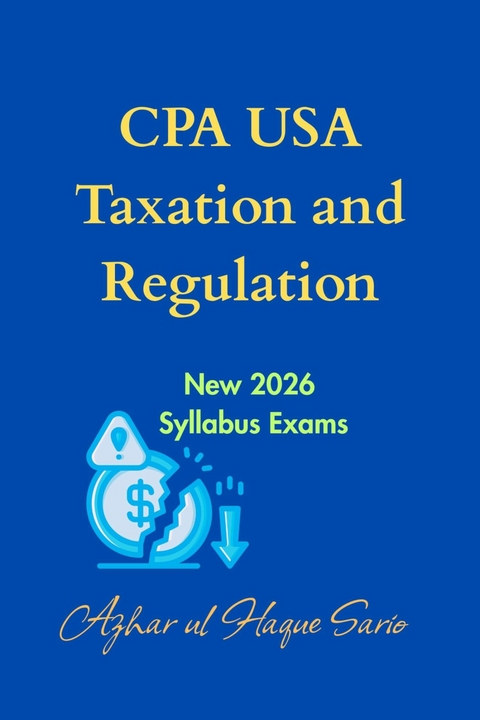
CPA USA Taxation and Regulation (eBook)
216 Seiten
Azhar Sario Hungary (Verlag)
978-3-384-77750-8 (ISBN)
Get ready to master the 2026 CPA Regulation exam with a guide that transforms complex tax codes into a clear, strategic narrative.
This book is a comprehensive roadmap for the 2026 CPA Regulation (REG) syllabus. It covers the new tax landscape following the Tax Cuts and Jobs Act sunset. You will learn about the 'One Big Beautiful Bill' Act. The text explains the new 2026 tax brackets. It details the updated Standard Deduction amounts. You will find deep dives into Circular 230. The book explores the ethical duties of tax professionals. It clarifies the disciplinary power of State Boards. You will study the 'Three Es' of licensure. The content breaks down federal tax procedures. It explains the audit machinery and the 'DIF' score. You will learn about the hierarchy of legal authority. The book covers business law concepts like agency and contracts. It details the Uniform Commercial Code. You will understand debtor-creditor relationships. The text explains bankruptcy proceedings and priorities. It covers the 'fresh start' doctrine. You will master secured transactions and perfection. The book analyzes the Affordable Care Act's employer mandates. It explains worker classification risks. You will study the Foreign Corrupt Practices Act. The text covers federal taxation of property transactions. It details the 'serviceable condition' standard for basis. You will learn about the 'dual basis' trap. The book explains the 2026 depreciation rules. It covers the phase-out of bonus depreciation. You will study Section 179 expensing limits. The text explains the taxation of individuals. It details gross income inclusions and exclusions. You will learn about the 'constructive receipt' doctrine. The book covers the new SALT cap rules. It explains the 'kiddie tax' and 'wash sale' rules. You will master C Corporation taxation. The text details the 'double taxation' dilemma. It explains the Book-to-Tax reconciliation on Schedule M-3. You will learn about the 'Net Operating Loss' rules. The book covers state nexus and apportionment. It explains the 'single sales factor' trend. You will master S Corporation eligibility. The text details the 'one class of stock' rule. It explains the 'AAA' account waterfall. You will learn about shareholder stock and debt basis. The book covers partnership taxation intricacies. It details the difference between inside and outside basis. You will understand how to handle guaranteed payments. The text explains the intricacies of tax-exempt organizations. It covers the requirements for 501(c)(3) status. You will find real-world case studies like 'Quantum Nexus Solutions.' The book uses narrative examples to illustrate complex points. It is designed to help you think like an auditor. This is your essential companion for the 2026 CPA exam.
This book provides value by shifting the focus from rote memorization to strategic application, a critical competitive advantage in the 2026 regulatory environment. While other texts merely list statutes, this guide uses an immersive narrative approach, employing the 'Quantum Nexus Solutions' case study to demonstrate how tax laws interact in real-time business scenarios. It uniquely addresses the psychological and procedural aspects of taxation, such as the 'auditor's mindset' and the specific 'diagnostic' checks required in modern tax software, bridging the gap between academic theory and the high-stakes reality of professional practice.
Copyright Disclaimer: This book is an independent publication by Azhar ul Haque Sario. It is not affiliated with, endorsed by, or sponsored by the American Institute of Certified Public Accountants (AICPA) or any specific State Board of Accountancy. All references to 'CPA' and related certification marks are used under the doctrine of nominative fair use for educational and descriptive purposes only.
Area III – Federal Taxation of Property Transactions
CPA Coursework Module: Federal Taxation of Property Transactions (2026)
Module Overview: The Lifecycle of a Tax Asset
Welcome to the 2026 curriculum on Property Transactions. If you are preparing for the Regulation (REG) section of the CPA exam, you must understand that tax accounting differs fundamentally from financial accounting. In financial accounting, we care about fair presentation. In tax accounting, we care about legislative grace and revenue collection.
This module focuses on two critical phases in an asset's life: birth (establishing basis) and aging (cost recovery). The year 2026 is a pivotal year in tax law. The massive expensing provisions of the Tax Cuts and Jobs Act (TCJA) are sunsetting. Bonus depreciation has dwindled to 20%, forcing tax professionals to rely heavily on Section 179 and strategic planning.
This guide will walk you through these complex rules using simple English, narrative examples involving our case study company, Quantum Nexus Solutions, and deep theoretical dives.
Part A: Basis of Assets
The concept of "basis" is the DNA of an asset. It tells us where the asset came from, how much tax-paid capital is locked inside it, and what the tax consequences will be when it leaves. Basis is not static; it is a living number that fluctuates with improvements, depreciation, and casualities.
1. Tax Basis of Assets Purchased for Use in a Trade or Business
When a business buys an asset, the tax law asks a simple question: "What did you really pay?"
For a layperson, the cost is the price tag. For a CPA, the cost is the "all-inclusive" price of getting the machinery ready to work. We call this the capitalization of costs. The Internal Revenue Code (IRC) dictates that we cannot deduct expenses that create a long-term benefit immediately. Instead, we bundle these costs into the asset's basis and recover them slowly.
The "Serviceable Condition" Standard
The golden rule for capitalization is the "Serviceable Condition" standard. Any cost incurred before the asset is ready and available for its specific use must be capitalized.
Components of Cost Basis:
Invoice Price: The starting point. This includes cash paid and debt assumed. If you take out a loan to buy a building, the loan amount is part of your basis. You get credit for spending the bank's money.
Sales Taxes: If you pay sales tax, it sticks to the asset. You generally capitalize it.
Freight-in: The cost to get the item to your door.
Installation: The cost to bolt it to the floor.
Testing and Calibration: The cost to ensure it works.
Note on Demolition: If you buy land with an old building on it, and you immediately demolish the building to build a new one, the cost of demolition is not a current expense. It is added to the basis of the land.
Detailed Example: Quantum Nexus Solutions
Let’s look at our fictional entity, Quantum Nexus Solutions (QNS). In March 2026, QNS decides to upgrade its server farm. They purchase a "Hyper-Cool" server rack.
List Price: $45,000.
Trade-in: QNS trades in an old rack worth $5,000.
Cash Paid: $40,000.
Delivery Fees: $1,200.
Electrical Wiring (Contractor): $2,500.
Calibration Testing: $800.
The CPA Analysis: The basis is not just the cash paid. It represents the total economic value sacrificed to acquire the asset.
Basis=$40,000 (Cash)+$5,000 (FMV of Trade-in)+$1,200+$2,500+$800
Total Basis=$49,500
If the calibration test failed and QNS had to pay a technician another $300 to fix a loose wire before the server went live, that $300 is also capitalized. The asset is not "placed in service" until it is ready.
2. Tax Basis of an Asset Converted from Personal to Business Use
Entrepreneurs often start businesses using their own personal gear. They might use a personal laptop for coding or a family SUV for deliveries. The IRS is very strict here. They do not want you to take a personal loss (which is non-deductible) and turn it into a business deduction.
To prevent this, we use the "Lower of Cost or Market" rule at the moment of conversion.
The Dual Basis Trap
When you convert an asset that has declined in value, you enter a "Dual Basis" zone. You have one basis for calculating depreciation (and future losses) and a different basis for calculating future gains.
The Rules:
For Depreciation: Use the lower of the Adjusted Basis (original cost) or the Fair Market Value (FMV) at the date of conversion.
For Loss on Sale: Use the basis calculated in step 1.
For Gain on Sale: Use the original Adjusted Basis.
Narrative Example: The Depreciation "Haircut"
Imagine the CFO of Quantum Nexus Solutions, Sarah, decides to convert her personal luxury sedan to a company fleet vehicle on January 1, 2026.
Original Purchase (2023): $60,000.
FMV at Conversion (2026): $40,000.
The car has lost $20,000 of value while Sarah used it personally. The IRS says, "That $20,000 loss is personal. You cannot deduct it."
Sarah's Basis for Depreciation: She must depreciate the car starting at $40,000 (the lower FMV). She effectively loses the tax benefit of that initial $20,000 drop.
Scenario A: The Further Crash Two years later, she sells the car for $30,000.
Basis for Loss: $40,000 (minus depreciation taken, let's say $10,000). Adjusted Basis = $30,000.
Sale Price: $30,000.
Gain/Loss: $0.
Scenario B: The Miracle Recovery The car becomes a collector's item and sells for $70,000.
Basis for Gain: Original $60,000 (minus depreciation).
The gap between the $40,000 FMV and the $60,000 cost is never taxed, but it also isn't deducted.
3. Tax Basis of Property Received as a Gift or Inheritance
How you receive property determines your tax future. The rules for gifts and death are opposites. Gifts generally carry over the old basis (to preserve the tax liability), while death generally wipes the slate clean (to help the heirs).
Property Received as a Gift: The "Rollover" Rule
When a living person gives you an asset, they are usually giving you their potential capital gains tax bill, too.
General Rule (Gain Basis): The donee (recipient) takes the donor's adjusted basis. If the donor bought Apple stock for $10 and gave it to you when it was worth $100, your basis is $10. If you sell it for $100, you pay tax on the $90 gain.
Exception (Loss Basis): If the asset has declined in value, the IRS steps in. They won't let a donor shift a tax loss to someone in a higher tax bracket.
If FMV < Donor's Basis at the time of the gift, you have a dual basis.
Loss Basis: FMV at the date of gift.
Gain Basis: Donor's adjusted basis.
The "Dead Zone": If you sell the asset for a price between the FMV and the Donor's Basis, you recognize no gain and no loss.
Property Received as an Inheritance: The "Step-Up"
This is the holy grail of tax planning. When a taxpayer dies, the assets in their estate are revalued to Fair Market Value (FMV) at the date of death.
Step-Up: If the asset appreciated, the basis jumps up to FMV. The old capital gains vanish.
Step-Down: If the asset depreciated, the basis drops to FMV. The potential loss dies with the decedent.
The Alternate Valuation Date (AVD) Executors can choose to value the estate 6 months after death. This is only allowed if:
The total value of the gross estate decreases.
The estate tax liability decreases.
This prevents executors from choosing a later date just to get a higher basis for income tax purposes.
Long-Term Holding Period Regardless of how long the decedent owned the property (even if they bought it the day before they died), inherited property is always treated as Long-Term Capital Property.
4. Tax Basis of Stock Acquired Through a Wash Sale
The Wash Sale rule is an anti-abuse provision found in Section 1091. It prevents investors from selling a stock at a loss just to lower their taxes, only to turn around and buy the same stock back immediately.
The 61-Day Window: A wash sale occurs if you buy "substantially identical" stock within 30 days before or 30 days after the sale.
The Consequence: The loss is not lost forever; it is merely deferred.
The realized loss is disallowed on...
| Erscheint lt. Verlag | 13.12.2025 |
|---|---|
| Reihe/Serie | CPA USA 2026 |
| Sprache | englisch |
| Themenwelt | Sachbuch/Ratgeber ► Beruf / Finanzen / Recht / Wirtschaft ► Bewerbung / Karriere |
| Sozialwissenschaften ► Pädagogik ► Bildungstheorie | |
| Schlagworte | 2026 CPA Regulation Exam Review • Business Law and Contracts • C Corporation and S Corporation Tax • Federal Tax Procedures and Ethics • Individual Income Taxation • Partnership Taxation and Basis • Property Transactions and Depreciation |
| ISBN-10 | 3-384-77750-6 / 3384777506 |
| ISBN-13 | 978-3-384-77750-8 / 9783384777508 |
| Informationen gemäß Produktsicherheitsverordnung (GPSR) | |
| Haben Sie eine Frage zum Produkt? |
 EPUB (Ohne DRM)
Digital Rights Management: ohne DRM
Dieses eBook enthält kein DRM oder Kopierschutz. Eine Weitergabe an Dritte ist jedoch rechtlich nicht zulässig, weil Sie beim Kauf nur die Rechte an der persönlichen Nutzung erwerben.
Dateiformat: EPUB (Electronic Publication)
EPUB ist ein offener Standard für eBooks und eignet sich besonders zur Darstellung von Belletristik und Sachbüchern. Der Fließtext wird dynamisch an die Display- und Schriftgröße angepasst. Auch für mobile Lesegeräte ist EPUB daher gut geeignet.
Systemvoraussetzungen:
PC/Mac: Mit einem PC oder Mac können Sie dieses eBook lesen. Sie benötigen dafür die kostenlose Software Adobe Digital Editions.
eReader: Dieses eBook kann mit (fast) allen eBook-Readern gelesen werden. Mit dem amazon-Kindle ist es aber nicht kompatibel.
Smartphone/Tablet: Egal ob Apple oder Android, dieses eBook können Sie lesen. Sie benötigen dafür eine kostenlose App.
Geräteliste und zusätzliche Hinweise
Buying eBooks from abroad
For tax law reasons we can sell eBooks just within Germany and Switzerland. Regrettably we cannot fulfill eBook-orders from other countries.
aus dem Bereich