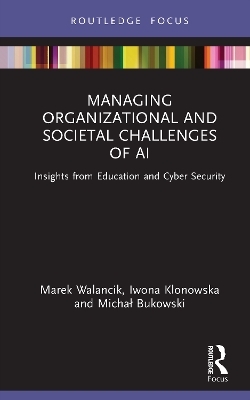
Managing Organizational and Societal Challenges of AI
Routledge (Verlag)
9781041081234 (ISBN)
- Noch nicht erschienen (ca. Juni 2026)
- Versandkostenfrei
- Auch auf Rechnung
- Artikel merken
Confronting how AI the Internet of Things (IoT), and big data analytics are changing how we live, this book examines how these technologies can affect society at large and education and internal and external security in particular. Managing Organizational and Societal Challenges of AI: Insights from Education and Cyber Security addresses such questions as:
What threats does AI pose to today's world, its internal security and broadly understood external security?
Will AI-based education take away people's will to think and create?
Why does AI inspire awe in some of us and fear in others?
The book answers these questions by analysing how AI, IoT, and data analytics are applied in security and education. This analysis begins with a literature survey of how these technologies bring both opportunities and threats that require responsible governance and global cooperation. The book underscores the necessity of resilience, adaptive strategies, and innovative technologies to ensure preparedness for both traditional and non-traditional threats. It also emphasises that sustainable global security requires coordinated efforts, effective governance, and multilateral cooperation.
The book continues its analysis by examining the practical applications of artificial intelligence in management, education, and security. Featuring case studies, it highlights how AI supports hazard monitoring, emergency response, and sustainable mobility, as well as personalising education, enhancing training, and automating administrative tasks. Discussing the opportunities and challenges of AI in education, including the risks of over-reliance, reduced critical thinking, and ethical concerns related to data privacy, the book concludes that AI offers significant benefits for improving efficiency, security, and adaptability, but also requires responsible regulation, investment, and awareness of its limitations to ensure ethical and sustainable implementation.
.
Prof. Marek Walancik, PhD is an educator, author and researcher in the field of education, security and interculturalism. He heads the Department of Pedagogy and Director of the Centre for Research and Education of Uniformed Services at the WSB Academy in Dąbrowa Górnicza. Since 2018, he has been the chair of the Scientific Council for the Scientific Discipline of Pedagogy, and since 2024, he has been the chair of the Education for Safety Section of the Committee on Pedagogical Sciences of the Polish Academy of Sciences. He is the author of numerous monographs and scientific publications (over 150), including key works on education, safety education, threats, social and intercultural issues. In 2017, he was awarded the Knight's Cross of the Order of Polonia Restituta for his scientific and social achievements. He actively promotes education and activities for safety in the media and social environment. He is a member of many scientific bodies and teams. Prof. Iwona Klonowska, PhD, is a retired police brigadier general and from 202 to 2024 was the rector of the Police Academy of Szczytno, Poland. A long-time police officer and academic teacher, she specialises in psychology, pedagogy, internal security and psychotraumatology. Her scientific interests also include criminology and investigative psychology. For many years, she held managerial positions in police organisational units, as well as in police education institutions, where she actively participated in shaping the education system for uniformed services. She was the creator and co-creator of many police training programmes. During her term as rector, studies in the field of cybercrime for police personnel were established, and cooperation was established with key institutions supporting the training of police officers, such as the UKNF. She focuses on the educational role and effects of artificial intelligence on humans on their mental state, development opportunities, and social threats. Colonel Michał Bukowski, PhD, is the engineer director of the Criminal Service Institute of the Faculty of Security and Legal Sciences at the Police Academy of Szczytno. He is a police officer with many years of experience in preventive and criminal services, as well as in the field of operational analysis. He holds an undergraduate degree in engineering and a master's degree in the field of electronics, telecommunications, and communications, as well as a doctoral degree in technical informatics. He specialises in internal security, combating criminal offences, cybercrime and the use of modern technologies, especially artificial intelligence in operational and investigative work. He has authored and co-authored scientific publications in the field of forensics, criminology of internal security, state security, cybercrime and cybersecurity. As Director of the Institute of Criminal Service at the Academy of Public Administration in Warsaw, he coordinates the scientific and teaching activities, supervises research work, and implements projects related to the development of methods and tools, mainly for the criminal service.
1. Future Technologies and Security 2. Social and Cultural Aspects of AI 3. Practical Applications of AI in Management and Education 4. Summary and Conclusions
| Erscheint lt. Verlag | 1.6.2026 |
|---|---|
| Zusatzinfo | 2 Tables, black and white |
| Verlagsort | London |
| Sprache | englisch |
| Maße | 138 x 216 mm |
| Themenwelt | Informatik ► Netzwerke ► Sicherheit / Firewall |
| Informatik ► Theorie / Studium ► Künstliche Intelligenz / Robotik | |
| Sozialwissenschaften ► Pädagogik ► Schulpädagogik / Grundschule | |
| ISBN-13 | 9781041081234 / 9781041081234 |
| Zustand | Neuware |
| Informationen gemäß Produktsicherheitsverordnung (GPSR) | |
| Haben Sie eine Frage zum Produkt? |
aus dem Bereich