


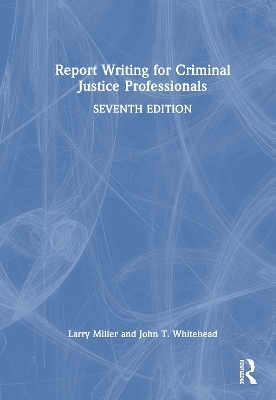
Report Writing for Criminal Justice Professionals
Routledge (Verlag)
978-1-041-01461-4 (ISBN)
- Noch nicht erschienen (ca. Mai 2026)
- Versandkostenfrei
- Auch auf Rechnung
- Artikel merken
This book is suitable for undergraduates across the Criminal Justice curriculum as well as for police academies and other criminal justice training venues.
Larry S. Miller is Distinguished Professor and former Chair in the Department of Criminal Justice and Criminology at East Tennessee State University. He received his Bachelor of Science from ETSU, Master of Science from Eastern Kentucky University, and Ph.D. in Health and Safety with collaterals in Forensic Anthropology and Criminology from The University of Tennessee. Miller, who has worked as a police officer, criminal investigator, and crime laboratory director, teaches in the area of law enforcement. He is also co-author of Effective Police Supervision, Criminal Investigation: A Method for Reconstructing the Past, Crime Scene Investigation, Police Photography, Huber and Headrick's Handwriting Identification: Facts and Fundamentals, and more. John T. Whitehead is Professor Emeritus and former Chair in the Department of Criminal Justice and Criminology at East Tennessee State University. He completed his M.A. at the University of Notre Dame and earned his Ph.D. in Criminal Justice from the University at Albany. He has published articles about corrections, probation, and the death penalty. He is also co-author of Juvenile Justice: An Introduction, Ethics in Criminal Justice: The Search for the Truth, Corrections: Exploring Crime, Punishment, and Justice in America, Sexual Abuse Within the Church: Assessment, Intervention, and Prevention, and more.
Section 1: The Nature of Report Writing Introduction 1. The Why and How of Report Writing Why Do You Write Reports? Law Enforcement Reports Security Reports Corrections Reports Probation and Parole Officer Reports Forensic and Scientific Reports How Do You Write Reports? Writing the Log Do Not Copy Randomly Chosen Models How Do You Get Started? What Kind of Notebook Should You Use? How Much Should You Record in a Notebook? Investigate, Do Not Just Record Do Not Use Legalese or Old-Fashioned Terminology Should You Use Abbreviations? Add Sketches, Photographs, and Diagrams Evidence for Law Enforcement Types of Evidence Evidence Collected for Security Evidence Collected for Probation and Parole Need for Documentation What Should Be Documented? The ABCs of Report Writing Summary 2. Starting to Write Planning Your Writing Completing the Face Page Review Your Notes Make a Shopping List Place Information in Groups Label the Groups Place Groups in Order Writing the Report Subheadings Proofreading and Revisions Sample Writing Exercise Using the Shopping List Method Creating a Shopping List from Notes Grouping the Shopping List Labeling the Shopping List Placing the Labeled Shopping List in Order Final Report Basic Recommendations for Writing Reports Spelling, Jargon, and Abbreviation Verb Tense Active versus Passive Voice Pronoun Agreement Third Person versus First Person Gender-Neutral Language Superfluous Words or Legalese Accurate and Factual Reporting Conciseness Promptness Summary 3. The Face Page UCR Crime Definitions Part I Offenses Part II Offenses Methods of Gathering Information Correct Abbreviation and Capitalization Dealing with Names Writing a Good Synopsis Keeping Up with Trends Summary 4. The Narrative—The Continuation Page and Follow-Up Report Continuation Page, Follow-Up Report, and Supplementary Report or Material What Is Your Purpose? Who Are Your Readers? Chronological Organization Using Military Time Headings and Subheadings as a Way of Organizing Creating Visual Impact and Ease of Reading Avoiding Repetition and Meaningless Material Getting Rid of Stereotyped Fillers Summary 5. Habits That Make for Speedy Writing Writing About People You and Your Fellow Employees Describing Other People Writing About Property Writing About Places Specific Parts of a Location Describing MOs and Trademarks Definitions of MO and Trademark Avoid Being Called on Your Time Off Summary 6. Other Types of Writing Learning from the Short Memo Writing a Letter Emails and Other Electronic Media Recording Minutes of a Meeting The Presentence Investigation Report Research and Other Reports Summary 7. Reading and Correcting Reports Common Problem Areas Use of Word Processors Improving the Agency by Helping the Individual Summary Section 2: The Mechanics of Report Writing 8. Simplified Study of Grammar Identifying Parts of Speech Using One Word in Several Ways Using Verbs in the Past Tense The Sentence Direct Objects versus Indirect Objects: Learning the Patterns Identifying Active and Passive Verbs Identifying Independent and Dependent Clauses Recognizing Prepositional, Participial, and Infinitive Phrases Using Phrases as Adverbs, Adjectives, and Nouns Prepositional Phrases Participial Phrases Infinitive Phrases Using Prepositions in Your Report Prepositions Commonly Used with Certain Verbs Prepositions Commonly Used After Certain Expressions Summary 9. Avoiding Errors in Sentence Structure The Run-On Sentence—Source of Many Errors Block Method of Visualizing Sentence Structure Punctuation Problems Subject–Verb Agreement Noun–Pronoun Agreement Dangling Participles Sentence Fragments Summary 10. Making Punctuation Work The Comma The Semicolon The Colon The Apostrophe The Ellipsis Parentheses Quotation Marks The Dash Underlines Summary 11. Breaking the Spelling Jinx Take Special Care with Names Learn Words Commonly Used in Report Writing Commonly Misspelled Words Study Common Problem Areas Clearing Up the -ing Confusion Learning Words with Tricky Letter Combinations Forming Plurals Dealing with Other Complexities of the English Language Strengthen Your Overall Writing Ability Developing Proofreading Techniques Summary 12. Using or Abusing Words Biases Slang and Dialects Do Not Use Legalese Avoid Using Words or Phrases That Draw Conclusions Improve Your Vocabulary Synonyms, Antonyms, and Homonyms Jargon Avoiding Sexism Avoiding Racism Considering Ageism Semantics Nonverbal Communication Developing Your Vocabulary Summary 13. Abbreviating and Capitalizing Abbreviating to Save Time and Space Numbers and Codes Used for Abbreviation Clarify Abbreviations Abbreviations of Latin Terms Changing Rules Be Consistent Postal Abbreviations for States and Territories Capitalization Do Not Overcapitalize General Rules for Capitalization Capitalizing and Indenting for Brevity and Impact Summary Section 3: The Modernization of Report Writing 14. Innovations in Criminal Justice Report Writing Identifying Criminals Identifying Trends Improving Ways of Sharing Information Innovations Looking Toward the Future Summary and Conclusion Summary of Innovations
| Erscheint lt. Verlag | 27.5.2026 |
|---|---|
| Zusatzinfo | 65 Line drawings, black and white; 10 Halftones, black and white; 75 Illustrations, black and white |
| Verlagsort | London |
| Sprache | englisch |
| Maße | 178 x 254 mm |
| Gewicht | 453 g |
| Themenwelt | Schulbuch / Wörterbuch ► Wörterbuch / Fremdsprachen |
| Recht / Steuern ► EU / Internationales Recht | |
| Recht / Steuern ► Strafrecht ► Strafverfahrensrecht | |
| Sozialwissenschaften ► Kommunikation / Medien ► Kommunikationswissenschaft | |
| ISBN-10 | 1-041-01461-9 / 1041014619 |
| ISBN-13 | 978-1-041-01461-4 / 9781041014614 |
| Zustand | Neuware |
| Informationen gemäß Produktsicherheitsverordnung (GPSR) | |
| Haben Sie eine Frage zum Produkt? |
aus dem Bereich


