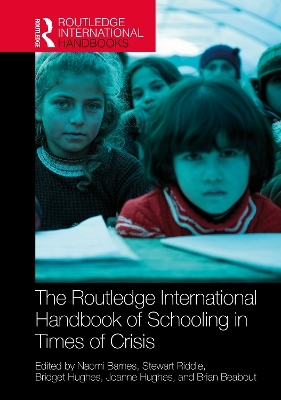
The Routledge International Handbook of Schooling in Times of Crisis
Routledge (Verlag)
9781032894782 (ISBN)
- Noch nicht erschienen (ca. Juni 2026)
- Versandkostenfrei
- Auch auf Rechnung
- Artikel merken
This Handbook brings together diverse international perspectives on the ways in which contemporary schooling and school communities can respond to crises, including natural disasters, pandemics, economic and social upheaval, war, crime and conflict. It is imperative for education policymakers, leaders, teachers, students and community members to understand the important role that schools can play in building community resilience during times of crisis.
The book provides a rich array of empirical and conceptual tools developed by researchers working in international contexts with schools and communities across six continents to build resilience, mitigation and adaptation strategies for multiple different crises. There are three main thematic sections. The first section provides nuanced definitions and conceptual tools for schooling and crisis. The second section details multiple accounts of schooling and crisis across different contexts and challenges. The final section presents a detailed set of practical strategies for education policymakers, school leaders, teachers, students and communities to consider adapting to their own contexts.
Easy to navigate and engaging for the reader, this Handbook will be of interest to educational researchers, including higher degree research students, working with communities in diverse contexts across the globe.
Naomi Barnes is a researcher interested in how political actors perform and respond to crises. With a specific focus on moral panics, she has focused on education politics in Australia, the US and the UK. Naomi is regularly asked to comment on how Australian teachers should respond to perceived threats to Australian nationalism, identity and democracy. Stewart Riddle is a Professor in the School of Education at the University of Southern Queensland, Australia. His research examines the democratisation of schooling systems, increasing access and equity in education and how schooling can respond to critical social issues in complex contemporary times. Bridget Hughes is an Australian Indigenous woman and educator who has worked across various educational settings for over 20 years. Her research explores the concepts of collective and social impact in relation to programs and services affecting Aboriginal and Torres Strait Islander peoples. She now applies these concepts to examine how they are operationalised in both education and health contexts. Joanne Hughes is Head of the Department of Education and Director of the Centre for Shared Education at the School of Social Sciences, Education and Social Work, Queen’s University, Belfast, Northern Ireland. She holds a UNESCO Chair in Shared Education for Peace Building and Social Justice in Education, and her main research interest is in the role of education in divided societies. Brian Beabout is the author of 16 peer-reviewed journal articles, 9 book chapters and 2 edited books. Much of his work tracks the last 2 decades of school reform in Post-Katrina New Orleans. His research focuses on community engagement in contexts of school choice, the unintended consequences of educational reform and urban school leadership.
Chapter 1 Schooling in times of crisis: the urgent need for new concepts, policies and practices in a rapidly changing world | Naomi Barnes and Stewart Riddle
Chapter 2 Education in the loop: Schooling as a cycle of capital and the conditions for crisis | Naomi Barnes
Chapter 3 School communities and policy responses in England in a time of polycrisis | Alice Bradbury and Gemma Moss
Chapter 4 Towards creating safe schools in war zones: a framework for educational leaders | Asmaa Abusamra and Samer Abuzerr
Chapter 5 Online learning and the social construction of the global education crisis during COVID-19 | Natasha Arthars and Lori Lockyer
Chapter 6 Education for, about and through natural disasters: Teacher professional development for bushfires | Amy Cotton, Emily Berger, Keith Heggart, Lisa Gibbs, Jane Nursey and Sean Cowlishaw
Chapter 7 Written on the student body: Tension between policy and safeguarding in education | Sheena MacRae
Chapter 8 Responding to Australia’s domestic and family violence crisis: Whole-of-school responses to supporting children and young people’s resilience and recovery | Katherine Reid, Martina Bateson, Elise Woodman and Silker Meyer
Chapter 9 Australian (anti-Asian) racism as education crisis | Aaron Teo
Chapter 10 Counter-hegemonic public pedagogies from the south: Stories of resistance-based education practices from Chile and Brazil in times of environmental and other crises | Haira Gandolfi, Gonzalo Guerrero and Betzabé Torres-Olave
Chapter 11 An ‘integrated’ future? Opportunities and challenges for integrated education in post-agreement Northern Ireland | Jessica Hadden
Chapter 12 Renewal: a crisis communication framework for educational contexts | Kevin Wombacher
Chapter 13 Schools of the Anthropocene: ‘Untimely’ meditations in the context of crisis | Matthew Krehl Edward Thomas, Rosalyn Black and Peter Kelly
Chapter 14 The role of storytelling, schooling and community in times of crisis | Elizabeth Heck
Chapter 15 Children’s voices through literature | Audrey Ahmed, Cobie Ahmed and Isla Ahmed
Chapter 16 Small schools as community pillars of strength | Sarah Langman
Chapter 17 There’s everything to see here: a healing praxis framework for acute crises | Amanda O. Man
Chapter 18 Teachers’ work in a polycrisis: Teacher workload and COVID-19 | Susan McGrath-Champ, Rachel Wilson, Mihajla Gavin, Meghan Stacey, Karolina Parding and Scott Fitzgerald
Chapter 19 Responding to multiple economic and political crises: the Zimbabwean education system response | Kathleen Smithers and Sarah Redshaw
Chapter 20 Hope and everyday agency in the Anthropocene: Cultivating the capacity to stay in rural Australia | Sally Patfield, Leanne Fray and Jennifer Gore
Chapter 21 Schools for peacebuilding: School and community resilience in rural Colombia during and after the internal armed conflict | Maria Margarita Ochoa-Diaz
Chapter 22 Teachers’ social media networks: Lost connections weaken crisis responsiveness | Steven Kolber
Chapter 23 The university’s third mission: Academic service and community resilience in Afghanistan | Daniel Couch
Chapter 24 The school–community interface during times of crisis: Mediating and remediating a ‘youth crime crisis’ | Andrew Hickey, Stewart Riddle, Michelle McCarthy and Hannah Orchard
Chapter 25 A school community resilient to socio-natural phenomena in Puerto Rico: an alternative response to the crisis | Andrea Barrientos-Soto, Nellie Zambrana-Ortiz, Bangesy Carrasquillo-Casado and Reinaldo Berríos-Rivera
Chapter 26 Crisis and the role of schooling: Perspectives of Australian high school students | Jun (Eric) Fu, Julia Cook and Johanna Wyn
Chapter 27 Care, memory and educational responsibility in a post-conflict context | Catherine Smith
Chapter 28 Supporting rural schools in Thailand to be resilient in the face of complexity and crisis | Chalermwut Uthaikun, Georgina Barton and Stewart Riddle
Chapter 29 How international student communities were already prepared for crises | M Zahid Juri
Chapter 30 Teaching through turbulence: Experiences of social studies teachers navigating curriculum standards, community expectations and controversial current events | Lynn Walters-Rauenhorst
Chapter 31 Dāk (letters) from an archive of the pandemic: on disobediences in the artistic practices | Baishali Ghosh
Chapter 32 Schooling in times of disaster: Principals as crisis leaders | Carol Mutch
Chapter 33 Educational leadership in a crisis event: the experience of retired principals | Bridget Hughes and Naomi Barnes
Chapter 34 The challenges Tanzanian schools face when tackling disruption to learning for vulnerable pupils during the cost-of-living crisis | Stuart Busby
Chapter 35 The role of Australian, New Zealand and Fijian school leaders in building community resilience for a century of crises | Christine Cunningham, Michelle Striepe, Sylvia Robertson, Adam Taylor, Pauline Thompson, Fiona Longmuir, Mohini Devi and David Gurr
Chapter 36 Trailblazing through turmoil: Exploring crisis management policy and governance of high school principals in Nepal | Shankar Dhakal and Jeevan Khanal
Chapter 37 ‘Leading with strength’: the role of schools in the recovery of disaster-affected communities | Alison Bedford and Jamie Parr
Chapter 38 School leadership and ‘empowerment’ during crisis: understanding relationships within and beyond school walls | Nicola Sum, Reshmi Lahiri-Roy, Wilma Culton, Lisa Gough, Helen Koziaris and Edward Strain
Chapter 39 From lost voices to safe spaces: a survivor-teacher’s journey through schooling in crisis | Thilinika Wijesinghe
| Erscheint lt. Verlag | 1.6.2026 |
|---|---|
| Reihe/Serie | Routledge International Handbooks of Education |
| Zusatzinfo | 10 Tables, color; 11 Line drawings, color; 13 Halftones, color; 24 Illustrations, color |
| Verlagsort | London |
| Sprache | englisch |
| Maße | 174 x 246 mm |
| Themenwelt | Sozialwissenschaften ► Pädagogik ► Bildungstheorie |
| ISBN-13 | 9781032894782 / 9781032894782 |
| Zustand | Neuware |
| Informationen gemäß Produktsicherheitsverordnung (GPSR) | |
| Haben Sie eine Frage zum Produkt? |
aus dem Bereich