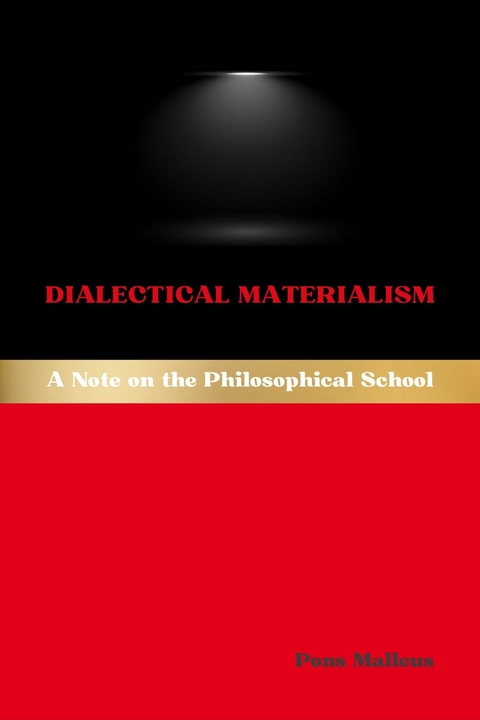
Dialectical Materialism (eBook)
111 Seiten
Publishdrive (Verlag)
978-0-00-111928-4 (ISBN)
This book is an inquiry into one of the most influential and controversial schools of philosophy in modern history: Dialectical Materialism. Rooted in the intellectual traditions of Hegelian dialectics and Marxist materialism, dialectical materialism represents not merely a philosophical method, but a worldview-one that seeks to understand and change the world through the lens of contradiction, motion, and material conditions.
Dialectical materialism emerged in the 19th century, shaped most decisively by Karl Marx and Friedrich Engels, who reconfigured Hegel's idealist dialectic into a materialist framework. They argued that ideas do not drive history independently of the material world; rather, human consciousness is shaped by the social and economic structures within which it develops. From this standpoint, thought is not abstracted from life but is inseparable from the lived, concrete reality of human labor, production, and social relations.
The dialectical method, as developed by Hegel, emphasized that reality is not static but dynamic, composed of contradictions whose tensions and resolutions drive development. Marx and Engels preserved this kernel but inverted its idealist foundation. In doing so, they established a materialist dialectic: a method of understanding historical and natural phenomena as processes-interconnected, constantly changing, and shaped by internal contradictions.
For dialectical materialism, change is not accidental but necessary; it arises from the conflicts inherent within systems. Whether in the natural world, in society, or in the realm of thought, contradictions are not anomalies but the very engine of transformation. Thus, history is not a random series of events, nor a steady progress guided by divine or moral teleology, but a process driven by the struggle between opposing forces-class against class, old against new, base against superstructure.
Yet dialectical materialism is not only a theory of how things change. It is also a theory of praxis-of informed, purposeful action in the world. It offers not just a way to interpret the world, but, as Marx famously insisted, a way to change it. It serves as the philosophical foundation for Marxist political theory, revolutionary strategy, and critical analysis of capitalism, imperialism, and ideology.
Throughout the 20th century, dialectical materialism became the official philosophical doctrine of many socialist states. Its institutionalization led to both developments and distortions. At times rigidly dogmatized, at other times creatively applied, dialectical materialism was variously embraced, critiqued, and reformulated by thinkers across the globe-from Lenin, Mao, and Lukács to contemporary philosophers still wrestling with its implications in the wake of global capitalism's evolution.
This book seeks to do justice to the complexity and richness of dialectical materialism-its origins, its development, its power, and its limitations. It is neither a hagiography nor a polemic. Instead, it is a philosophical exploration: of a method that refuses to accept the world as it is, and insists instead on uncovering how and why it came to be, and what it might yet become.
In an era marked by ecological collapse, growing inequality, and crises of meaning, the questions posed by dialectical materialism remain urgently relevant: What drives social change? What are the roots of suffering and exploitation? And how can we act, consciously and collectively, to reshape our world?
These pages are offered in the spirit of critical engagement. May they serve both those newly encountering dialectical materialism and those already steeped in its tradition. Above all, may they stimulate thought-and action.
| Erscheint lt. Verlag | 9.12.2025 |
|---|---|
| Sprache | englisch |
| Themenwelt | Sozialwissenschaften ► Politik / Verwaltung |
| ISBN-10 | 0-00-111928-1 / 0001119281 |
| ISBN-13 | 978-0-00-111928-4 / 9780001119284 |
| Informationen gemäß Produktsicherheitsverordnung (GPSR) | |
| Haben Sie eine Frage zum Produkt? |
 EPUB (Adobe DRM)
Größe: 118 KB
Kopierschutz: Adobe-DRM
Adobe-DRM ist ein Kopierschutz, der das eBook vor Mißbrauch schützen soll. Dabei wird das eBook bereits beim Download auf Ihre persönliche Adobe-ID autorisiert. Lesen können Sie das eBook dann nur auf den Geräten, welche ebenfalls auf Ihre Adobe-ID registriert sind.
Details zum Adobe-DRM
Dateiformat: EPUB (Electronic Publication)
EPUB ist ein offener Standard für eBooks und eignet sich besonders zur Darstellung von Belletristik und Sachbüchern. Der Fließtext wird dynamisch an die Display- und Schriftgröße angepasst. Auch für mobile Lesegeräte ist EPUB daher gut geeignet.
Systemvoraussetzungen:
PC/Mac: Mit einem PC oder Mac können Sie dieses eBook lesen. Sie benötigen eine
eReader: Dieses eBook kann mit (fast) allen eBook-Readern gelesen werden. Mit dem amazon-Kindle ist es aber nicht kompatibel.
Smartphone/Tablet: Egal ob Apple oder Android, dieses eBook können Sie lesen. Sie benötigen eine
Geräteliste und zusätzliche Hinweise
Buying eBooks from abroad
For tax law reasons we can sell eBooks just within Germany and Switzerland. Regrettably we cannot fulfill eBook-orders from other countries.
aus dem Bereich